

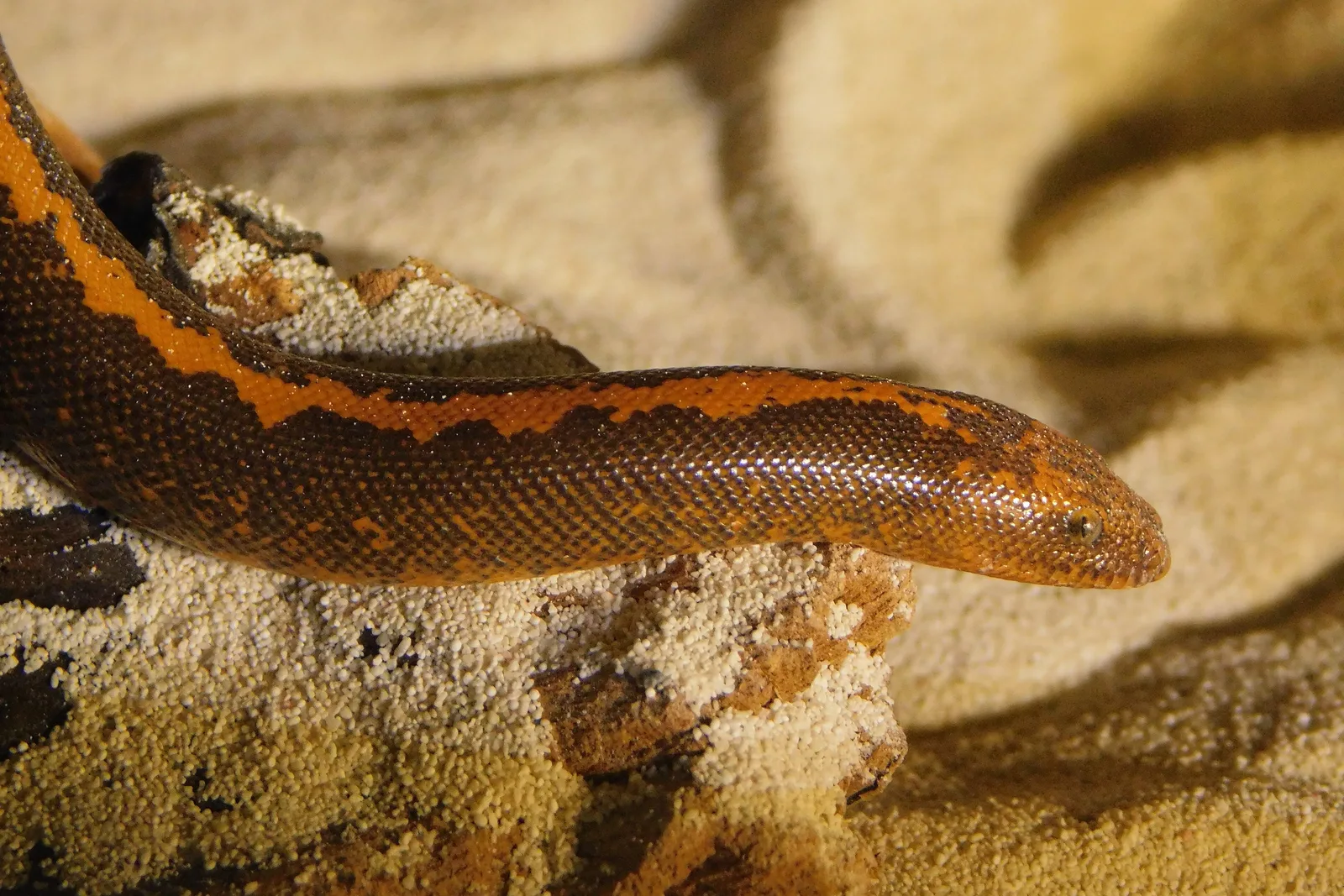
Kenyan Sand Boa care guide
Eryx colubrinus
A Kenyan sand boa needs a vivarium at least 60×30×30 cm for a male or 90×45×30 cm for a female, 13-15 cm of dry sand mix to burrow in, 32-35 °C on the sand surface at one end, and a keeper who feeds it less often than it asks. Males stay under about 150 g; females weigh three to five times as much. It is small and calm, and the commonest problem is a fat one.
Before you buy
It lives under the sand, and a female is three to five times a male's weight. Ask the sex, and how it was confirmed.
- Adult length
- 38-81 cmFemales much larger
- Lifespan
- 15-20+ yrUp to 30 reported
- Lifetime cost
- ≈ £2,600
- Licence
- NoneCITES Annex B
Know this first
This guide covers the Kenyan sand boa, Eryx colubrinus, which some sources list as Gongylophis colubrinus. Russian, rough-scaled, Arabian and javelin sand boas have different needs and are not covered here.
- It lives under the sand. A sand boa spends most of its time buried, ambushes prey from beneath the surface, and may show itself mainly at dusk. If you want a snake that sits on view, choose another species.
- The sex decides everything. An adult male is about 38-51 cm and 80-150 g. An adult female is about 61-81 cm and 300-800 g, so the enclosure, the prey and the feeding interval all differ. Build for a female until the sex is confirmed.
- They get fat. A male weighs so little that one adult mouse too many, too often, shows within months. Obesity is the top problem in captive sand boas.
Other sand boas
Published care data for these species is thin, so treat the figures as a guide to what differs. The general rules are in the handbook.
| Species | How care differs |
|---|---|
| Russian or Tartar Eryx miliaris | Smaller. The cool end can drop to about 21 °C |
| Rough-scaled Gongylophis conicus | Tolerates 40-60 % humidity and a firmer substrate |
| Arabian Eryx jayakari | About 38 cm and lays eggs. Needs the driest, best-ventilated setup |
| Javelin or spotted Eryx jaculus | Listed in Annex A, so any sale needs an Article 10 certificate. Check before buying |
Lifetime cost, vets, freezer space and hygiene: handbook, Before you buy.
Morphs and welfare
bask applies REPTA's Deleterious Gene Policy in full. How the three groups work is in the handbook, Morphs and welfare. These are the Kenyan sand boa rows.
No Kenyan sand boa morph is on REPTA's prohibited list, and none carries a breeding guidance or welfare note on it.
Common morphs include albino, anerythristic, snow, paradox, stripe, splash, paint, hypo and ghost, plus line-bred high-colour animals such as the California Flame Dodoma. We found no welfare problem linked to any of them, but that does not show they are problem free, because no one has studied it. The inheritance of hypo, splash and paint is not firmly settled, so ask a seller what their pairings are known to produce.
REPTA reviews its list every six months and bask follows each change. Checked against the list current on 22 November 2026.
Buying a Kenyan sand boa
The general seller questions, health checks and quarantine rules are in the handbook, Buying, collection, quarantine. For a Kenyan sand boa, push harder on these.
- Sex, and how it was confirmed, probing or popping. A female needs a 90 cm viv and bigger prey; a male stays small.
- The feeding record on frozen-thawed prey: size, the last three to five meals, any refusals or braining. A hatchling that has only taken live prey may need converting.
- Current weight in grams and hatch date. Prices run about £70-100 for a standard captive-bred snake; very high-colour line-bred animals cost far more.
Check the animal
A rounded body with a slight taper, clear eyes, a clean vent, no mites around the eyes or chin, no clicking or mucus at the mouth, no brown belly patches, no wrinkled or thin look.
UK law
No licence; sand boas are not on the Dangerous Wild Animals schedule. All boas are CITES Appendix II. The Kenyan sand boa is Annex B in Great Britain, so you need no Article 10 certificate to buy, sell or keep a captive-bred one, but you must be able to show you got it lawfully. Ask for a receipt naming the species, captive-bred status, breeder and birth year, and keep it. The javelin sand boa (Eryx jaculus) is different: it is Annex A and needs an Article 10 certificate for any sale. Duty of care, business licensing and the release offence: handbook, UK law.
Setting up
Deep dry sand, heat from above on a thermostat measured on the sand, and a damp hide at the cool end only.
The vivarium
Floor area and depth
| Stage | Snake | Minimum enclosure | Notes |
|---|---|---|---|
| Hatchling or small juvenile | Small | 45×30×30 cm | Or a secure tub of similar floor area. Still give deep substrate |
| Adult male | 38-51 cm, 80-150 g | 60×30×30 cm | A bigger viv is better. One snake per enclosure |
| Adult female | 61-81 cm, 300-800 g | 90×45×30 cm | Use 90×45×45 cm if you fit an overhead lamp and guard |
The snake needs room to burrow and a gradient to choose from, so floor area matters more than height. Height only has to fit 10-15 cm of sand plus lamp clearance, which is why 45 cm tall units are popular.
Glass or PVC copes with the weight of deep sand and does not rot from damp patches. Wood holds heat better in a cold house but needs sealed joints. Sand boas push hard, so use a lockable front or lid and check every seam.
Enclosure types, ventilation, locks: handbook, The enclosure.
Heat and light
Heat from above, measured on the sand
Kenyan sand boas come from the dry country of East Africa. The snake is under the sand, so the number that matters is the temperature of the sand it surfaces into and sleeps beneath.
| Zone | Target |
|---|---|
| Sand surface, warm end | 32-35 °C |
| Warm-end air | about 27-30 °C |
| Cool end | 24-28 °C |
| Night | about 21 °C |
A halogen flood on a dimming stat, with a mesh guard, over one end. Measure the sand surface with an infrared thermometer or a probe, never the glass. Check the sand a few centimetres down at the warm end too. Turn the lamp off at night, but if the room would fall below about 18-20 °C, add a mat or ceramic heater on its own stat.
A low-wattage mat under a third of the floor can add belly heat. Put it on its own stat, with the probe in the sand above the mat, not between the mat and the glass. Otherwise the stat reads the mat and the sand stays cool.
UVB
The Kenyan sand boa is Ferguson Zone 2, a partial-sun or occasional basker. A low-output T5 or shade-dweller tube over the warm end, about half the length of the enclosure, on a 12 hour timer, for a UV Index of about 2-3 on the sand surface under the lamp. It falls to nothing in the shade and in the hides, and the snake can always bury itself out of it. Older sheets said a nocturnal burrower needs none. Current welfare guidance says a UV gradient gives it a choice. This is a welfare argument and does not show that sand boas fall ill without it.
Thermostats, probe placement, tube replacement: handbook, Heat, light and safety.
Humidity, substrate and furniture
30-50 %, deep dry sand, one damp hide
Keep it mostly dry: 30-50 % relative humidity, read on a digital probe hygrometer in the middle of the enclosure. The main risk is damp. Cool and damp together bring respiratory infection, and wet bedding brings scale rot. Put lightly damp sphagnum moss in one hide at the cool end and check it weekly. Cross-ventilation stops household humidity building up in a heated box.
Use at least 8-10 cm of loose, dry substrate, and 13-15 cm if the viv allows. Washed play sand or reptile sand works, as does an additive-free topsoil and play sand mix between about 50:50 and 60:40, either way round, with no fertiliser or perlite. Keep aspen for hatchlings and quarantine only. Never calcium sand, which clumps when wet and gets swallowed, crushed walnut shell, which is sharp, or anything that stays wet. Remove waste daily and replace the substrate every 3-4 months.
Snug hides at each end, one warm and one cool and damp, and flat clutter on the surface: cork flats, slate, sturdy branches, drought-tolerant plants. The sand is its main cover. A small, shallow, heavy water bowl, refilled daily, limits spills that wet the sand.
Humidity: handbook, Humidity. Substrate compared: handbook, Substrate. Hides and water: handbook, Hides, cover and water.
The first weeks
Leave it alone for about two weeks, and offer the first meal after 5-7 days, at dusk, from tongs.
Bringing it home
Cloth bag in a rigid insulated box, especially in winter, straight into the enclosure you ran for at least 48 hours. No handling for about two weeks, and until it eats. First meal after 5-7 days, the same prey and the same dusk routine the seller used. Weigh it on arrival and every 2-3 weeks.
Running the enclosure empty first, quarantine and the first fortnight for any reptile: handbook, The first weeks.
Handling
Tap first, scoop from below
- Leave a new snake for about two weeks, and until it eats regularly. Early sessions no longer than 5 minutes.
- Most bites are feeding responses to a hand that looks like prey at the surface. Tap the sand with a paper towel roll or hook first, then scoop from underneath and support the body.
- Wait 48 hours after a meal. Not in shed. At least weekly, no more than once a day.
- Wash your hands first. A snake that has just fed on mice may mistake a hand for the next one.
Growing up
Frozen-thawed prey no wider than the snake. Tap the sand before you reach in, and weigh it every 2-3 weeks.
Feeding
Frozen-thawed mice, and long gaps
Prey no wider than the widest part of the snake. Warm it in a sealed bag in hot water to about 32 °C and offer it with tongs, at dusk, onto a flat slate or dish in the enclosure. Feeding off the sand cuts the amount swallowed with the meal.
| Age | Interval | Prey |
|---|---|---|
| Hatchling | 5-7 days | Pinkie |
| Juvenile, from about 6 months | 7-10 days | Fuzzy |
| Adult male, 80-150 g | 14-21 days | Fuzzy or hopper |
| Adult female, 300-800 g | 14-21 days | Adult mouse; a rat pup for a big female |
Adults can go to four weeks between meals, and an adult male may fast for months in winter. A male on adult mice becomes obese quickly, so keep him on fuzzies or hoppers. For a hatchling that refuses, check the prey is warm, offer at dusk, and try braining, a small cut in the skull of the prey to release scent. Two refusals in a row from an adult in summer is a reason to weigh and check the vivarium.
A lean adult is rounded with a slight taper to the tail. Weigh every 2-3 weeks and write it down. Leave the snake alone for 48 hours after a meal.
Thawing, tongs, live prey: handbook, Food you store or keep alive.
Shedding
Mostly trouble at the tail
Retained shed usually sticks at the tail tip. A short lukewarm soak and the damp hide in place fix most cases. Check for retained eye caps after every shed. Repeated bad sheds mean humidity that is too low or a dehydrated snake, so check the damp hide is actually damp and the water bowl is full.
Treating stuck shed: handbook, Health.
Adult life
An adult eats every 2-4 weeks. Males often skip winter meals; under 10 % weight loss just needs patience.
Winter fasting
Males often stop for the winter
Adult males often skip food from about November to March. A healthy male loses less than about 10 % of his body weight over a fast. Weigh every 2-3 weeks, keep the gradient and light on, and offer food now and then. Do not force-feed. Breeders cool males before pairing. A pet does not need it, and hobby sources disagree on how to do it.
A male loses more than 10 % of his weight, any snake loses weight in summer without a seasonal cause, or a fast comes with wheezing, mouth bubbles or a wrinkled look.
Health
What sand boas actually get
| Problem | Why sand boas get it | What to do |
|---|---|---|
| Obesity Round in section, no taper to the tail | Fed like a hungry hatchling for years; males are tiny | Adult interval, fuzzies for a male, weigh every 2-3 weeks |
| Respiratory infection Clicking, wheezing, mucus at the mouth | Cool and damp together | Vet. Raise the warm end, dry the viv, improve airflow |
| Scale rot Brown or reddish belly patches | Wet bedding, a tipped bowl | Change substrate, dry the viv. Blisters are a vet |
| Mites Tiny black dots round the eyes and chin | Arrive with animals and kit | Vet-guided treatment of the snake and the enclosure together |
| Regurgitation | Handled within 48 hours of a meal, too cold, prey too big | No food for a while, then a smaller meal. Twice in a row is a vet |
| Impaction | Sand swallowed with food, or dehydration and low temperatures | Feed from a dish, keep heat and water right. Nothing passed for days is a vet |
Mouth rot, burns, retained shed and the same-day signs: handbook, Health. Finding a vet: handbook, Vets and insurance.
Where the advice has changed Older advice you might still come across, and what we back instead
Sand boa care sheets were written for a snake kept in a tub. You'll still see some of these on older care sheets and in shop advice. We've looked at both sides, and this is what we back.
| Older advice | What we back | Why |
|---|---|---|
| A tub or 10 gallon tank for life | 60×30×30 cm for a male, 90×45×30 cm for a female, one snake each | Room for a gradient and deep sand, and females grow far larger than males. Build for a female if the sex is unknown |
| A heat mat, often unregulated | Overhead heat on a stat, measured on the sand surface; a mat only as an extra | Thick sand blocks or traps mat heat, and the snake surfaces into the top layer. An unregulated mat is a burn risk |
| Aspen shavings only | 8-10 cm minimum, 13-15 cm preferred, of sand or a sand and soil mix | A snake that can bury itself behaves normally and holds a burrow shape. Aspen is for hatchlings and quarantine |
| No UVB for a nocturnal burrower | Low UVB, Zone 2, with shade always available | It does bask now and then, and a UV gradient gives it a choice |
| Sand causes impaction, never use it | Sand or a sand and soil mix, fed from a dish, never calcium sand | Impaction follows swallowing sand with food and poor husbandry. Calcium sand clumps when wet |
| Feed every week for life | Every 2-4 weeks as an adult, smaller prey for a male | A male weighs 80-150 g, so weekly adult mice make him obese |