

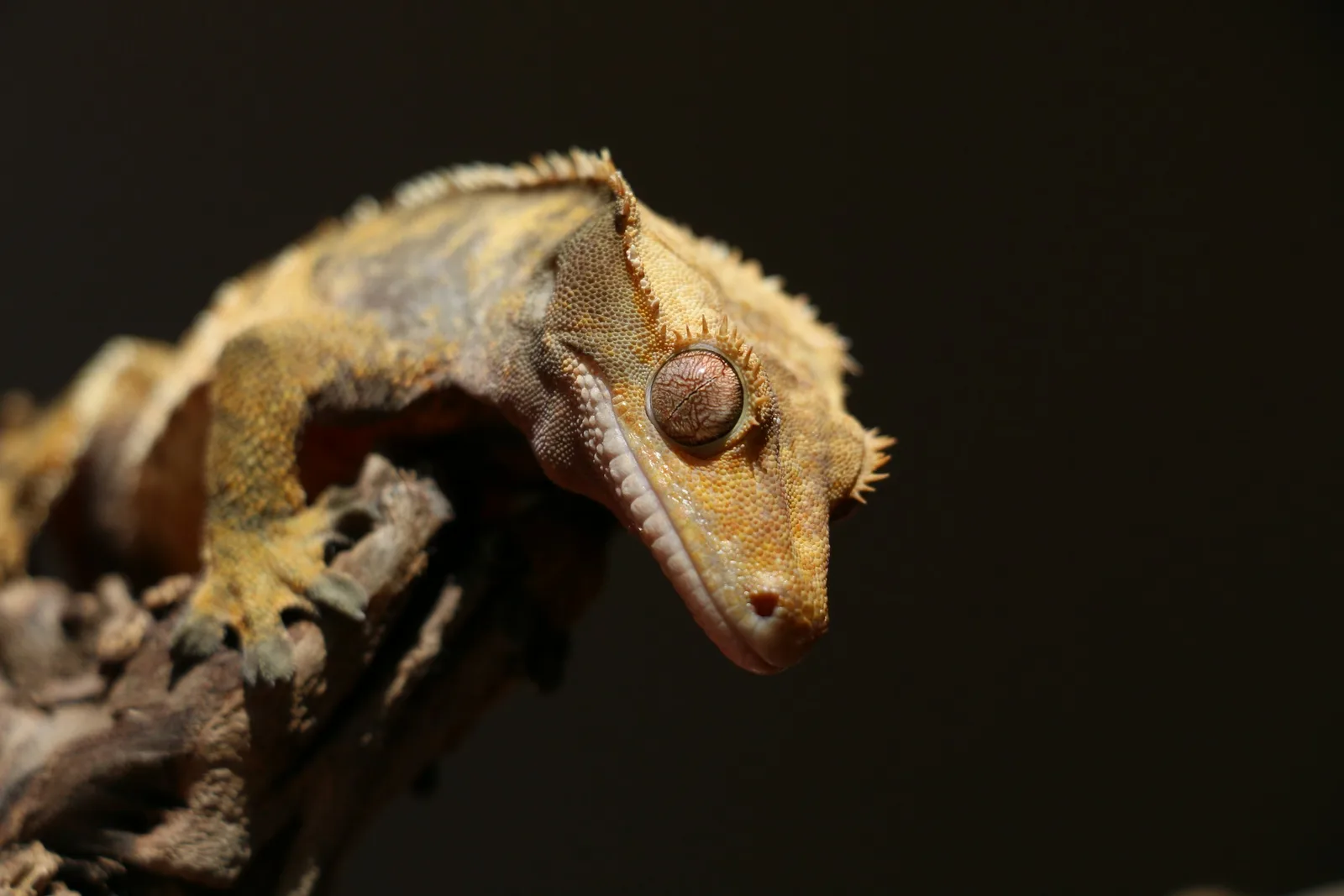
 Photo: Pierre Bamin on Unsplash
Crested Geckocare guide
Correlophus ciliatus
A crested gecko needs a tall planted terrarium at room temperature, a misting every evening, and a dish of complete gecko diet. It is the cheapest reptile on bask to run and the only one harmed by the heat every other species needs. Above 28 °C it is in danger.
Before you buy
It's the cheapest reptile on bask to run, and the only one that heat kills.
- Adult length
- 18-23 cmIncluding tail
- Adult weight
- 35-55 g
- Lifespan
- 15-20 yr
- Lifetime cost
- ≈ £2,400Lowest on bask
- Licence
- NoneNot CITES-listed
Know this first
- Heat kills them. Every other species here wants a hot spot; a crested gecko above 28 °C for long is in trouble, and a viv on a sunny windowsill can kill one in an afternoon.
- The tail does not grow back. A crestie drops it once and stays tailless for life. It lives perfectly well without one.
- They jump, without looking where. Handle low, over something soft, and briefly.
Lifetime cost, vets and hygiene: handbook, Before you buy.
Morphs and welfare
bask applies REPTA's Deleterious Gene Policy in full. How the three groups work is in the handbook, Morphs and welfare. These are the crested gecko rows.
Prohibited: cannot be listed on bask
| Morph | Condition |
|---|---|
| Super Cappuccino Super Lilly White | Structural. A high likelihood of skull, spine and limb defects and skin problems. Super Lilly Whites rarely survive long past hatching. |
Breeding guidance: healthy, but not to be paired with
| This morph | Do not pair with |
|---|---|
| Lilly White | another Lilly White |
| Cappuccino | another Cappuccino |
A single-copy Lilly White or Cappuccino is a healthy gecko with no welfare note. When you enquire about one you confirm you have read the pairing guidance.
REPTA reviews its list every six months and bask follows each change. Checked against the list published on 6 September 2026.
Buying a crested gecko
The general seller questions, health checks and quarantine rules are in the handbook, Buying, collection, quarantine. For a crested gecko, push harder on these.
- What it eats: which complete diet, and whether it takes it from a dish. A gecko raised on fruit or baby food may already have soft bones.
- The tail. Tailless cresties are healthy and often cheaper; just know which you are buying.
- Its genetics, if it is a Lilly White or Cappuccino.
Check the animal
A straight spine and tail with no kinks or waves, hips that hold the tail up when it hangs, all toes with no shed rings, clear eyes with intact crests, and a firm grip on glass with all four feet.
UK law
No licence; not on the Dangerous Wild Animals schedule and not CITES-listed. New Caledonia has not exported wild geckos for decades. Duty of care, business licensing and the release offence: handbook, UK law.
Setting up
Tall, planted and front-opening, at room temperature, with nowhere warmer than 28 °C.
The enclosure
Tall, planted, front-opening
| Stage | Gecko | Minimum enclosure | Notes |
|---|---|---|---|
| Hatchling | 5-8 cm | Faunarium, 20×20×30 cm | In a big planted viv a hatchling cannot find its dish |
| Juvenile | 8-15 cm | 30×30×45 cm | |
| Adult | 18-23 cm | 45×45×60 cm | 60×45×60 or 45×45×90 is better. Height matters more than floor |
A front-opening glass terrarium with a mesh top holds humidity from an evening mist, breathes through the top so it dries by morning, and takes plants. A wooden viv holds too much heat and moisture and rots. Keep them singly: males fight, a male with a female breeds her constantly, and a tail lost to a cage-mate is lost for good.
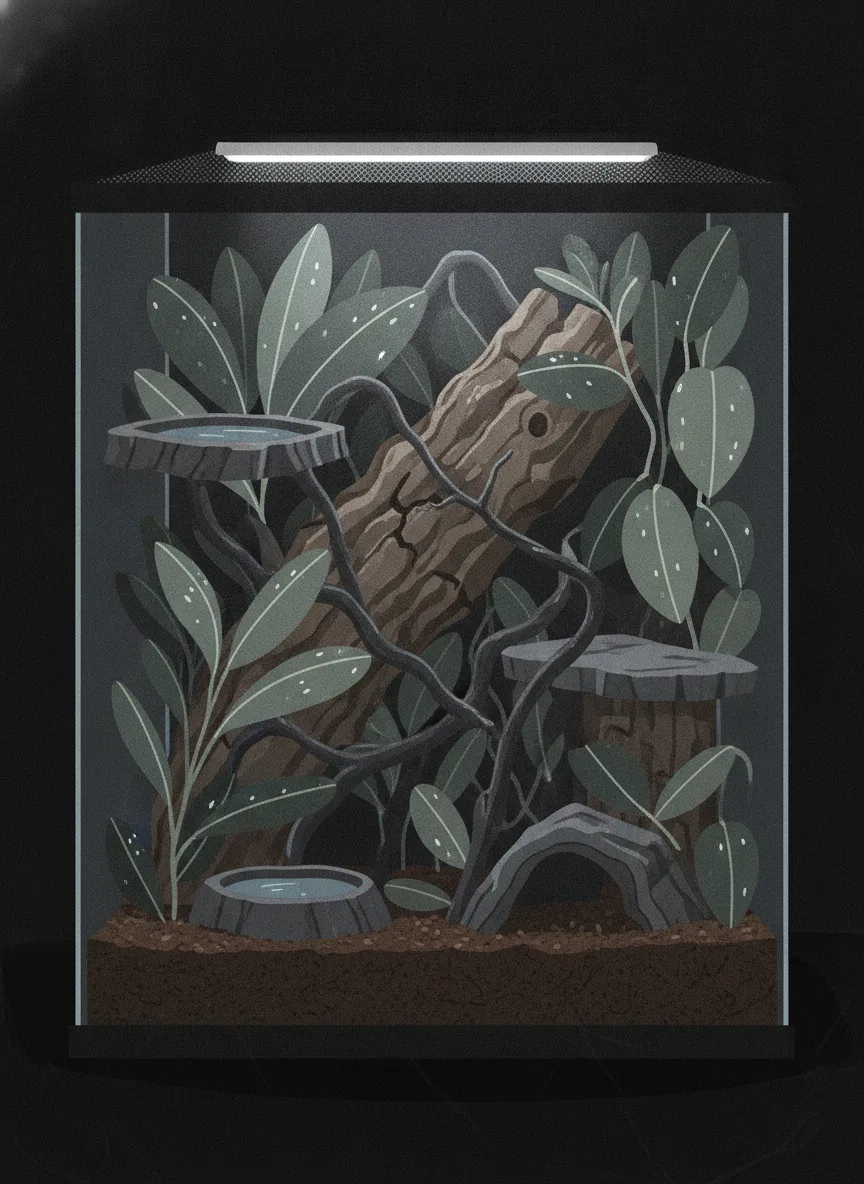
Enclosure types, ventilation, locks: handbook, The enclosure.
Heat and light
Room temperature, with a ceiling
| Zone | Target | Notes |
|---|---|---|
| Daytime | 22-26 °C | A heated room usually provides this with no equipment |
| Warm spot, top of the viv | up to 28 °C | Optional, and the ceiling |
| Night | 18-22 °C | A drop is natural |
| Danger | over 28 °C | Stress, refusal to eat, death in a hot viv |
If the room drops below 20 °C in winter, add a low-wattage deep heat projector or halogen on a dimming stat over the mesh top, probe at the highest perch, set to 26 °C, or a small mat on the side of the glass. Never a heater the gecko can reach, never a mat under a floor it lies on. A digital thermometer at the top of the viv matters more than any heater.
UVB
Zone 1, nocturnal. A 2.4 % or 6 % T5 tube on the mesh top for a UV Index of 0.5-1.0 at the top of the viv, 12 hours, with dense planting for shade. A small LED grow light on the same timer keeps live plants alive and gives a day-night cycle. Both sit outside the mesh, so allow for it.
Thermostats, probe placement, tube replacement: handbook, Heat, light and safety.
Humidity, planting and food ledge
Wet at night, dry by day, leaves everywhere
The cycle matters more than the number. Mist heavily in the evening until the glass and leaves run, so humidity peaks at 80-100 % and the gecko drinks the droplets. By the next evening it should have dried to 50-60 %. Always wet grows mould and skin infections; never wet gives stuck sheds and dehydration. If it never dries, more ventilation and less water; if it is dry by midnight, a coir floor, more plants and a light morning mist.
A bioactive tropical mix with springtails and woodlice, planted with pothos, bromeliads or ficus, holds the cycle and cleans itself. Coco fibre and artificial plants work. Nothing loose and fine a gecko could swallow lunging at an insect.
Planting is not decoration. A crestie sleeps in foliage by day and moves through it at night; a bare viv with one branch is a stressed gecko. Cork bark, vines and broad leaves at several heights, dense enough to cross the viv unseen. The food dish goes on a ledge in the upper half where the gecko lives, not on the floor.
Humidity: handbook, Humidity. Substrate compared: handbook, Substrate. Cover for tree-dwellers: handbook, Hides, cover and water.
The first weeks
Don't handle it for 7-10 days. Fresh diet every other evening, and a heavy mist at dusk.
Bringing it home
A small ventilated tub with damp paper towel, in an insulated box at 20-25 °C, never in a hot car, straight into the planted viv. No handling for 7-10 days. Fresh diet in the dish every other evening, a heavy mist at dusk, and check the dish for tongue marks and droppings in the morning. A hatchling that has not eaten in a week needs the dish moved closer to where it sleeps.
Running the enclosure empty first, quarantine and the first fortnight for any reptile: handbook, The first weeks.
Handling
Low, brief, let it walk
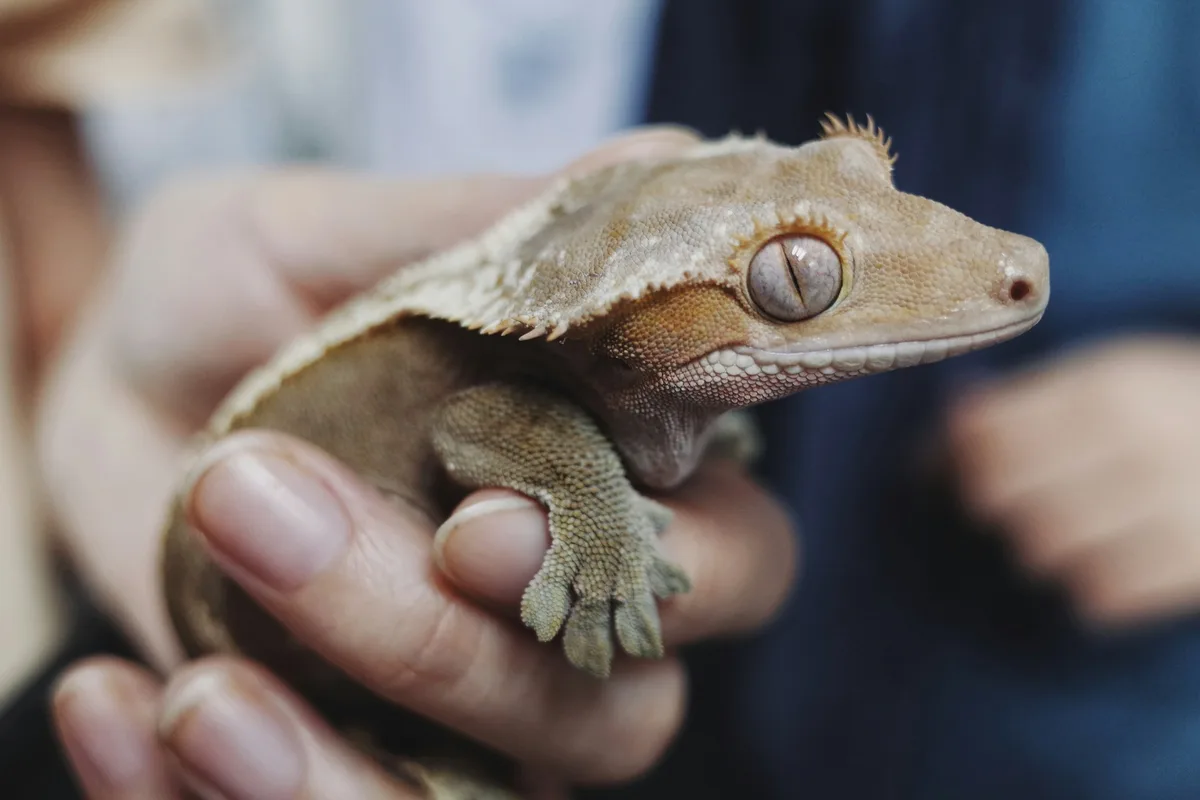
- Let it step onto your hand from a leaf; do not close fingers around it. Hand over hand as it walks, low over a bed or sofa.
- Never restrain the tail. It comes off at a touch when the gecko is frightened.
- 5 minutes, a couple of times a week, in the evening when it is awake. Tolerated, not enjoyed.
Growing up
Complete gecko diet as the staple, dusted insects on the side, and weigh it every month.
Feeding
Powder and water, insects on the side
A complete crested gecko diet, a powder mixed with water to a ketchup consistency, is the whole diet. It carries the calcium and vitamins. Baby food and fruit purée are not substitutes and cause bone disease.
| Age | Gecko diet | Insects |
|---|---|---|
| Hatchling and juvenile | Fresh every evening | Small crickets 2-3 times a week, dusted |
| Adult | Fresh every 2-3 evenings, removed after 24 h | Crickets or small roaches once or twice a week, dusted |
A crestie kept on insects and fruit alone has soft bones within a year. One pack of diet lasts an adult two to three months, which is why this is the cheapest reptile here to run.
Keeping live insects and supplements: handbook, Food you store or keep alive.
Shedding
Overnight, eaten, check the toes
Cresties shed in one go at night and eat it. The evening mist is what makes it come off cleanly. Check toes, tail tip and the crests above the eyes after any day the gecko looked dull; skin left on the toes tightens and the toe is lost. Ten minutes in a humid tub, then a damp cotton bud. Never pull dry skin.
Treating stuck shed: handbook, Health.
Adult life
Handle it low and briefly. A dropped tail never grows back.
Health
What crested geckos actually get
| Problem | Why cresties get it | What to do |
|---|---|---|
| Metabolic bone disease Kinked spine, wavy tail, soft jaw, wobbly hips | Fed fruit or baby food instead of a complete diet; breeding females drained of calcium | Vet. Complete diet, calcium on every insect, rest a female from breeding |
| Floppy tail syndrome Tail flops over the back when it hangs head-down | Weak pelvis, from calcium and from hanging upside down on flat glass | Diet as above, and more branches so it rests on angles rather than glass |
| Overheating Gasping, flat on the floor, dark, off food | A sunny window, a room over 28 °C, a heater with no stat | Move it to a cool room at once and mist. Same-day vet if not better within an hour |
| Dehydration Sunken eyes, wrinkled skin, sticky mouth | Missed evening mists | Mist, and a shallow dish. Vet if severe |
| Tail loss | Grabbed, startled, a cage-mate | Keep the stump clean; heals in weeks, never regrows |
| Egg binding (females) | Infertile eggs without a male. No laying site, low calcium | A laying box of damp coir on the floor. Straining with nothing laid is a same-day vet |
Respiratory infection, mites, mouth rot, parasites and the same-day signs: handbook, Health. Finding a vet: handbook, Vets and insurance.
Where the advice has changed Older advice you might still come across, and what we back instead
Crested gecko care changed when a complete diet became available. You'll still see some of these on older care sheets and in shop advice. We've looked at both sides, and this is what we back.
| Older advice | What we back | Why |
|---|---|---|
| Mashed banana, baby food and a few crickets | A complete crested gecko diet, insects on the side | Fruit and baby food have no calcium worth the name. The bone disease and floppy tails of the 2000s came from that diet |
| Room temperature is fine, no thermometer needed | Room temperature, with a digital thermometer at the top of the viv | The danger is heat: a warm room or a window. Cresties die of it far more often than cold, and nobody notices without a thermometer |
| No UVB; they are nocturnal | Low UVB with shade | They are exposed to dawn and dusk light in the wild, and a low tube makes them visibly more active and colourful |
| Keep the glass wet all the time | Wet at night, dry by day | Permanently wet vivs grow mould and give skin and respiratory infections. The daily dry-out is what keeps them healthy |
| A pair or trio can share a tank | Singly | Cage-mates take tails, and a crestie's tail does not come back |