

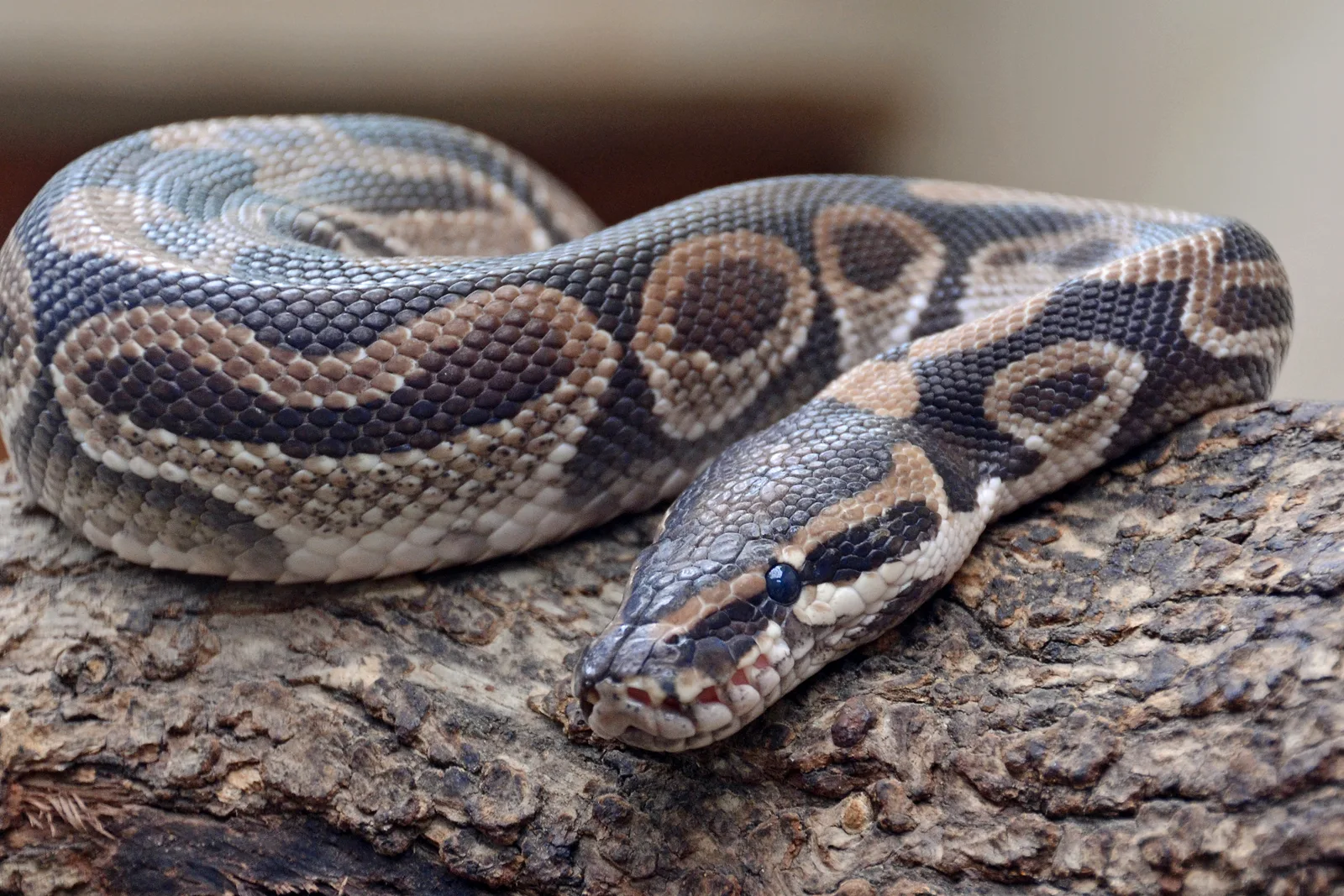
 Photo: Clément Bardot, CC BY-SA 4.0
Royal Pythoncare guide
Python regius
A royal python needs a vivarium at least as long as the snake, 31-32 °C at one end, 24-26 °C at the other, and humidity held at 55-65 %. The rest of this guide is detail on those numbers, and on the one habit that worries every new keeper: it stops eating.
Before you buy
You're signing up for twenty to thirty years. Buy a snake with a feeding record, not one that "usually eats".
- Adult length
- 90-150 cmFemales larger
- Lifespan
- 20-30 yr40+ recorded
- Lifetime cost
- ≈ £4,850Setup plus running
- Licence
- NoneAnnex B, no Article 10
Know this first
A royal python bought as a hatchling in 2026 may still be alive in 2056. Cost, vets and household hygiene are in the handbook; these two are royal-specific.
- They stop eating. Healthy adults, particularly mature males, refuse food for weeks or months, usually between November and March. It is normal and it will still worry you. Hunger strikes covers it.
- They hide. Royals are ambush predators that spend the day in a hide and come out at dusk. A snake visible in the open all day is usually one that cannot find the temperature or cover it wants.
Lifetime cost, vets, freezer space and hygiene: handbook, Before you buy.
Morphs and welfare
bask applies REPTA's Deleterious Gene Policy in full. How the three groups work is in the handbook, Morphs and welfare. These are the royal python rows.
Prohibited: cannot be listed on bask
| Morph | Condition |
|---|---|
| Spider Super Spider | Neurological. An inherited inner-ear anomaly: head tilt, corkscrewing, stargazing, poor righting reflex. There is no non-wobbling spider. |
| Super Champagne Super Hidden Gene Woma | Lethal. Dies in the egg or within hours of hatching. |
| Champagne × Hidden Gene Woma | Neurological. Often severe. |
| Super Black Pastel Super Cinnamon | Structural. Underdeveloped lower jaw, spinal and tail kinking. |
Welfare note: allowed, with a note on the listing
| Morph | Concern |
|---|---|
| Champagne Woma Hidden Gene Woma | Neurological. Milder or less certain than spider. |
| Super Sable Super Spotnose | Neurological. REPTA names Super Spotnose as a likely future prohibition. |
| Desert | Reproductive. |
| Caramel Albino | Structural. |
| Super Lesser Super Butter | Ocular. |
Breeding guidance: healthy, but not to be paired with
| This morph | Do not pair with |
|---|---|
| Champagne | another Champagne, a Hidden Gene Woma or a Spider |
| Hidden Gene Woma | another Hidden Gene Woma, a Champagne or a Spider |
| Black Pastel | another Black Pastel or a Cinnamon |
| Cinnamon | another Cinnamon or a Black Pastel |
| Lesser | another Lesser or a Butter |
| Butter | another Butter or a Lesser |
| Sable | another Sable |
| Spotnose | another Spotnose |
When you enquire about one of these on bask you confirm you have read the guidance, and the seller keeps that as the record REPTA asks for.
Keeping a spider breaks no rule. It cannot be advertised on bask, including to rehome it; a reptile rescue is the route. Do not breed from it.
REPTA reviews its list every six months and bask follows each change. Checked against the list published on 6 September 2026.
Buying a royal python
The general seller questions, health checks and quarantine rules are in the handbook, Buying, collection, quarantine. For a royal python, push harder on these.
- The feeding record: last four feeds with dates, prey and size. You want a snake feeding reliably on frozen-thawed before it moves, not one that "usually eats".
- Weight now and a month ago.
- The genetics, and what any welfare note or breeding guidance on the listing means for this animal.
Check the animal
No retained eye caps, no spine ridge, silent breathing, and a snake that grips as it moves through your hands. Watch it on a flat surface for a minute: head tilt or corkscrewing is a neurological sign whatever the listed morph.
UK law
No licence to keep one; royals are not on the Dangerous Wild Animals schedule. CITES Annex B, so no Article 10 certificate for a UK sale, but keep the captive-bred paperwork. Duty of care, business licensing and the release offence: handbook, UK law.
Setting up
Wood or PVC, as long as the snake, heat from above on a thermostat, and two identical hides.
The vivarium
A wooden vivarium as long as the snake
| Stage | Snake | Minimum vivarium | Notes |
|---|---|---|---|
| Hatchling | 25-45 cm | 60×40×40 cm | An adult viv works too if it is densely cluttered |
| Juvenile | 45-90 cm | 90×45×45 cm | Most go straight to the adult viv here |
| Adult | 90-150 cm | 120×60×60 cm | 150 cm is better for a large female and costs little more |
A melamine-faced wooden vivarium, or PVC, holds the warmth and 55-65 % humidity a royal needs through a British winter; a glass tank with a mesh lid loses both. Three opaque sides also suit a snake that reads open space as danger. Fit a lock on day one; royals push at doors slowly and persistently.
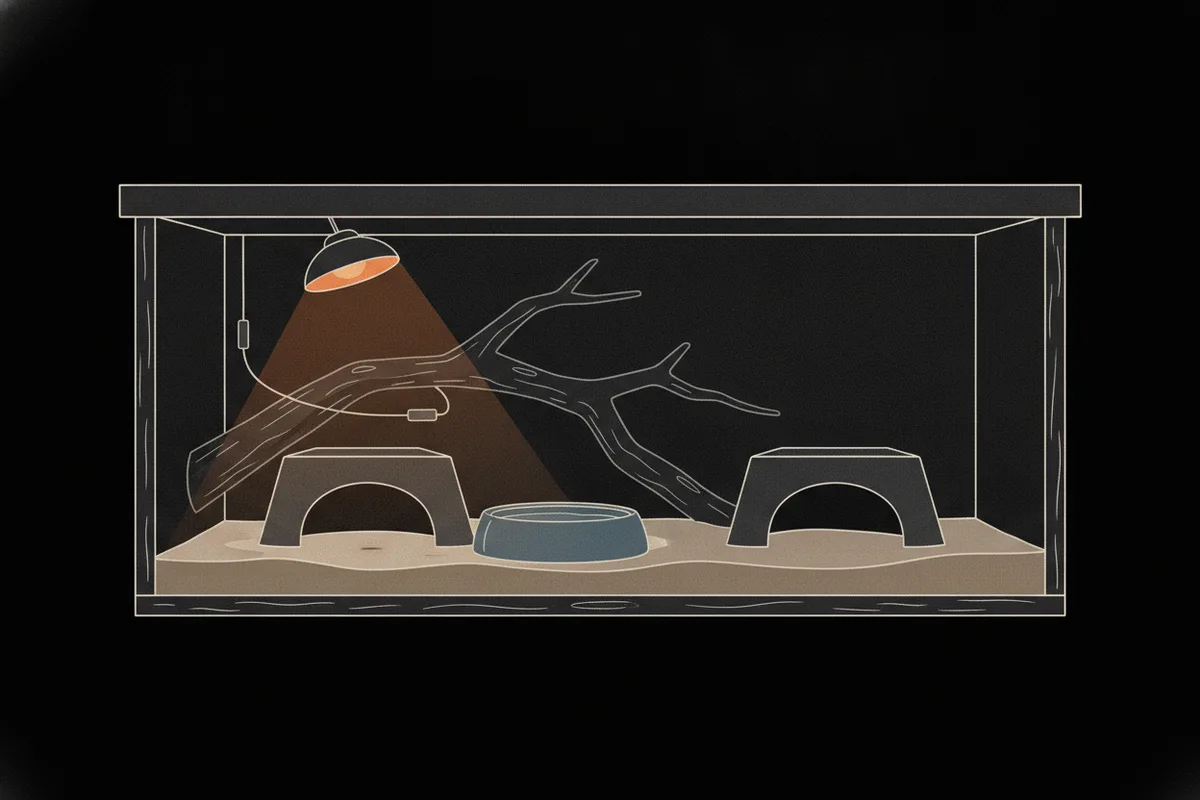
Enclosure types compared, ventilation and locks: handbook, The enclosure.
Heat and light
Warm at one end, cool at the other
The snake picks its own temperature by moving. Your job is the range, and where the probe goes.
| Zone | Target | Measured with |
|---|---|---|
| Basking surface | 31-32 °C | Infrared gun under the heat source |
| Warm-end air | 28-30 °C | Digital probe, hide height |
| Cool-end air | 24-26 °C | Digital probe, hide height |
| Night | 21-24 °C | A modest drop is natural |
| Never below | 20 °C | Digestion stalls |
Use a deep heat projector on a pulse-proportional thermostat, guarded, in the ceiling at the warm end. It warms air and surfaces together, gives no light, and runs day and night. A ceramic on the same stat is the cheaper option. Heat mats belong in racks in a warm room; in a vivarium a mat cannot warm the air, and a heavy-bodied royal lying on one is how mat burns happen. An unguarded overhead element is the other burn: royals coil around warm objects rather than moving away.
UVB
Royals are Ferguson Zone 1 shade dwellers. Fit a low-output T5 tube (2.4-6 % depending on distance) over the warm third for a UV Index of 0.7-1.0 at the basking spot, 12 hours on a timer. It is cheap, it is now standard practice, and the snakes use it.
Thermostats, probe placement, measuring kit, tube replacement: handbook, Heat, light and safety.
Humidity, substrate and furniture
55-65 %, deep bedding, two identical hides
| Humidity | Target | How |
|---|---|---|
| Normal | 55-65 % | Coir or orchid bark plus a large bowl usually holds this in a wooden viv |
| In shed | 75 %+ | Humid hide packed with damp sphagnum moss |
| Never sustained above | 75 % | Wet, still air is how royal respiratory infections start |
Give at least 5-8 cm of coco fibre, orchid bark or a bioactive mix; wild royals live in rodent burrows and yours will push into the bedding given the chance. Aspen moulds at this humidity. Never pine, cedar or calci-sand.
Two hides, identical and snug enough that the snake touches the sides, one at each end. If one hide is nicer the snake must choose between warmth and safety, and a royal that cannot find safety stops eating. Clutter the open floor with cork bark and a branch. Water in a heavy bowl at the cool end; a royal that soaks constantly is too dry, too hot, or has mites.
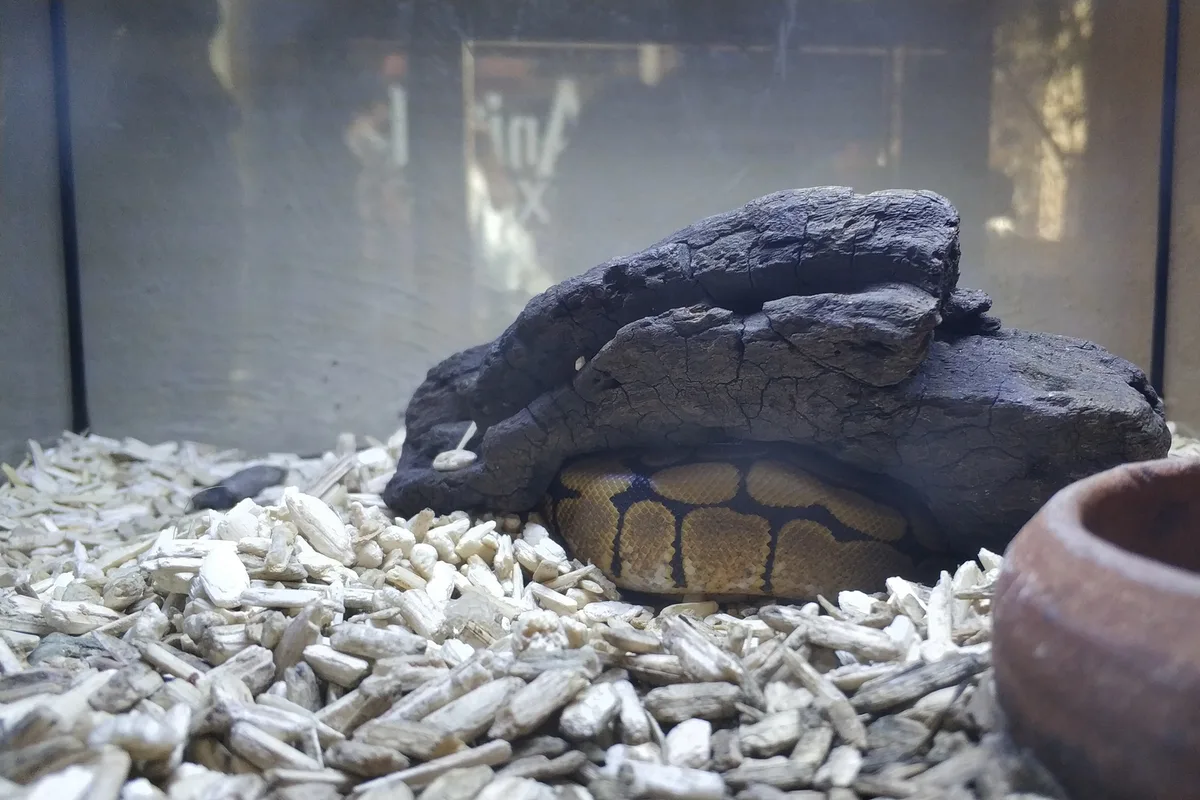
Measuring and fixing humidity: handbook, Humidity. Substrate compared: handbook, Substrate. Hides and water: handbook, Hides, cover and water.
The first weeks
Run the viv empty for 48 hours, then leave the snake alone for a week before you offer its first meal.
Bringing it home
Cloth bag in a rigid insulated box at 20-28 °C, straight into the vivarium you ran for 48 hours beforehand. No handling for 7-14 days. Offer the first meal after a week, the same prey the seller used; if refused, wait a full week before trying again.
Running the enclosure empty first, quarantine and the first fortnight for any reptile: handbook, The first weeks.
Handling
Short, supported, not after dinner
- Wait 48 hours after a meal; handling on a full stomach causes regurgitation.
- Not while in shed.
- 10-15 minutes, two or three times a week, is plenty. Handling is tolerated, not enjoyed.
- Two hands, weight spread, let the snake move through them. Never lift by the head or tail.
- Wash your hands first. Rodent scent on fingers is what causes royal bites.
A snake that balls up tightly, hisses or pushes its head into your palm has had enough. Put it back.
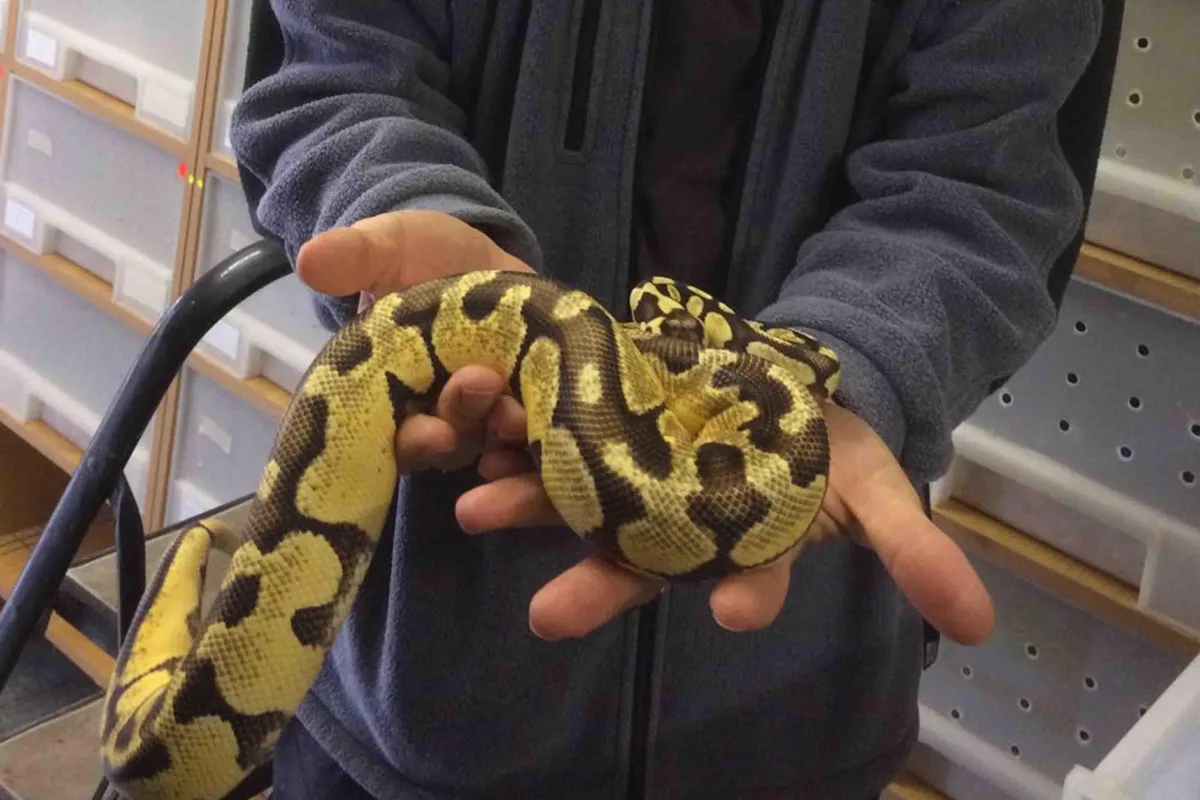
Growing up
Frozen-thawed prey no wider than the snake, spaced further apart as it grows. Weigh it every month.
Feeding
Frozen-thawed, no wider than the snake
Prey at 10-15 % of body weight and no wider than the snake's widest point. Get either wrong and you get a regurgitation.
| Age | Weight | Interval | Prey |
|---|---|---|---|
| Hatchling | under 200 g | 5-7 days | Hopper or small adult mouse |
| Juvenile | 200-600 g | 7 days | Adult mouse or rat pup |
| Sub-adult | 600-1200 g | 7-10 days | Rat weaner |
| Adult male | 900-1500 g | 14-21 days | Small to medium rat |
| Adult female | 1500-2200 g | 10-14 days | Medium rat |
Warm the thawed rodent until its head is around 38-40 °C. Royals find prey with heat-sensing pits along the lip and often ignore a cold-headed mouse however hungry they are. Offer with tongs, in the vivarium, at dusk, and leave the snake alone for 48 hours. Never live prey: a rat will chew a snake that is not hungry, which for a royal is often.
Thawing, tongs, why not a feeding tub: handbook, Food you store or keep alive.
Shedding
The cycle, and the one thing you do
Every four to six weeks as a juvenile, six to ten as an adult. The whole cycle takes about a fortnight.
Stretch the shed out afterwards. You want one piece, tail tip included, with both eye caps at the head end. Fragments mean the viv was too dry; retained eye caps or a tail-tip ring that survive a second shed need a vet. Never peel.
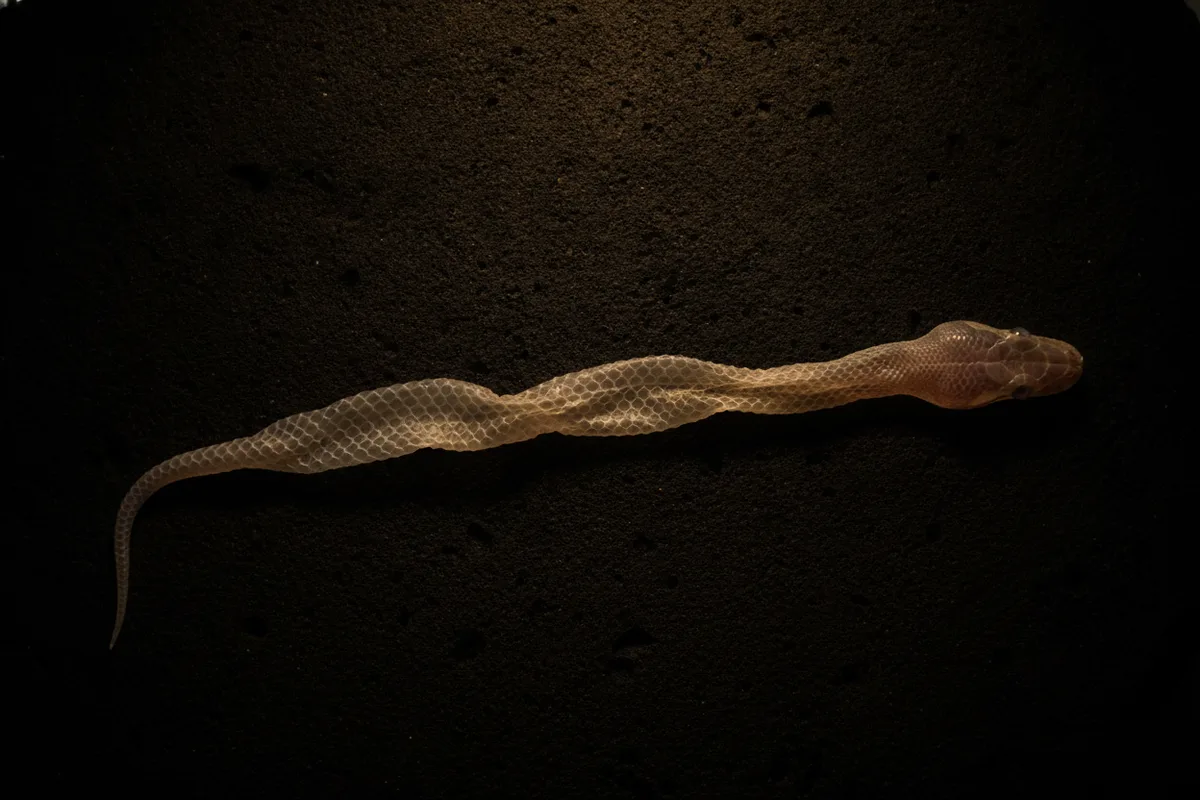
Treating stuck shed: handbook, Health.
Adult life
A royal refusing food in winter is normal. If it loses more than 10 % of its weight, see a vet.
Hunger strikes
They refuse food. That is the species.
Mature males often stop eating from November to March, and healthy adults go two to four months with no meaningful weight loss. Panic about it is the commonest reason you end up changing four things at once and learning nothing. Work through this in order.
- Check the temperatures with the gun. A cold hot spot is the usual cause.
- Check the hides: two, identical, snug. Add clutter.
- Check the season and the sex. An adult male in January refusing food is normal.
- Check for a shed. Many refuse from pink belly until a few days after shedding.
- Change one thing: prey species, time of day, or leave it in overnight.
- Weigh it. This is the only number that matters.
Weight loss over 10 %, lost muscle tone or a visible spine ridge, regurgitation, wrinkled skin, or refusal with any respiratory or mouth sign. Assist-feeding is a vet's decision, not a month-two experiment.
Health
What royals actually get
| Problem | Why royals get it | What to do |
|---|---|---|
| Respiratory infection Wheezing, bubbles at the nostrils, open-mouth breathing | A warm end below 31 °C with humidity held high in a poorly ventilated viv | Vet. Hot spot to the top of range, more airflow |
| Regurgitation | Prey too wide, handled within 48 h, or too cold to digest | No food for 10-14 days, then one size down. Twice is a vet |
| Retained eye caps | Humidity under 55 % through the blue phase | Humid hide next time. Never pick at the eye. Vet if they survive a second shed |
| Obesity Round in section, folds when coiled | An adult fed on a juvenile schedule | Adult interval, monthly weighing |
| Head tilt, corkscrewing | Heritable: spider above all, some champagne and woma lines | Not treatable. Low furniture, secure hides. See Morphs and welfare |
Mites, mouth rot, scale rot, burns, and the signs that need a same-day vet: handbook, Health. Finding a vet: handbook, Vets and insurance.
Where the advice has changed Older advice you might still come across, and what we back instead
Royal python husbandry has moved a long way since the tub-and-heat-mat era. You'll still see some of these on older care sheets and in shop advice. We've looked at both sides, and this is what we back.
| Older advice | What we back | Why |
|---|---|---|
| A royal stresses in a large space; keep it in a small tub or rack | A vivarium at least as long as the snake, cluttered | It was the bare space, not the size, that stressed them. Given hides and cover, royals use the whole viv. UK guidance and the welfare acts now expect full-length enclosures |
| No UVB needed; they are nocturnal | Low UVB, Zone 1, 12 h a day | They are crepuscular, not nocturnal, and are exposed to dawn and dusk sun in the wild. Captive royals under low UVB show more natural activity. It costs a tube |
| A heat mat is all a royal needs | Heat mats for racks in a warm room; overhead heat in a vivarium | Mats work well in a racking system, where the tub is shallow and the room is already warm. In a vivarium with a heavy-bodied snake like a royal, a mat cannot warm the air, and the snake lying its weight on the warm floor is how mat burns happen. Never a mat under a royal in a viv |
| Feed in a separate tub so it does not associate you with food | Feed in the vivarium | The extra handling before and after a meal raises regurgitation risk, and "cage aggression" is a feeding response you avoid by washing your hands, not by moving the snake |
| Feed adults weekly | Adults every 10-14 days, males 14-21 | Weekly feeding produces obese adults. Weight, not the calendar, decides |
| Spider royals are fine if you do not breed them | Spider is prohibited for sale on bask | REPTA's list and the veterinary evidence: every spider carries the condition. We follow REPTA rather than judging morph by morph ourselves |