

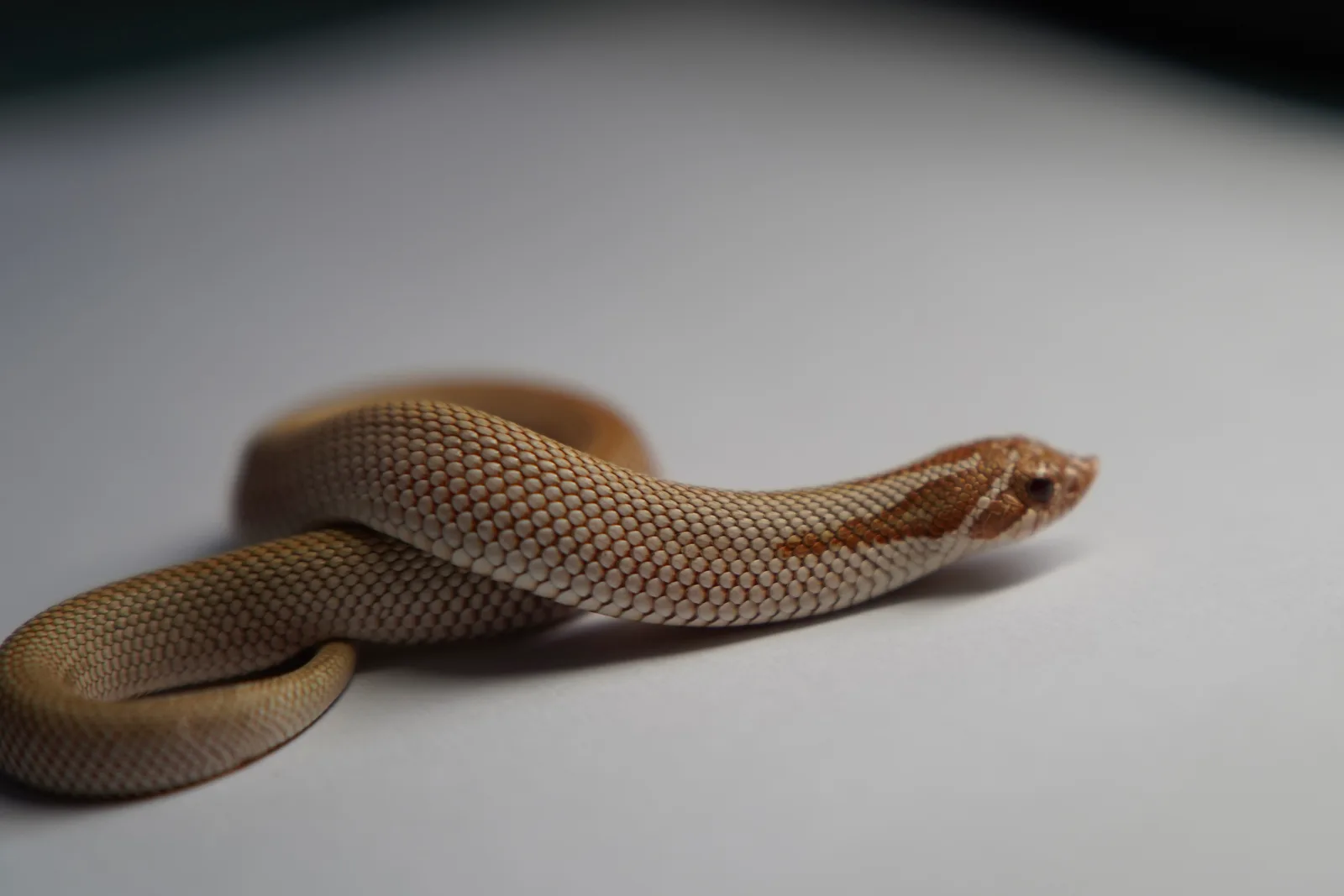
 Photo: Dr.Zoidberg2186, CC BY 4.0
Hognosecare guide
Heterodon nasicus
A western hognose needs a 90 cm vivarium with 8-10 cm of dry substrate to bury itself in, 32-34 °C at one end, and a keeper who does not panic when it hisses, flattens its neck and plays dead. All of that is normal. So is a hatchling that refuses food.
Before you buy
It'll hiss, flatten and play dead. Buy one that's already eating plain mice.
- Adult length
- 40-90 cmFemales much larger
- Lifespan
- 15-20 yr
- Lifetime cost
- ≈ £2,600
- Licence
- NoneMildly venomous, not DWA
Know this first
This guide covers the western hognose, which is the whole UK morph market. Eastern and Mexican hognoses have different needs and their own type on bask.
- They are mildly venomous. Enlarged rear teeth and a mild saliva toxin for subduing toads. Bites are rare and the snake has to chew to deliver anything, but a long bite can swell, and a few people react. Legal to keep, not on the Dangerous Wild Animals list. Handling covers it.
- They bluff. Hissing, a flattened cobra-style neck, closed-mouth head-butts, and playing dead with the mouth open. A new hognose does all of it. None of it means aggression or illness.
- Hatchlings are fussy. Wild hognoses eat toads. Getting a captive-bred hatchling onto mice can take patience. Buy one already feeding on unscented mice.
Lifetime cost, vets, freezer space and hygiene: handbook, Before you buy.
Morphs and welfare
bask applies REPTA's Deleterious Gene Policy in full. How the three groups work is in the handbook, Morphs and welfare. These are the hognose rows.
Prohibited: cannot be listed on bask
| Morph | Condition |
|---|---|
| Skullface Super Skullface | Structural. A high likelihood of malformation of the skull, jaw, eyes and nasal passages. The snout a hognose digs with is the part that is deformed. |
No hognose morph carries a welfare note or breeding guidance. Albino, axanthic, anaconda, arctic, lavender, toffee and their combinations are cosmetic.
Keeping a Skullface breaks no rule. It cannot be advertised on bask, including to rehome it; a reptile rescue is the route. Do not breed from it.
REPTA reviews its list every six months and bask follows each change. Checked against the list published on 6 September 2026.
Buying a hognose
The general seller questions, health checks and quarantine rules are in the handbook, Buying, collection, quarantine. For a hognose, push harder on these.
- Is it feeding on plain mice? Ask for the last five feeds and whether each was scented, cut or plain. Five plain pinkies in a row is a different purchase from a scented one last week.
- Sex. A female needs a 120 cm viv and eats more; a male stays under 60 cm.
- Weight now and a month ago, especially for a hatchling.
Check the animal
A symmetrical head with a clean upturned snout, both nostrils open, no retained eye caps, a rounded body with no folds. Displays are normal; a hognose that does not react at all to being picked up may be unwell.
UK law
Mildly venomous and still unlicensed: the Dangerous Wild Animals schedule covers front-fanged snakes and a few named rear-fanged species, not hognoses. Not CITES-listed. Duty of care, business licensing and the release offence: handbook, UK law.
Setting up
Floor space, 8-10 cm of dry substrate to dig in, and 32-34 °C at the warm end.
The vivarium
Floor space and depth, not height
| Stage | Snake | Minimum enclosure | Notes |
|---|---|---|---|
| Hatchling | 15-25 cm | Tub, 30×20 cm | Small and enclosed helps a nervous hatchling start feeding. Deep substrate even here |
| Juvenile | 25-45 cm | 60×45×30 cm | Or the adult viv, heavily cluttered |
| Adult male | 40-60 cm | 90×45×45 cm | Males stay small |
| Adult female | 60-90 cm | 120×60×60 cm | Twice the size and weight of a male |
A wooden vivarium holds the warm, dry conditions well. Hognoses do not climb much; 45 cm of height is plenty. What matters is a floor they can dig through, so a viv with a deep base lip holds more substrate.
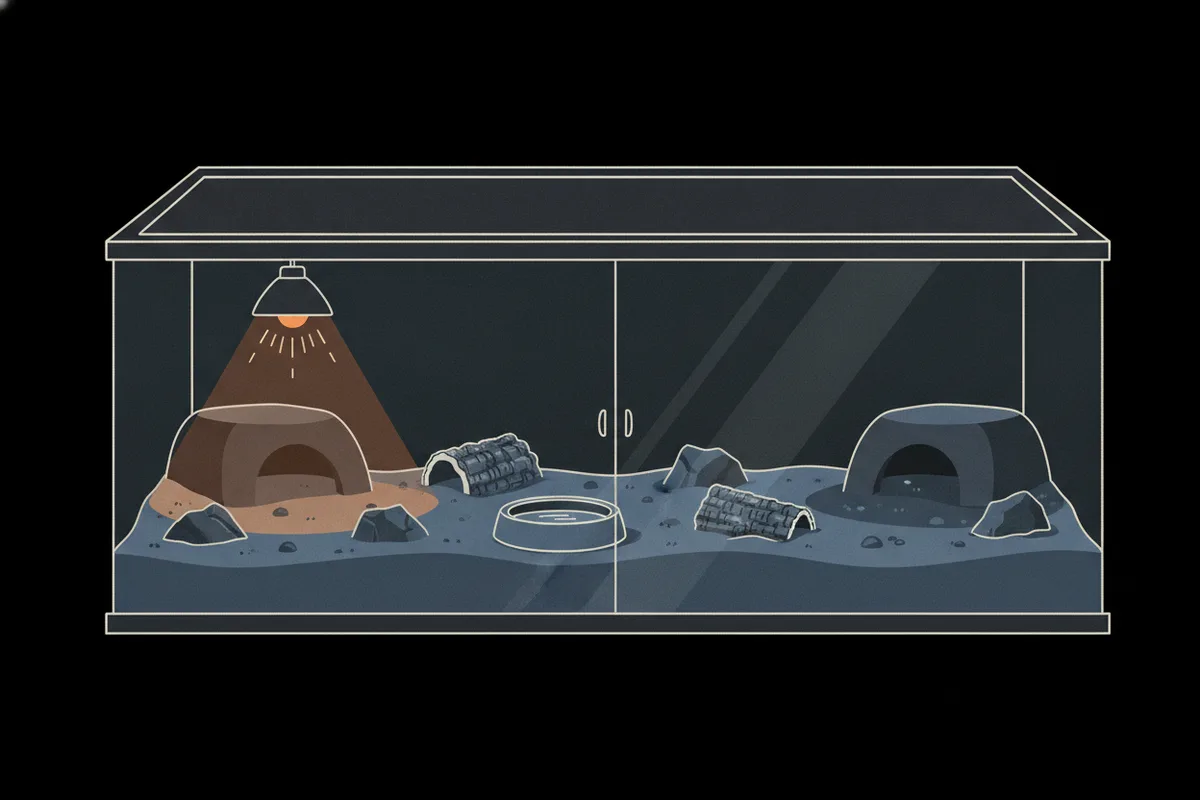
Enclosure types, ventilation, locks: handbook, The enclosure.
Heat and light
Warmer than a corn, heat from above
| Zone | Target |
|---|---|
| Basking surface | 32-34 °C |
| Warm-end air | 28-30 °C |
| Cool-end air | 22-25 °C |
| Night | 19-22 °C |
A deep heat projector on a pulse stat or a halogen on a dimming stat, guarded, at the warm end. Hognoses are daytime baskers and use a halogen well. A mat only works in a hatchling tub with shallow substrate.
UVB
Zone 2, a daytime basker. A 6 % T5 tube over the warm third for a UV Index of 1-2, 12 hours, ten in winter. A snake basking under the tube in the morning is using it as intended.
Thermostats, probe placement, tube replacement: handbook, Heat, light and safety.
Humidity, substrate and furniture
Dry, deep, diggable
The driest-living snake on bask: 30-50 %, never damp. Damp substrate gives a hognose scale rot and respiratory infection faster than any other species here. Small bowl at the cool end; damp moss in one hide only while the eyes are blue, removed after the shed.
The upturned snout is a shovel and a hognose that cannot bury itself is a stressed one. Give 8-10 cm of topsoil and play sand, about 60:40, dry on top, or aspen if you prefer a lighter bed. Never pure sand, calci-sand, pine, cedar or damp coir. Feed on a tile or dish so it is not swallowing soil with the mouse.
The substrate is the main hide, but still give two identical snug hides and low clutter: flat cork, rocks bedded so they cannot fall onto a burrowing snake, dried grasses. Nothing tall.
Humidity: handbook, Humidity. Substrate compared: handbook, Substrate. Hides and water: handbook, Hides, cover and water.
The first weeks
Let it bury itself, don't handle it for 10-14 days, and offer the first meal after a week, on a dish.
Bringing it home
Cloth bag in a rigid insulated box at 20-26 °C, straight into the viv you ran for 48 hours, and let it bury itself. No handling for 10-14 days. First meal after a week: the same prey and preparation the seller used, on a dish, in the evening. If refused, wait a week and try again before changing anything.
Running the enclosure empty first, quarantine and the first fortnight for any reptile: handbook, The first weeks.
Handling and the bluff
All bluster, and a mild bite you still avoid
Almost no hognose bites defensively. The bites that happen are feeding mistakes, when a hand smells of mouse.
- Wash your hands before, every time.
- Approach from the side, scoop from underneath, let it settle. The hissing usually stops within a minute.
- 48 hours after a meal, not in shed, 10-15 minutes.
- If it bites and holds on, do not pull. Put it down and let go; cool water over its head makes it release. Wash the bite well.
A quick bite delivers nothing. A chewing bite can cause swelling, bruising and itching for a day or two, and a few people react more strongly. Anyone with a history of allergic reactions, or bitten on the face, should seek medical advice. Keep hognoses away from small children's hands.
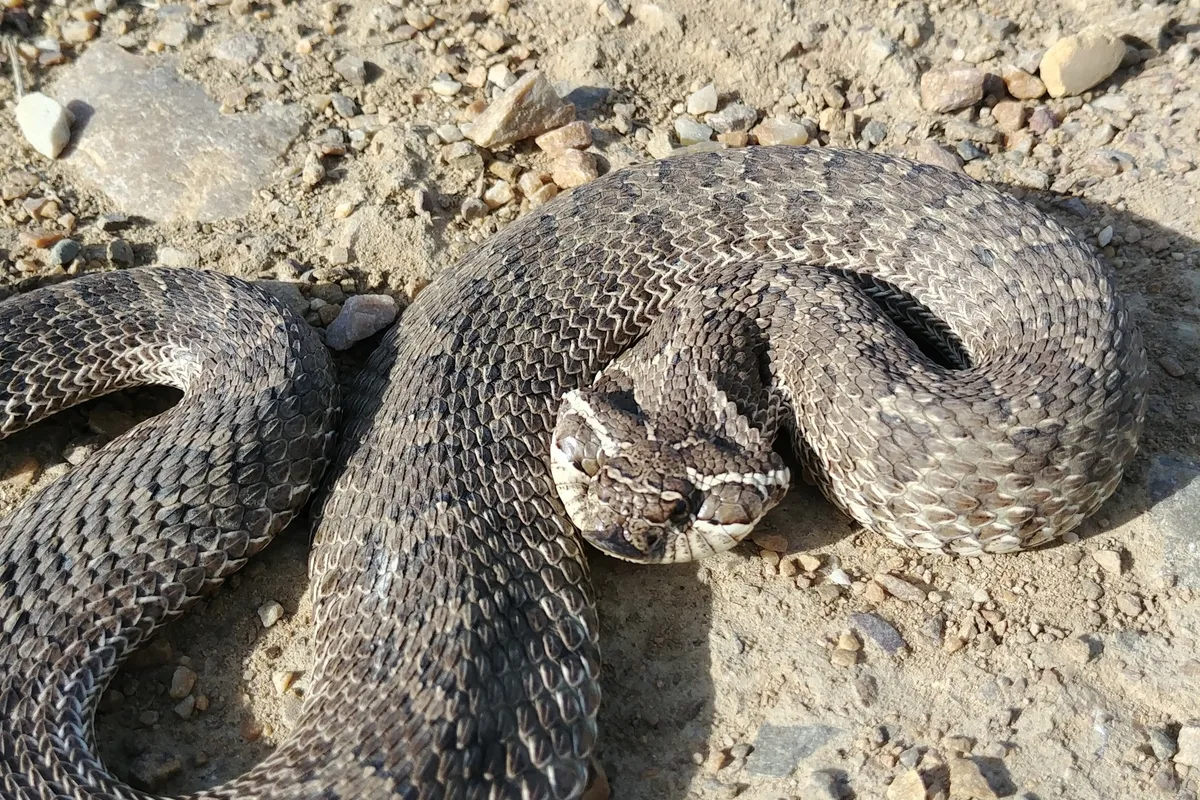
Growing up
Frozen-thawed mice no wider than the snake. Weigh a hatchling every week.
Feeding
Frozen-thawed mice, and the tricks for a fussy one
| Age | Interval | Prey |
|---|---|---|
| Hatchling, under 20 g | 5-7 days | Pinkie, often cut or scented at first |
| Juvenile, 20-80 g | 7 days | Fuzzy, then hopper |
| Adult male, 80-200 g | 10-14 days | Small adult mouse |
| Adult female, 200-500 g | 7-10 days | Adult mouse |
For a hatchling that will not eat, try one thing a week: offer in the evening on a dish and leave the room; leave the mouse in overnight in a small tub; scent it with a thawed frog leg or tinned tuna and rinse less each week; nick the pinkie's head. Weigh weekly. A hatchling holding weight can be worked with for months; one losing it needs a vet.
Adult females get fat easily, so the interval matters. Feed in the vivarium with tongs, leave 48 hours, never live.
Thawing, tongs, live prey: handbook, Food you store or keep alive.
Shedding
Dry snake, damp hide, one piece
Every four to six weeks as a juvenile, every two or three months as an adult. Because the viv is dry, hognoses leave stuck sheds if you do nothing. Damp moss in one hide when the eyes cloud, out again after the shed, and check the tail tip and eye caps each time.
Treating stuck shed: handbook, Health.
Adult life
Adults, males especially, often refuse food from October to February. Under 10 % weight loss just needs patience.
Winter refusals
Adults stop in winter
Adult hognoses, males especially, often refuse from October to February whatever you do. If the snake was in good condition going in, this is normal. Weigh monthly; a winter strike with under 10 % loss needs only patience. Keep the gradient and light on, offer fortnightly, and change nothing in response to refusals.
Weight loss over 10 %, a summer refusal with no seasonal cue, regurgitation, or refusal with any respiratory or mouth sign. A hatchling that has never fed and is losing weight is a vet visit, not a tricks list.
Health
What hognoses actually get
| Problem | Why hognoses get it | What to do |
|---|---|---|
| Non-feeding hatchling | Bred from toad-eaters; not yet switched to mice | The tricks under Feeding, weekly weighing, vet if weight falls |
| Scale rot | Damp substrate on a dry-climate snake | Vet. Dry substrate, paper while treating |
| Respiratory infection | Damp and cool together | Vet. Raise the warm end, dry the viv |
| Obesity (females) | Fed weekly for years | Stretch the interval, weigh monthly |
| Egg binding (females) | Females lay infertile eggs without a male. Low calcium, no laying site, a cool viv | Laying box of damp moss at the warm end. Straining with nothing passed is a same-day vet |
| Impaction | Substrate swallowed with food | Feed from a dish. Warm soak; vet if nothing passes in 48 h |
Mites, mouth rot, stuck shed, burns and the same-day signs: handbook, Health. Finding a vet: handbook, Vets and insurance.
Where the advice has changed Older advice you might still come across, and what we back instead
Hognose care used to be copied from corn snake sheets. You'll still see some of these on older care sheets and in shop advice. We've looked at both sides, and this is what we back.
| Older advice | What we back | Why |
|---|---|---|
| A heat mat under the tub | Overhead heat on a stat, over deep substrate | A mat under 10 cm of soil reaches nothing, and a hognose on a thin layer over a mat gets belly burns. They bask from above in the wild |
| 2-3 cm of aspen is enough | 8-10 cm of a diggable mix | Burrowing is most of what a hognose does. A snake that cannot bury itself stays stressed and often refuses food |
| No UVB | Low UVB, Zone 2 | They are day-active baskers, more so than corns. They use a tube visibly |
| Keep humidity at 50-60 % like a corn | 30-50 %, never damp | Hognoses are prairie snakes and get scale rot and respiratory infection at corn snake humidity |
| Scent every meal for life | Scent only until it takes plain mice, then stop | Scenting is a bridge. A hognose kept on scented food for years is one meal away from a strike every time the scent runs out |