

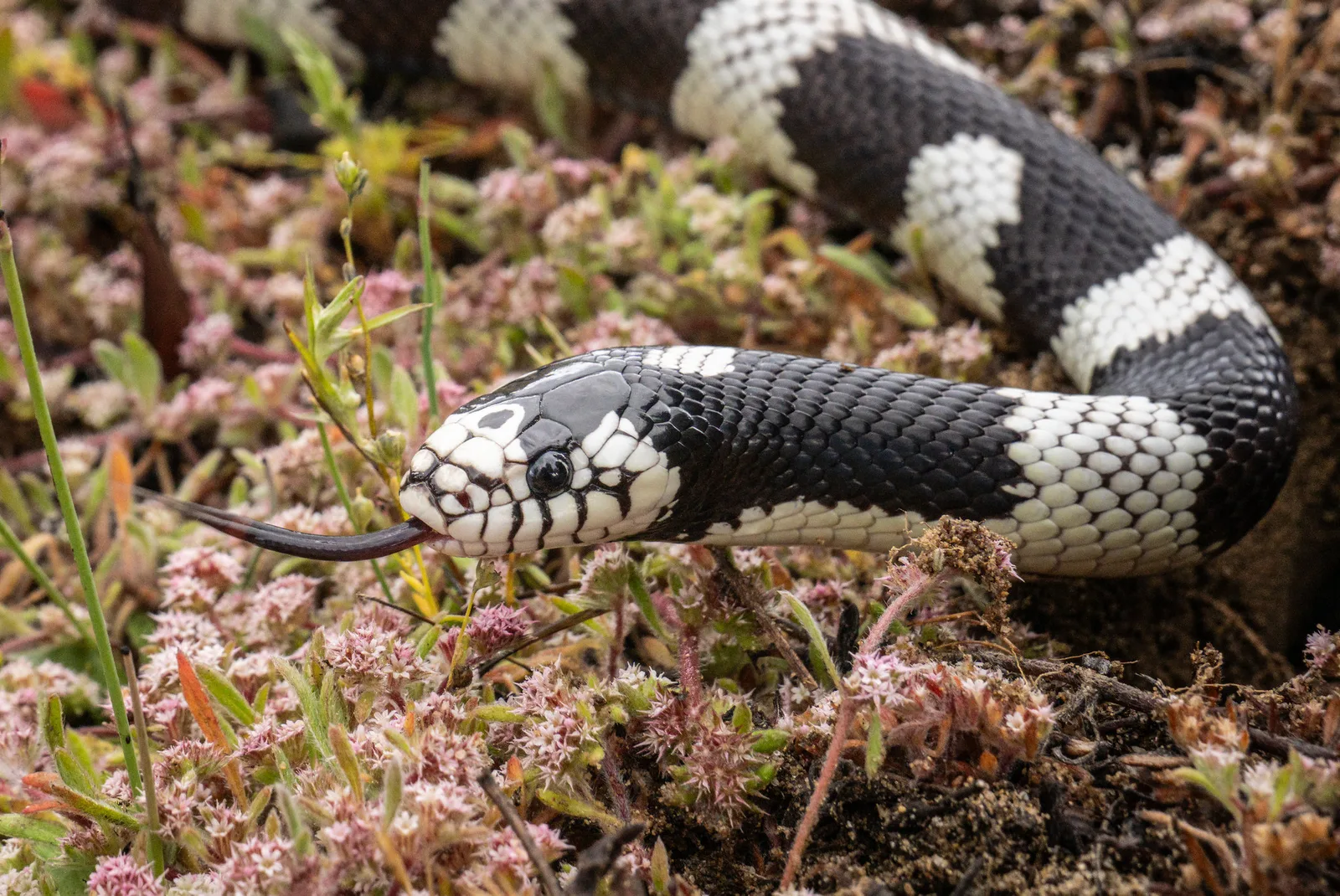
California Kingsnake care guide
Lampropeltis californiae
A California kingsnake needs a vivarium at least as long as the snake (120×60×60 cm for most adults), 29-32 °C at the basking spot, 21-24 °C at the cool end, and a vivarium to itself. It eats other snakes. It also eats keenly, so the commonest problem is a fat one.
Before you buy
Budget for twenty years of care and a vivarium to itself: a kingsnake eats other snakes.
- Adult length
- 90-120 cmOccasionally 150-180
- Lifespan
- 20+ yrPlan for 20
- Lifetime cost
- ≈ £3,400
- Licence
- NoneNot CITES-listed
Know this first
- It eats snakes. Kingsnakes are ophiophagous: a second snake in the vivarium is prey, and a cage mate can be attacked or eaten. Keep one snake per vivarium for life. The Animal Welfare Act 2006 already expects an animal to be housed apart from others where its needs require it.
- It is strong and inquisitive, and it will push at sliding glass. Plan the lock before you plan the decor.
- It eats keenly. A healthy adult looks hungry on any schedule, and a snake fed like a hatchling for life ends up obese.
Other kingsnakes
The setup in this guide suits most kingsnakes sold in the UK, but published species-specific data is thin.
| Species | How care differs |
|---|---|
| Mexican black kingsnake Lampropeltis getula nigrita | Grows larger, so size the vivarium to the snake: a 150 cm snake needs at least 150×60×60 cm. |
| Florida kingsnake Lampropeltis getula floridana | Grows larger, so size the vivarium to the snake. It may like slightly more humidity than a California. We have not confirmed that from a fetched source. |
| Grey-banded kingsnake Lampropeltis alterna | Stays smaller. Kept at around 26.5-29.5 °C. The first meal can be difficult, and a winter cool-down can restart a reluctant feeder. |
| Desert kingsnake Lampropeltis splendida | Suits a drier setup than a California. We have not confirmed that from a fetched source. |
Lifetime cost, vets, freezer space and hygiene: handbook, Before you buy.
Morphs and welfare
bask applies REPTA's Deleterious Gene Policy in full. How the three groups work is in the handbook, Morphs and welfare. These are the California kingsnake rows.
No California kingsnake morph is on REPTA's prohibited list, and none carries a welfare note. Albino, lavender, hypo, hyper, ghost, banana, high white, striped and aberrant lines can all be listed.
The RSPCA says albino snakes may find bright light harmful. Give an albino or other low-melanin snake more shade and the lower end of the UV range, and ask a reptile vet about lighting. When you enquire about a het, ask whether it is stated as 100 % or only as a likelihood.
REPTA reviews its list every six months and bask follows each change. Checked against the list current on 22 November 2026.
Buying a California kingsnake
The general seller questions, health checks and quarantine rules are in the handbook, Buying, collection, quarantine. For a California kingsnake, push harder on these.
- Whether it feeds on frozen-thawed mice, with no live, scented or "brained" feeds. Ask for a written feeding record showing several consecutive plain feeds.
- Whether it has ever lived with another snake. Shared housing carries both cannibalism risk and cryptosporidiosis exposure.
- Regurgitation history, the hatch date, the last shed, and what it is housed in now. A sale vivarium is a short-term display size, and a hatchling should not stay in one for long.
Check the animal
Frequent tongue flicks, clear bright eyes, smooth blister-free skin, no mites, a clean mouth and vent, no mid-body swelling, a rounded body with no folds.
UK law
No licence; not on the Dangerous Wild Animals schedule and not CITES-listed. California kingsnakes are not native to Britain; releasing one is an offence. Duty of care, business licensing and the release offence: handbook, UK law.
Setting up
As long as the snake, locked, 29-32 °C at the basking spot and 21-24 °C at the cool end.
The vivarium
As long as the snake, and locked
| Stage | Snake | Minimum enclosure | Notes |
|---|---|---|---|
| Hatchling | 20-30 cm | 45-60 cm long | Or the adult viv with plenty of cover. Either way, a snug hide and a sealed lid |
| Juvenile | to about 75 cm | 75-90×40-45×30-45 cm | Or the adult viv, well cluttered |
| Adult | 90-120 cm | 120×60×60 cm | A snake over 120 cm needs a length at least equal to its own: 150 cm snake, 150×60×60 cm |
The RSPCA and the government's Animal Welfare Committee both put the length of the vivarium at least equal to the length of the snake, so it can lie fully straight. The older two-thirds figure is a short-term retail minimum for sale vivaria. Size the home for the individual snake.
A wooden or PVC vivarium holds heat better than glass in a UK house. Check every seam, the cable entry and the runner gap, and fit a lock or locking runners. Kingsnakes push at doors, and they find gaps you cannot see.
Enclosure types, ventilation, locks: handbook, The enclosure.
Heat and light
Warm by day, cooler at night
California kingsnakes come from the western United States and do well in a gradient with a real night-time drop. Put the heat above, at one end, and switch it off or dim it at night.
| Zone | Target |
|---|---|
| Basking surface | 29-32 °C |
| Warm-end air | 27-29 °C |
| Cool-end air | 21-24 °C |
| Night | 18-22 °C |
Use a deep heat projector on a dimming or pulse stat, or a halogen on a dimming stat, guarded, at one end. Every heat source goes on a thermostat. If the room falls below the night figure, add a ceramic or a mat on its own stat. A hot rock concentrates heat and burns.
UVB
Older care sheets said snakes need none. The RSPCA and ReptiFiles now recommend a low-output tube: a T5 of 2-7 % over one third to one half of the length, toward the hot end, giving a UV Index of about 0.7 at the basking spot and none in the shade, on a timer for 12 hours. Check it with a UVI meter or the maker's distance chart, and keep a shaded hide so the snake can avoid it.
Thermostats, probe placement, tube replacement: handbook, Heat, light and safety.
Humidity, substrate and furniture
40-55 %, a deep burrowing mix, snug hides
Keep humidity moderate with one damp corner. Damp air with poor ventilation gives blisters and respiratory infection, so read a hygrometer and add ventilation if it runs high. A humid hide of moistened sphagnum moss gives the snake a damp refuge when it wants one.
Kingsnakes burrow. Give about 8-10 cm of a topsoil and sand mix (60:40 works) or aspen, or an organic reptile soil topped with sterilised dried leaves. Sand on its own irritates the skin. Paper towel suits a sick snake for a short time. Beech chips do not hold a tunnel.
Fit a snug hide at each end, so the body touches the sides when coiled, plus the humid hide. Add boiled natural branches, cork and rocks bedded so they cannot fall. Put the water bowl at the cool end, big enough to soak in and heavy enough to stay upright, and change it at least daily.
Humidity: handbook, Humidity. Substrate compared: handbook, Substrate. Hides and water: handbook, Hides, cover and water.
The first weeks
Leave it alone for a week, offer the first meal after five to seven days, and handle it once it feeds regularly.
Bringing it home
Hatchlings travel in a ventilated plastic tub with paper, adults in a secure cloth bag inside a ventilated tub, kept short and away from heat and cold. Set up and run the vivarium for a week first. No handling for the first week. Offer the first meal after 5-7 days and retry weekly if it refuses. Keep it apart from any other snake, with its own equipment, for at least 60-90 days.
Running the enclosure empty first, quarantine and the first fortnight for any reptile: handbook, The first weeks.
Handling
Short and calm, and never straight after a meal
- Leave a new snake alone for the first week. Wait until it feeds regularly before handling it routinely, which takes anything from two weeks to two months.
- Then handle it once or twice a week for 10-15 minutes, never more than once a day. Wait 48 hours after a meal and skip it when the eyes are cloudy. Handling after feeding can cause regurgitation, which can be fatal.
- Scoop with the whole body supported. Never grab.
- Many hatchlings musk, rattle the tail and bite at first. Short, regular sessions usually settle them.
- Wash your hands before and after. Reptiles can carry salmonella.
- Do not handle this snake straight after handling another snake. Your hands smell of prey.
Growing up
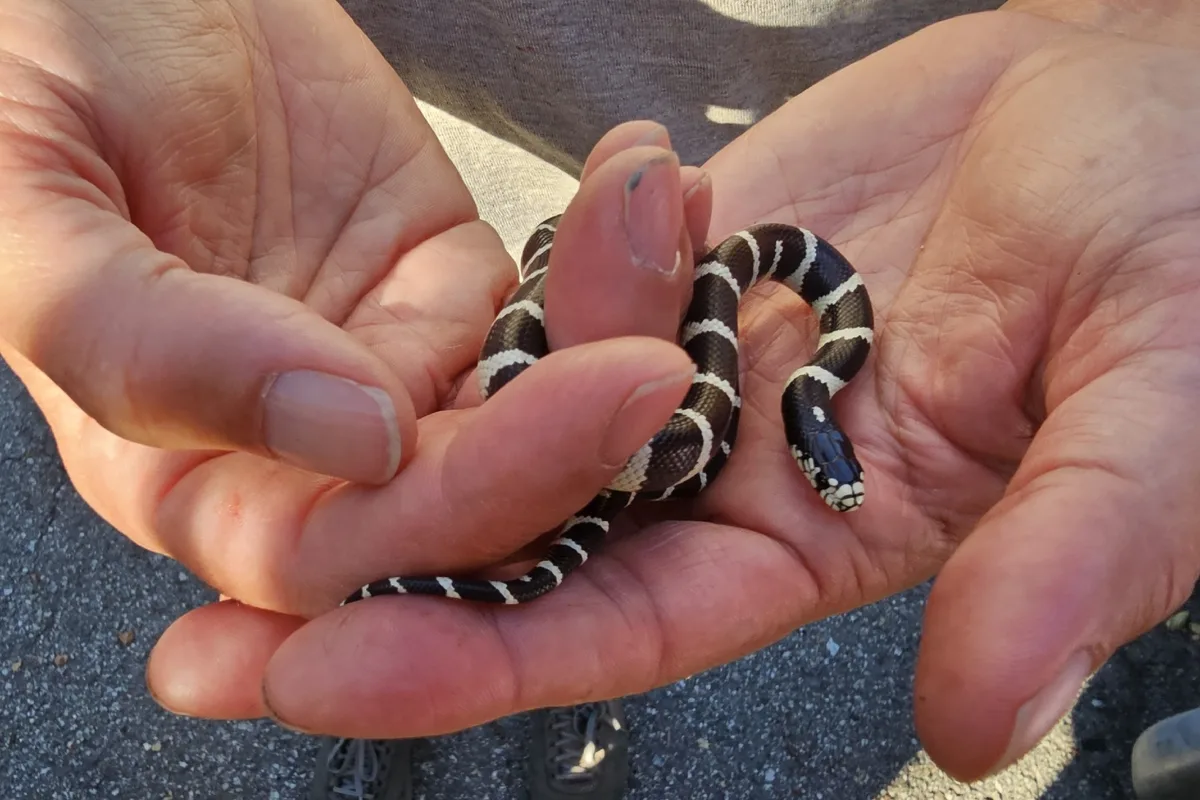
Frozen-thawed mice from tongs, with an adult fed every 10-14 days, not on a hatchling schedule for life.
Feeding
Frozen-thawed mice, from tongs every time
Offer prey about as wide as the snake's thickest point, never much wider. A strong feeding response makes the interval the discipline.
| Age | Interval | Prey |
|---|---|---|
| Hatchling | 5-7 days | Pinkie |
| Juvenile | 7-10 days | Fuzzy, then hopper, then small mouse |
| Adult | 10-14 days | Adult mouse; an occasional chick for variety |
Thaw fully, to room temperature or a little above, and offer with tongs at least 30 cm long. Feed in the vivarium. Live prey can injure the snake. Weigh regularly and judge body condition rather than a gram target: rounded, no spine ridge, no folds.
A kingsnake that has smelled food strikes at anything that moves, hand included. Use tongs, never fingers, and wash your hands after handling prey. Many keepers tap the snake lightly with a snake hook or a flat hand before lifting it, so it learns that the hook means out and the tongs mean food.
Thawing, tongs, live prey: handbook, Food you store or keep alive.
Shedding
One piece, with a damp hide to help
Cloudy eyes mean a shed is coming. With a humid hide of damp moss available, the shed should come off in one piece, eye caps included. If it does not, a soak in slightly warm water helps. Never pull skin off. Retained eye caps go to a reptile vet and are not removed at home.
A bad shed usually points to a snake that is too cold, too dry or underfed. Check the tail tip each time.
Treating stuck shed: handbook, Health.
Adult life
The commonest problem is a fat snake. Weigh it and stretch the gap between feeds. Repeated regurgitation means a vet and isolation.
Winter slowdown
Slowing down in winter is normal. Cooling is optional
Shorter days can make a kingsnake eat less in winter. That is normal while its weight holds. Weigh it, keep the gradient and light on, and offer food on the usual cycle.
Deliberate cooling is mainly for breeders and for resetting a reluctant feeder, and a pet never needs it. Cool only a healthy adult in good condition. Hatchlings and underweight or sick snakes stay warm.
Stop feeding 10-14 days before, so the gut is empty. Hold it at roughly 10-15 °C for about 8-12 weeks with water always available, weigh it every two weeks, and warm it slowly afterwards. These figures are an estimate from related Lampropeltis and have no tested standard for this species, so talk to a reptile vet before the first time.
A snake that stops eating outside winter, or loses weight in it, needs a vet.
Health
What kingsnakes actually get
| Problem | Why kingsnakes get it | What to do |
|---|---|---|
| Obesity | Fed weekly or more for years | Interval to 10-14 days, regular weighing |
| Regurgitation | Prey too large, handled too soon, too cold | No food for 10-14 days, then one size down. Two meals in a row is a vet, and see the next row |
| Cryptosporidiosis Repeated regurgitation, weight loss, sometimes a firm mid-body swelling | A stomach parasite, usually fatal once signs show, with no proven cure | Vet, and isolate. Ask for a PCR test. It never shares a room or equipment with other snakes |
| Respiratory infection Open-mouth breathing, bubbles or mucus at the nose or mouth | Damp and poorly ventilated | Vet, same day. Raise the warm end, dry the viv, add ventilation |
| Mites Black specks, long soaks in the bowl | Arrive with animals and equipment, and can carry disease | Treat snake and viv together. A vet if they do not clear |
| Blisters and mouth rot | Damp substrate, or an unwell snake | Vet. Dry the viv. Red, swollen or cheesy mouth tissue is a vet visit |
| Burns | Unguarded heat, or a hot rock | Guard every heat source and use a stat. A burn is a vet |
Healthy signs are frequent tongue flicks, clear bright eyes and smooth blister-free skin. A snake that stops feeding outside winter, or goes more than four to six weeks without eating and loses weight, should see a reptile vet. Keep temperature and feeding records to take along.
Burns, parasites, dehydration and the same-day signs: handbook, Health. Finding a vet: handbook, Vets and insurance.
Where the advice has changed Older advice you might still come across, and what we back instead
Kingsnake care sheets from retailers and older books still circulate. You'll still see some of these on older care sheets and in shop advice. We've looked at both sides, and this is what we back.
| Older advice | What we back | Why |
|---|---|---|
| A 50-gallon tank or a 90 cm viv; two-thirds of the snake's length | At least as long as the snake, so 120×60×60 cm for most adults | Snakes lie straight when they can. The government's advisory committee calls the two-thirds figure a short-term retail minimum that is inadequate in the long term |
| Snakes need no UVB | Low-output UVB, about UVI 0.7 at the basking spot, shade available | The RSPCA and ReptiFiles now recommend it. The Ferguson zone is inferred from related Lampropeltis, so we keep the dose low |
| A heat mat holds 27 °C all night | Heat off or dimmed at night, 18-22 °C | A natural night drop avoids constant heat, and related Lampropeltis are kept much cooler in winter |
| Beech chips, or aspen only | 8-10 cm of a burrowing mix | Kingsnakes dig, and a soil and sand mix holds a tunnel and a damp corner |
| Feed adults weekly, growing snakes two or three times a week | Adults every 10-14 days, weighed regularly | A strong appetite makes obesity easy |
| Offer live or stunned mice | Frozen-thawed, from tongs, in the vivarium | Live prey can bite back. Tongs keep your fingers out of the feeding response |