

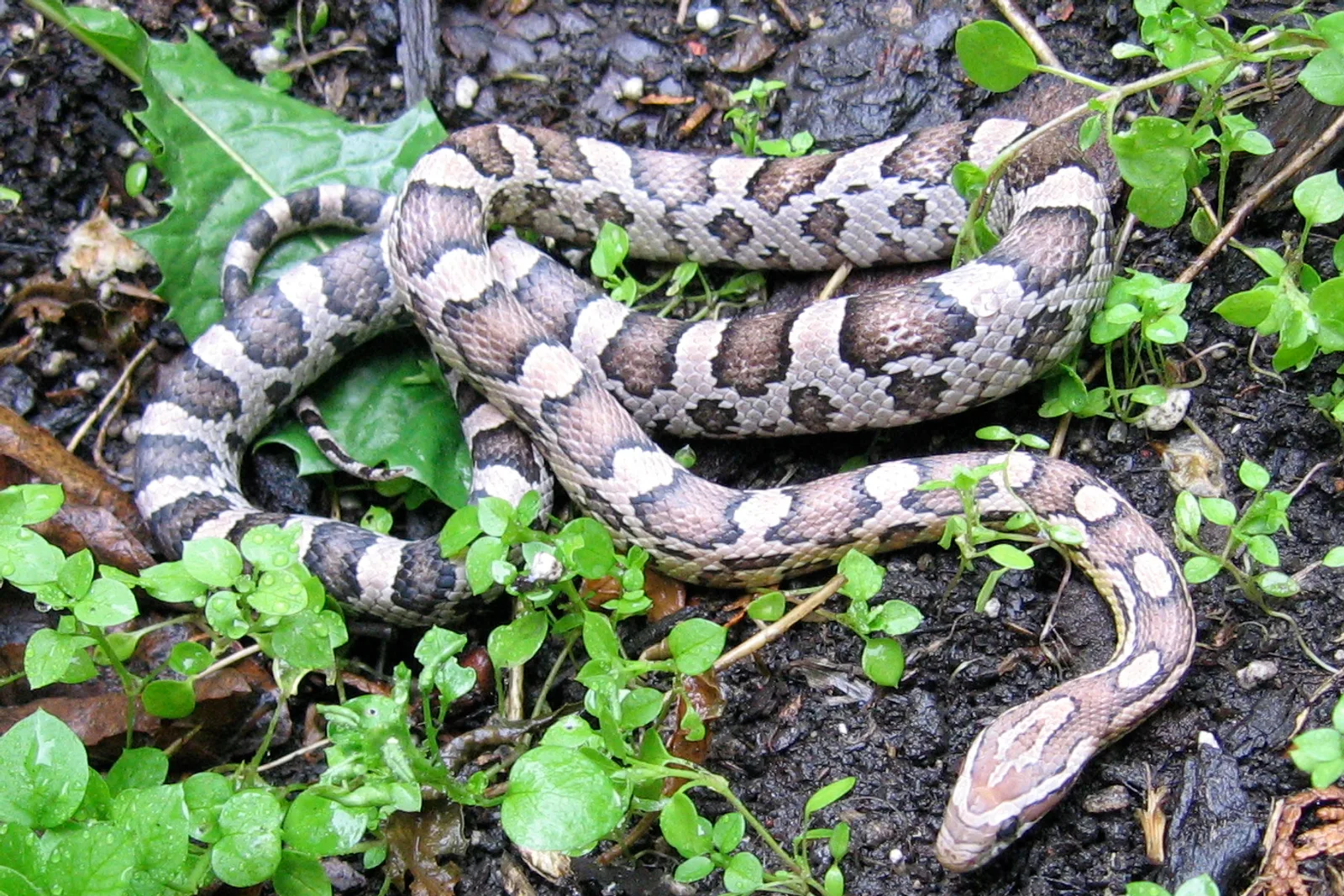
 Photo: Antsterr, CC BY-SA 3.0
Corn Snakecare guide
Pantherophis guttatus
A corn snake needs a vivarium at least as long as the snake, 30-32 °C at one end, 22-24 °C at the other, and a lock on the door. It is the most forgiving snake on bask, and the one most often kept too fat.
Before you buy
You're budgeting for fifteen to twenty years, and for a lock: escape is the commonest way corn snakes die.
- Adult length
- 120-150 cmOccasionally 180
- Lifespan
- 15-20 yr25 recorded
- Lifetime cost
- ≈ £2,750
- Licence
- NoneNot CITES-listed
Know this first
- They escape. A corn will find a gap you did not know was there, and a hatchling fits through a vivarium vent. Escape is the commonest way corn snakes die in captivity.
- They get fat. They eat so reliably that you can end up feeding an adult like a hatchling for life.
- They are active in the evening, climb, and are often out. More rewarding to watch than a royal, and more likely to be out when the door is open.
Lifetime cost, vets, freezer space and hygiene: handbook, Before you buy.
Morphs and welfare
bask applies REPTA's Deleterious Gene Policy in full. How the three groups work is in the handbook, Morphs and welfare. These are the corn snake rows.
No corn snake morph is on REPTA's prohibited list. One carries a welfare note.
| Morph | Concern |
|---|---|
| Stargazer | Neurological. Recessive. An affected snake holds its head up and back, loses coordination and may struggle to strike. It only affects a snake with two copies; a het is unaffected and bask shows no note on het listings. |
If you plan to breed, ask whether either parent is a known carrier; two hets paired produce affected hatchlings. Scaleless corns are allowed and carry no note; they need care with rough décor and heat, and a seller should say so.
REPTA reviews its list every six months and bask follows each change. Checked against the list published on 6 September 2026.
Buying a corn snake
The general seller questions, health checks and quarantine rules are in the handbook, Buying, collection, quarantine. For a corn snake, push harder on these.
- Whether it has ever regurgitated, and how often. Repeated regurgitation is the first sign of cryptosporidiosis, which spreads to every snake you own.
- Body condition rather than weight. A heavy adult corn is not a healthy one.
- What it is housed in now. A hatchling from a tub needs your vents meshed from day one.
Check the animal
No mid-body swelling, no retained eye caps, a straight spine along the whole length, purposeful movement with good grip.
UK law
No licence; not on the Dangerous Wild Animals schedule and not CITES-listed. Corns are not native to Britain; releasing one is an offence and it would not survive a winter. Duty of care, business licensing and the release offence: handbook, UK law.
Setting up
As long as the snake, sealed at every vent, 30-32 °C at one end and 22-24 °C at the other.
The vivarium
As long as the snake, and sealed
| Stage | Snake | Minimum enclosure | Notes |
|---|---|---|---|
| Hatchling | 25-40 cm | Tub, 30×20 cm | Hatchlings escape through standard vents. A clipped tub, or a viv with vents meshed, until about 60 cm long |
| Juvenile | 40-90 cm | 90×45×45 cm | Or the adult viv, well cluttered |
| Adult | 120-150 cm | 120×60×60 cm | 150 cm suits a big female. Height gets used |
A wooden vivarium with a lock. Check every seam, the runner gap, and the cable entry; corns push at the top of the glass, so the runners must grip. A branch or cork tube up the back wall gets used every night.
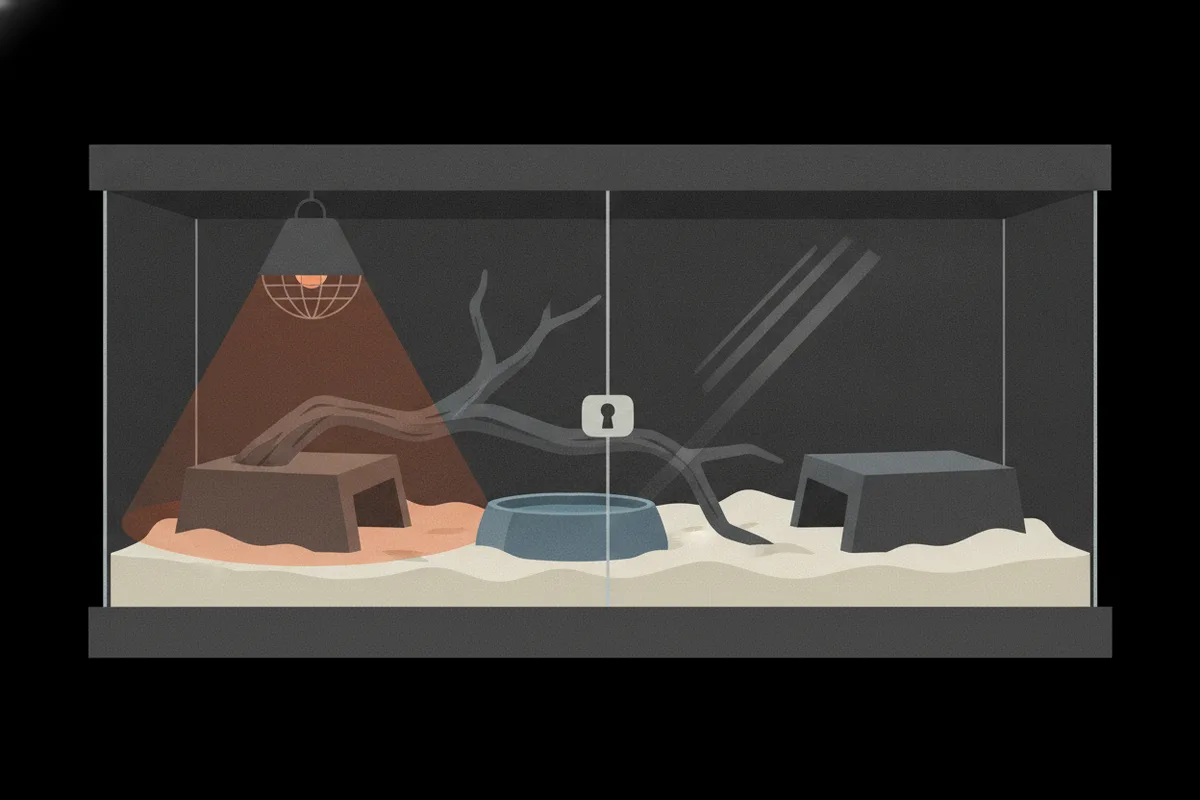
Enclosure types, ventilation, locks: handbook, The enclosure.
Heat and light
A few degrees cooler than a royal
Corns come from the woodland edge and farmland of the eastern United States. Same gradient, lower numbers.
| Zone | Target |
|---|---|
| Basking surface | 30-32 °C |
| Warm-end air | 27-29 °C |
| Cool-end air | 22-24 °C |
| Night | 18-21 °C |
A heat mat under a third of a hatchling tub on a mat stat is enough to start. For the adult viv, a deep heat projector or ceramic on a pulse stat, guarded, or a halogen on a dimming stat; corns will bask under it.
UVB
Corns are out by day more than royals: Ferguson Zone 2. A 6 % T5 tube over the warm third for a UV Index of 1-2 at the basking spot, 12 hours on a timer.
Thermostats, probe placement, tube replacement: handbook, Heat, light and safety.
Humidity, substrate and furniture
40-60 %, deep aspen, a branch
Corns want it drier than a royal. Dry substrate and a bowl at the cool end hold 40-60 % on their own; over 65 % sustained, aspen moulds and scale rot follows. Put damp moss in one hide when the eyes go blue.
Corns burrow. Give 5-8 cm of aspen, which holds a tunnel, stays dry and is cheap; lignocel or a topsoil and coir mix if you want a natural look. Never pine, cedar or calci-sand.
Two identical snug hides, clutter across the floor, a climbing route up the back, and a heavy bowl at the cool end that the snake cannot tip into the aspen.
Humidity: handbook, Humidity. Substrate compared: handbook, Substrate. Hides and water: handbook, Hides, cover and water.
The first weeks
Check the lock, leave it alone for a week, and offer the first meal at the prey size the seller used.
Bringing it home
Cloth bag in a rigid insulated box at 20-26 °C, straight into the viv you ran for 48 hours, lock checked. No handling for 7 days. First meal after five to seven days, the same prey size the seller used. Check the lock and every vent each time you leave the room.
Running the enclosure empty first, quarantine and the first fortnight for any reptile: handbook, The first weeks.
Handling
Active, fast, and fine with it
- Wait 48 hours after a meal. Not in shed.
- A corn travels through your hands rather than sitting in them. Keep both hands moving under it, away from doors and gaps behind furniture.
- Hatchlings rattle their tail, strike and musk. Short calm sessions a few times a week settle them within a couple of months.
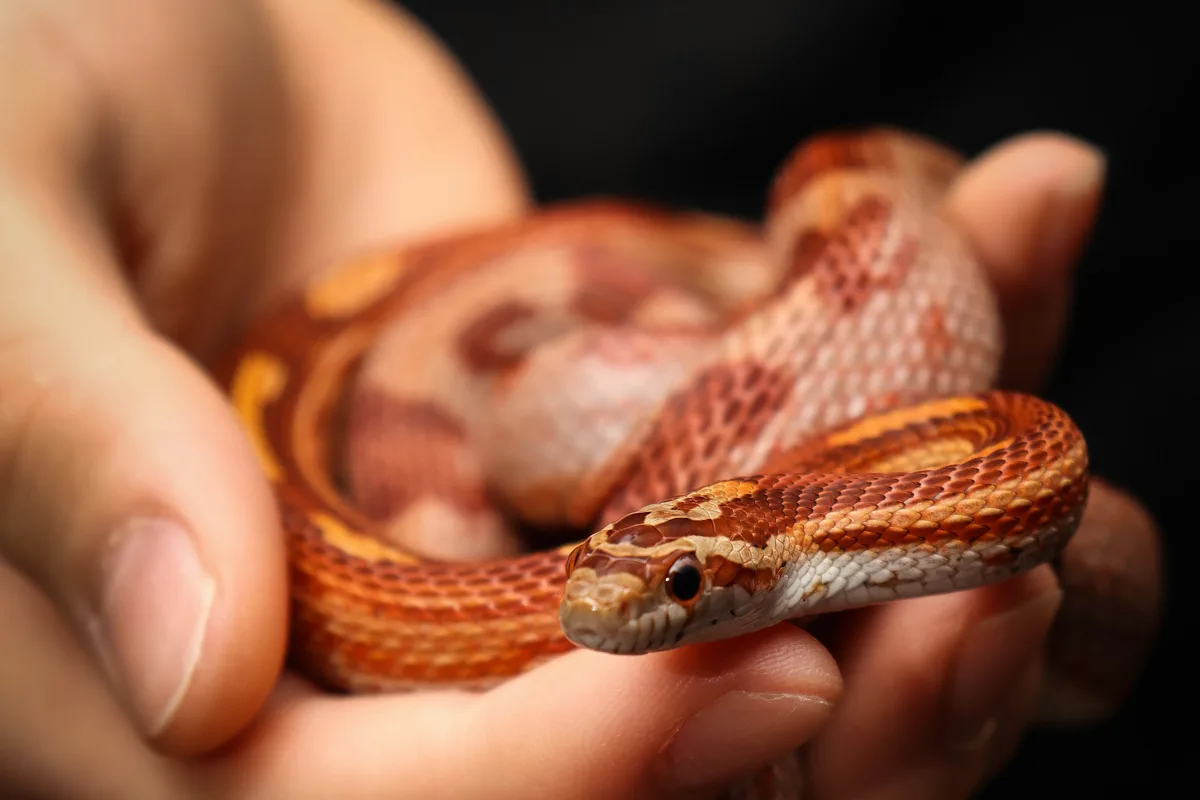
Growing up
Frozen-thawed mice, with an adult fed every 10-14 days, not on a hatchling schedule for life.
Feeding
Frozen-thawed mice, less often than you think
Prey no wider than the snake, about 10-15 % of body weight. Corns rarely refuse, so the discipline is in the interval.
| Age | Interval | Prey |
|---|---|---|
| Hatchling, under 30 g | 5-7 days | Pinkie |
| Juvenile, 30-150 g | 7 days | Fuzzy, then hopper |
| Sub-adult, 150-400 g | 7-10 days | Small to adult mouse |
| Adult, 400-900 g | 10-14 days | Adult mouse; two for a big female |
An adult on a weekly feed is obese within two years: round in cross-section, folds when it coils, a fat line along the belly. Weigh monthly and stretch the interval once it has stopped growing in length. Feed in the vivarium with tongs and leave it for 48 hours. Some adults eat less for a few weeks in winter; that is normal and short.
Thawing, tongs, live prey: handbook, Food you store or keep alive.
Shedding
One piece, every four to eight weeks
Eyes go blue for a few days, clear, and the shed follows within a week. Damp moss in one hide when the eyes cloud and it comes off whole, eye caps and tail tip included. Fragments mean too dry; add the humid hide earlier next time.
Treating stuck shed: handbook, Health.
Adult life
The commonest problem is a fat snake. Weigh it monthly and stretch the gap between feeds.
Health
What corns actually get
| Problem | Why corns get it | What to do |
|---|---|---|
| Obesity | Fed weekly for life | Interval to 10-14 days, monthly weighing |
| Regurgitation | Prey too large, handled too soon, too cold | No food 10-14 days, then one size down. Twice is a vet, and see the next row |
| Cryptosporidiosis Repeated regurgitation, a firm mid-body swelling, steady weight loss | A stomach parasite, contagious between snakes, untreatable | Vet, and isolate. A crypto snake never shares a room or equipment with other snakes |
| Escape injuries Rubbed nose, found cold behind a radiator | The lid, the vents, the runner gap | Warm it slowly in the viv. Find the gap |
| Scale rot Blistered belly scales, musty smell | Aspen wet from a tipped bowl | Change substrate, dry the viv, heavier bowl. Blisters are a vet |
Respiratory infection, mites, mouth rot, burns and the same-day signs: handbook, Health. Finding a vet: handbook, Vets and insurance.
Where the advice has changed Older advice you might still come across, and what we back instead
Corn snake care sheets from the shop era still circulate. You'll still see some of these on older care sheets and in shop advice. We've looked at both sides, and this is what we back.
| Older advice | What we back | Why |
|---|---|---|
| A 90 cm viv is plenty for an adult | At least as long as the snake, so 120 cm for most adults | Corns use every centimetre and climb when given height. The welfare acts expect an enclosure the animal can stretch out in |
| No UVB; keep the lights off | Low UVB, Zone 2, 12 h | Corns are diurnal and bask. Under a tube they are out and active in daylight, which is also nicer to keep |
| Feed adults every 7 days | Every 10-14 days once growth stops | Weekly feeding is why so many adult corns are obese. Weigh, and let the scales set the interval |
| Feed in a separate tub | Feed in the vivarium | Moving a snake before and after a meal adds stress and raises regurgitation risk |
| Aspen is dusty and old-fashioned; use bark | Aspen is still the best choice for a dry, burrowing species | It holds a tunnel and stays dry. Bark and coir suit humid species; on a corn they hold more moisture than the snake wants |