

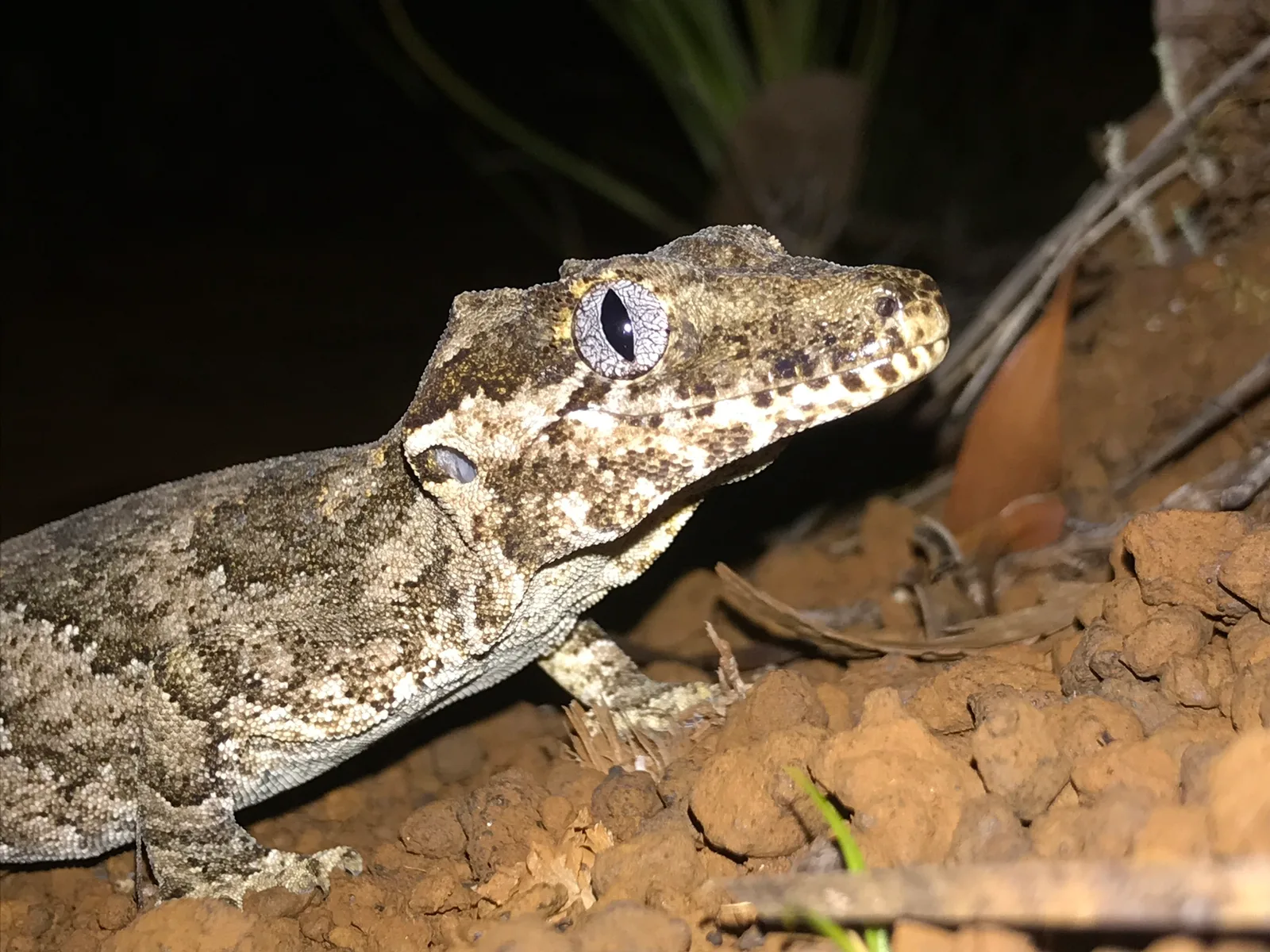
 Photo: anguspritchard, CC BY 4.0
Gargoyle Gecko care guide
Rhacodactylus auriculatus
A gargoyle gecko needs a tall planted terrarium, a basking branch at 28-29 °C, a misting every evening, and a complete gecko diet with insects twice a week. It is a crested gecko's heavier cousin, with a harder bite, a tail that grows back and a heat limit only a little higher. Air above 30 °C is dangerous.
Before you buy
It's a crested gecko's heavier cousin. It bites harder and has to live alone, because cage-mates take tails.
- Adult length
- 20-25 cmSnout to tail tip
- Adult weight
- 45-65 g
- Lifespan
- 15-20 yr
- Lifetime cost
- ≈ £3,300
- Licence
- NoneNot CITES-listed
Know this first
- Heat is the danger. A gargoyle takes a little more warmth than a crested gecko, but the margin is small. Air above 30 °C is a risk, and a room in a heatwave can reach it.
- They bite harder than cresties, and they bite each other. A bite is usually a quick nip that rarely breaks skin. Two together take each other's tails, so keep one per enclosure.
- The tail grows back, unlike a crested gecko's. The new one never looks the same, and regrowing it costs the gecko energy and calcium.
Lifetime cost, vets, live insects in the house and hygiene: handbook, Before you buy.
Morphs and welfare
bask applies REPTA's Deleterious Gene Policy in full. How the three groups work is in the handbook, Morphs and welfare. These are the gargoyle gecko rows.
Prohibited: none
No gargoyle gecko morph is on REPTA's list. The crested gecko's Super Cappuccino and Super Lilly White are on it.
Gargoyle colours are descriptive pattern lines such as striped, reticulated, red or orange blotch and pale base, and there are few named single-gene morphs. We have no welfare note or pairing guidance to add for any of them. Floppy tail syndrome is the one condition to ask about, because affected animals do reach the UK market. The seller should say if a gecko has it.
REPTA reviews its list every six months and bask follows each change. Checked against the list current on 22 November 2026.
Buying a gargoyle gecko
The general seller questions, health checks and quarantine rules are in the handbook, Buying, collection, quarantine. For a gargoyle gecko, push harder on these.
- The tail: is it original or regrown, and why. A regrown tail is harmless, so just know which you are buying.
- How it was raised: alone, and on which complete diet and insect schedule.
- Hatch date and weight in grams, and how sure the seller is of its sex. A young gecko sold as a male is unconfirmed, because young females can look male.
Check the animal
Alert, clear eyes, a straight jaw and limbs, no skin stuck on the toes or tail tip, the tail held normally and not limp when the gecko is head-up, a rounded pelvis and tail base, a clean vent, and a weight that suits its age.
UK law
No licence; not on the Dangerous Wild Animals schedule and not CITES-listed. New Caledonia restricts export of its native geckos, so UK stock should be captive-bred. Treat a wild-caught claim as a red flag. Duty of care, business licensing and the release offence: handbook, UK law.
Setting up
Tall, planted and front-opening, with a gentle basking branch at 28-29 °C and nowhere above 30 °C.
The enclosure
Tall, planted, front-opening, one gecko
| Stage | Gecko | Minimum enclosure | Notes |
|---|---|---|---|
| Hatchling | under 12 g | 30×30×30 cm | A smaller grow-out, so it finds its food and water |
| Juvenile | over 12 g | 45×45×90 cm | The adult enclosure, filled with cover |
| Adult | 20-25 cm, 45-65 g | 45×45×90 cm | Height matters more than floor, and more of either is better |
A front-opening glass terrarium with a mesh top holds humidity from an evening mist, dries by morning and gives the UVB tube a clear path. A wooden viv needs sealing against damp and cannot take an overhead tube. Keep them singly. Two males fight, and a larger gecko can eat a smaller one. Even similar-sized females lose tails together, and a regrown tail is usually lost again once it is big enough to bite.
Enclosure types, ventilation, locks: handbook, The enclosure.
Heat and light
A gentle basking branch, with a ceiling
Unlike a crested gecko, a gargoyle gets a basking spot. It is a gentle one, and the ceiling sits only a little above it.
| Zone | Target | Notes |
|---|---|---|
| Basking branch, upper third | 28-29 °C | Measure at the branch it sits on, not the air above it |
| Cool zone, low in the viv | 22-23 °C | A heated room often gives this unaided |
| Night | 18-22 °C | A drop is healthier than night heat. No night lamp, no blue or red bulbs |
| Limits | never over 30 °C, never under 18 °C | A constant 29 °C throughout the viv is too warm |
Use a low-wattage halogen or clear incandescent bulb over the mesh (25 W is a usual start) on a dimming thermostat, with the probe at the basking branch, off at night. Most centrally heated homes need little more. A small heat mat on a stat suits tiny hatchling tubs only, and goes off at night. Never put a mat under a floor the gecko lies on.
The real UK risk is a summer heatwave. If the room nears 28 °C, switch the lamp off, move the enclosure somewhere cooler and watch a digital thermometer at the top of the viv. Restraint can also overheat a hatchling, so keep handling short.
UVB
Low and shaded. Aim for a UV Index of 1.0-2.0 at the highest branch, from a T5 ShadeDweller-type tube over the mesh, 12 hours a day, with dense foliage so the gecko can retreat to UV Index 0. Sources disagree on whether the gargoyle is Ferguson Zone 1 or Zone 2, but both lead to the same low-output tube and the same target. Measure it with a UV meter, and change the tube every 12 months. Over a small hatchling grow-out the same tube can be dangerously strong, so raise the lamp or use a lower-output one on a stand.
Thermostats, probe placement, tube replacement: handbook, Heat, light and safety.
Humidity, planting and food ledge
Wet at night, dry by day, cover at every height
Average humidity is 50-70 %, and the daily cycle does the work. Mist heavily in the evening so humidity reaches 80-100 % and the gecko drinks the droplets. Mist lightly in the morning. Then let the enclosure dry back to about 50 % before the next heavy mist. Always wet grows mould and gives skin and chest infections. A mesh top, ideally with low front vents, lets it dry.
A bioactive mix over a drainage layer, with springtails and isopods, and live plants such as bromeliads, holds the cycle and keeps itself clean. Offer branches that run diagonally and horizontally as well as upright, and put cover on the floor: a gargoyle comes down to the ground more than a crested gecko does.
Humidity: handbook, Humidity. Substrate compared: handbook, Substrate. Cover for tree-dwellers: handbook, Hides, cover and water.
The first weeks
Don't handle it for the first fortnight. Offer the seller's diet, weigh it at day 14, and mist at dusk.
Bringing it home
A small ventilated tub with damp paper towel, in an insulated box, cool but never cold and never in a hot car, straight into the planted enclosure. No handling for the first fortnight. Offer the diet the seller used, weigh it on arrival and again at day 14, and mist at dusk.
Running the enclosure empty first, quarantine and the first fortnight for any reptile: handbook, The first weeks.
Handling
Low, brief, and mind the bite
- Let it step onto your hand from a branch, and keep your fingers open. Gargoyles leap, so handle low over something soft.
- No handling for the first fortnight. After that, 5-15 minutes a few times a week, in the evening when it is awake.
- Never grab or restrain the tail. A dropped tail grows back over a few months, looking different, and it costs the gecko calcium and energy. Do not let a gecko drop it again and again.
- A bite is a quick nip that rarely breaks skin. Put the gecko back and try later.
Growing up
Complete gecko diet as the staple, dusted insects twice a week, and weigh it every week.
Feeding
Complete diet first, insects twice a week
A complete gecko diet, a powder mixed with water as the pack says, is the staple. Baby food cannot replace it. Fruit is an occasional treat, because too much makes a gecko refuse its diet and go short of calcium. A gargoyle hunts more than a crested gecko, so it gets more insects.
| Age | Gecko diet | Insects |
|---|---|---|
| Hatchling and juvenile | Fresh every evening | 2-3 times a week |
| Adult | Fresh every 2-3 evenings, removed after 24 h | 1-2 times a week |
Feed crickets, dubia or discoid roaches, silkworms or black soldier fly larvae, none longer than the gap between the gecko's eyes, gut-loaded for at least 24 hours. Waxworms are an occasional treat. Dust every insect with calcium: calcium without D3 when a UVB tube is fitted, with D3 when it is not. Add nothing to the diet powder, which is already complete. Keep fresh water in a separate bowl.
A pinky mouse is optional, and a good diet plus insects does without it. If you offer one, it is frozen and thawed, never live, and no more than twice a month, because it is fattening. Skipping two to four feeds a month does an adult no harm.
Keeping live insects and supplements: handbook, Food you store or keep alive.
Shedding
Check the toes and the tail tip
The evening mist helps skin come away cleanly. After any shed, check the toes and tail tip. Skin left on can tighten and cost a toe or the tip of the tail. Soak the gecko for ten minutes in a shallow tub of lukewarm water, then ease the skin off with a damp cotton bud. Never pull dry skin. If it is still tight after 24-48 hours, see a vet.
Treating stuck shed: handbook, Health.
Adult life
Handle it low and briefly, and never by the tail. It grows back, but it never looks the same.
Health
What gargoyle geckos actually get
Weigh it every week and write the weight down. Sudden weight loss is the earliest sign of illness, and reptiles hide illness well.
| Problem | Why gargoyles get it | What to do |
|---|---|---|
| Metabolic bone disease Soft or kinked jaw, limbs or tail; tremors | Too little calcium, no UVB or D3, or a poor diet | Vet. Complete diet, calcium on every insect, the UVB tube checked |
| Floppy tail syndrome Tail flops over the back or sideways | The cause is unsettled. Low calcium, weak hips, hanging head-down on glass and no horizontal perches are all suspected | Diet as above, and branches at angles so it rests off the glass. Ask a vet |
| Overheating Gasping, flat on the floor, off food | Air above 30 °C, a heatwave, a lamp with no stat, a hatchling held too long | Lamp off, to a cool room, mist. Same-day vet if not better within an hour |
| Tail loss | Grabbed, startled, or bitten by a cage-mate | Keep the stump clean. It regrows over a few months and looks different |
| Obesity | Too many pinkies, waxworms or fruit | Cut the treats back and weigh weekly |
| Retained shed | Humidity too low, or a missed evening mist | Soak and ease. Vet if still tight after 24-48 h |
| Egg binding (females) | Breeding without a rest, low calcium, no laying site | A straining or lethargic female is a same-day vet |
Respiratory infection, mites, mouth rot, parasites and the same-day signs: handbook, Health. Finding a vet: handbook, Vets and insurance.
Where the advice has changed Older advice you might still come across, and what we back instead
Gargoyle gecko care has moved on from small tanks and baby food to a taller enclosure, low UVB and a complete diet. You'll still see some of these on older care sheets and in shop advice. We've looked at both sides, and this is what we back.
| Older advice | What we back | Why |
|---|---|---|
| A 10-gallon tank or 45×45×60 cm is enough | At least 45×45×90 cm, height first | It lives in branches, and the extra height gives a better heat and UV gradient |
| No UVB; dust everything with calcium and D3 | Low UVB with shade, and calcium without D3 | A low tube lets it make its own vitamin D, and it avoids over-dosing on D3 powder |
| Baby food or fruit mixes as the staple | A complete gecko diet, with insects and fruit as extras | Baby food has little calcium, and too much fruit makes a gecko refuse its proper diet |
| Adults can share an enclosure all year | Singly | Tails get bitten off and eaten, and a smaller gecko can be killed |
| A heat mat, or no basking lamp | A low-wattage lamp on a thermostat, with mats for tiny hatchling tubs only | It warms from above, a gradient lets it choose, and a night drop is healthier than night heat |
| Pinkies as a regular food | Optional, frozen and thawed, at most twice a month | They are fattening, and a complete diet with insects does the job |