

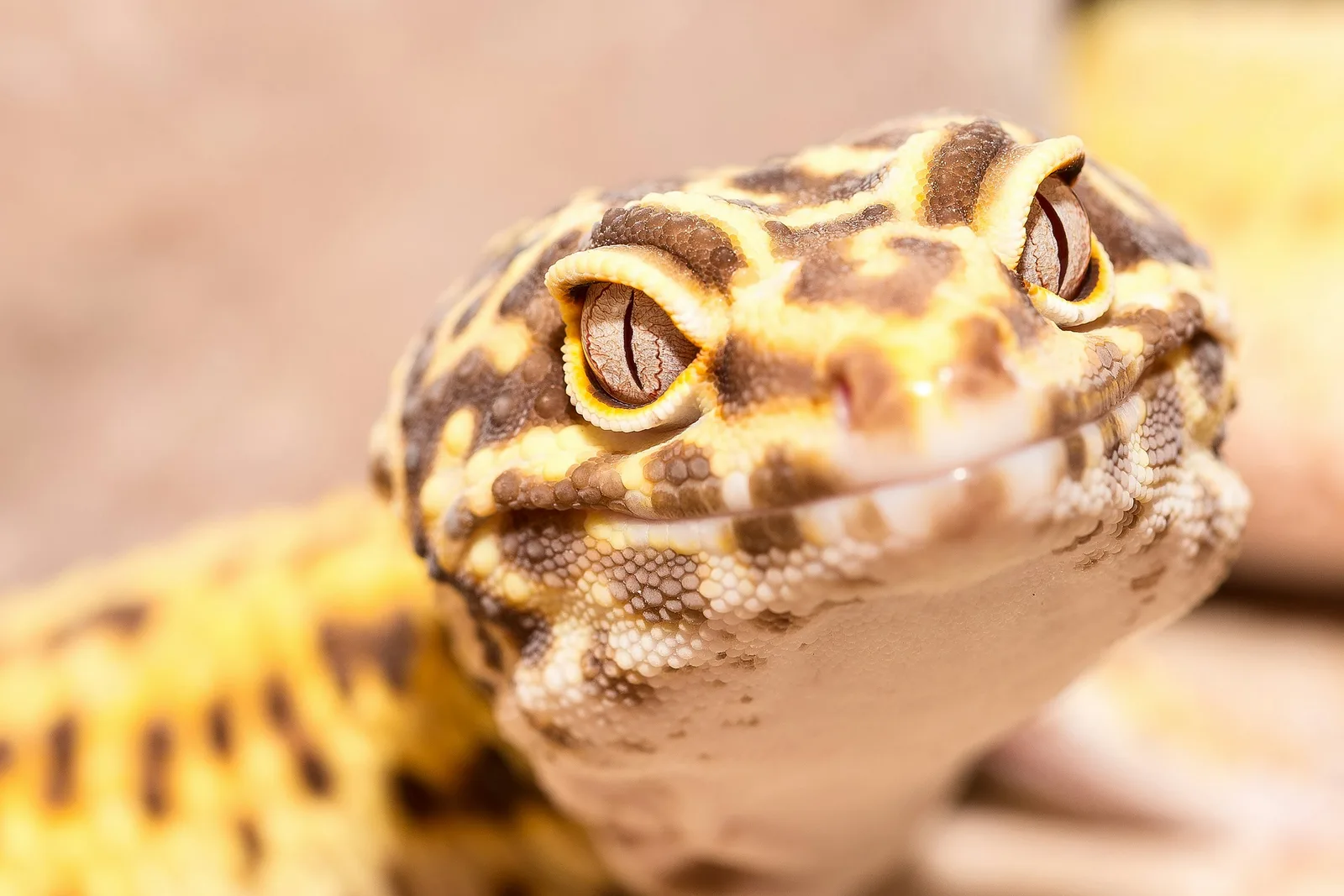
 Photo: Andy Holmes on Unsplash
Leopard Geckocare guide
Eublepharis macularius
A leopard gecko needs a 90 cm vivarium with a warm surface at 32-34 °C, three hides including a damp one, calcium on its insects, and a hand that never takes it by the tail. It is the easiest lizard on bask, and still one that dies of preventable bone disease.
Before you buy
You'll have live insects in the house for twenty years, so start with a gecko that has a plump tail.
- Adult length
- 18-25 cm
- Adult weight
- 50-90 gA fat tail is healthy
- Lifespan
- 15-20 yr
- Lifetime cost
- ≈ £3,250
- Licence
- NoneNot CITES-listed
Know this first
- They eat only insects: crickets, locusts and roaches in the house every week for twenty years.
- They are crepuscular. Active at dusk and dawn, asleep in a hide most of the day. A leo out in the open all day is too hot or has nowhere better to be.
- The tail is the health gauge. A leopard gecko stores fat in it. A plump tail is a well gecko; a thinning one is the first sign of illness, weeks before anything else shows.
Lifetime cost, vets, live insects in the house and hygiene: handbook, Before you buy.
Morphs and welfare
bask applies REPTA's Deleterious Gene Policy in full. How the three groups work is in the handbook, Morphs and welfare. These are the leopard gecko rows.
Prohibited: cannot be listed on bask
| Morph | Condition |
|---|---|
| Enigma Super Enigma | Neurological. Enigma syndrome: circling, head tilt, stargazing, poor coordination, trouble catching food. It varies and worsens with stress, and every gecko carrying the gene has it to some degree. |
| Lemon Frost Super Lemon Frost | Tumours. The gene that makes the colour also causes skin tumours that spread internally. Most Lemon Frosts develop them. |
No leopard gecko morph carries a welfare note or breeding guidance. Enigma is dominant, so any gecko showing the Enigma look carries it; ask about morphs bred from Enigma lines.
Keeping an Enigma or Lemon Frost breaks no rule. It cannot be advertised on bask, including to rehome it; a reptile rescue is the route. Do not breed from it.
REPTA reviews its list every six months and bask follows each change. Checked against the list published on 6 September 2026.
Buying a leopard gecko
The general seller questions, health checks and quarantine rules are in the handbook, Buying, collection, quarantine. For a leopard gecko, push harder on these.
- The tail. It should be plump and wider than the neck. A thin tail on a young gecko is the first sign of cryptosporidiosis, and shops sell those geckos every week.
- Whether a faecal test has been done. If not, have one done in the first fortnight.
- Whether either parent was an Enigma, whatever the morph is sold as.
Check the animal
A plump tail, straight jaw and limbs with no swelling, all toes with no shed rings, clear open eyes, and a gecko that walks straight and reacts to movement. Circling, head tilt or a wobble is a reason to walk away.
UK law
No licence; not on the Dangerous Wild Animals schedule and not CITES-listed. Duty of care, business licensing and the release offence: handbook, UK law.
Setting up
A 90 cm vivarium, a 32-34 °C warm surface, and three hides, one of them damp.
The vivarium
Floor space, low, kept singly
| Stage | Gecko | Minimum vivarium | Notes |
|---|---|---|---|
| Hatchling | 7-10 cm | 45×30×30 cm | Or the adult viv, cluttered so it can find food |
| Juvenile | 10-18 cm | 60×45×45 cm | Adult size by about a year |
| Adult | 18-25 cm | 90×45×45 cm | 120×60×45 gives a better gradient and room for three hides |
A wooden vivarium or a front-opening glass terrarium; leos are a dry species and a glass tank's heat loss matters less than for a snake. Length matters, height does not. Keep them singly: females housed together bully quietly, and a male with females breeds them into the ground.
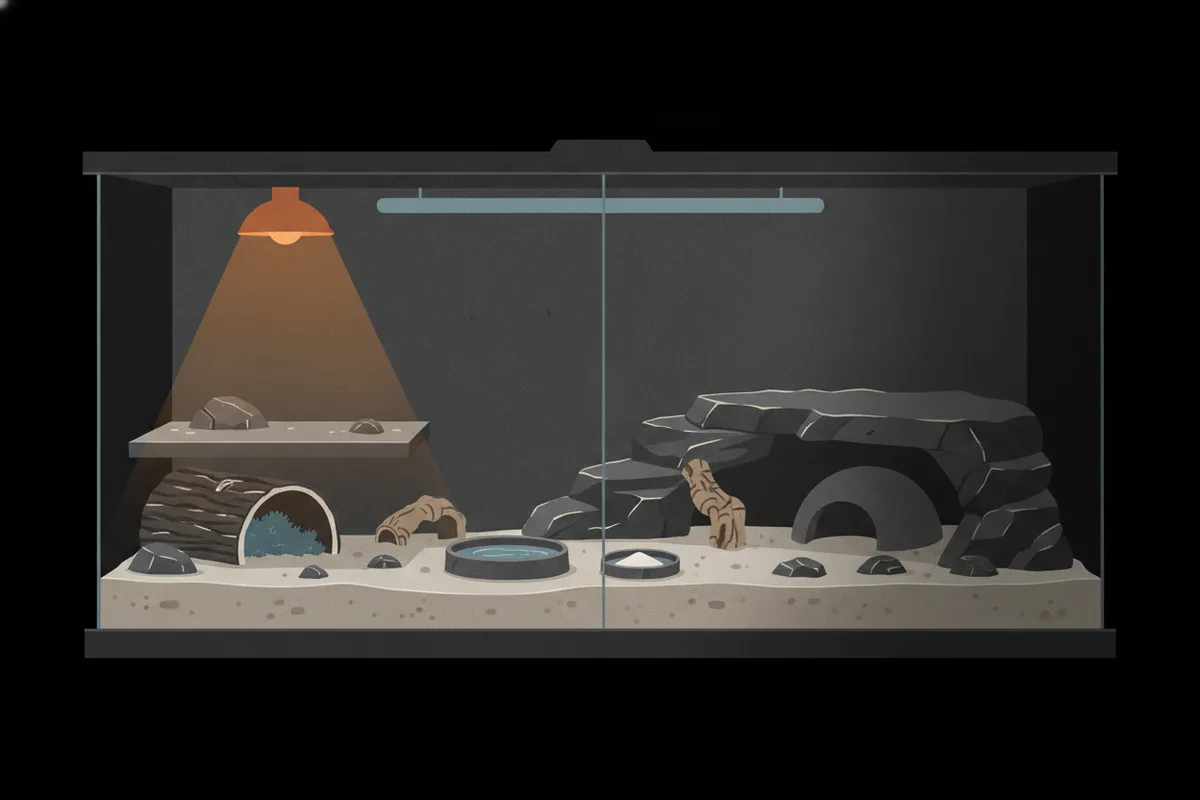
Enclosure types, ventilation, locks: handbook, The enclosure.
Heat and light
Warm belly, cool retreat, low light
Leopard geckos lie on warm rock after dark to digest.
| Zone | Target |
|---|---|
| Warm surface, floor of the warm hide | 32-34 °C |
| Warm-end air | 28-30 °C |
| Cool-end air | 22-25 °C |
| Night | 18-21 °C, mat on, overhead off |
A heat mat under the warm third on a mat stat, outside a wooden viv's floor or under a thin layer inside a glass one, probe on the surface the gecko lies on. On its own it leaves the air cold, so add a deep heat projector on a pulse stat overhead at the same end. A mat with no thermostat is the classic leopard gecko burn.
UVB
Zone 1. A 2.4 % or 6 % T5 tube (depending on distance) for a UV Index of 0.5-1.0 at the warm end, 12 hours, with the hides giving full shade. It lets you use plain calcium at most feeds instead of relying on D3 powder.
Thermostats, probe placement, tube replacement: handbook, Heat, light and safety.
Humidity, substrate and furniture
Dry viv, damp hide, three hides, two dishes
The viv stays at 30-40 %. The humid hide is the exception: packed with damp moss or coir, kept damp all the time, in the middle or warm end. A leo uses it to shed and often sleeps in it; without one, sheds stick on the toes and the toes are lost.
A 60:40 topsoil and play sand mix, 5-8 cm, dry on top, holds a dig and does not blow about. Slate tile works and holds belly heat. Never loose sand, calci-sand, wood chips or walnut shell; impaction is a common leopard gecko death. Hatchlings under three months go on paper or tile, and everyone is fed from a dish.
- Warm hide over the mat, cool hide at the far end, humid hide between. All snug and dark.
- Rocks bedded so they cannot shift, cork bark, a low branch.
- A shallow water dish at the cool end, changed daily.
- A bottle cap of plain calcium powder, always available. Geckos lick it when they need it; it is the cheapest insurance against bone disease there is.
Humidity: handbook, Humidity. Substrate compared: handbook, Substrate. Hides and water: handbook, Hides, cover and water.
The first weeks
Put it straight into the warm hide, offer a few insects at dusk from day one, and don't handle it for 7-10 days.
Bringing it home
A small ventilated tub with paper towel, in an insulated box at 22-28 °C, straight into the warm hide. No handling for 7-10 days. A few insects in a dish at dusk from day one; remove uneaten ones before bed. Watch the tail rather than the food bowl.
Running the enclosure empty first, quarantine and the first fortnight for any reptile: handbook, The first weeks.
Handling
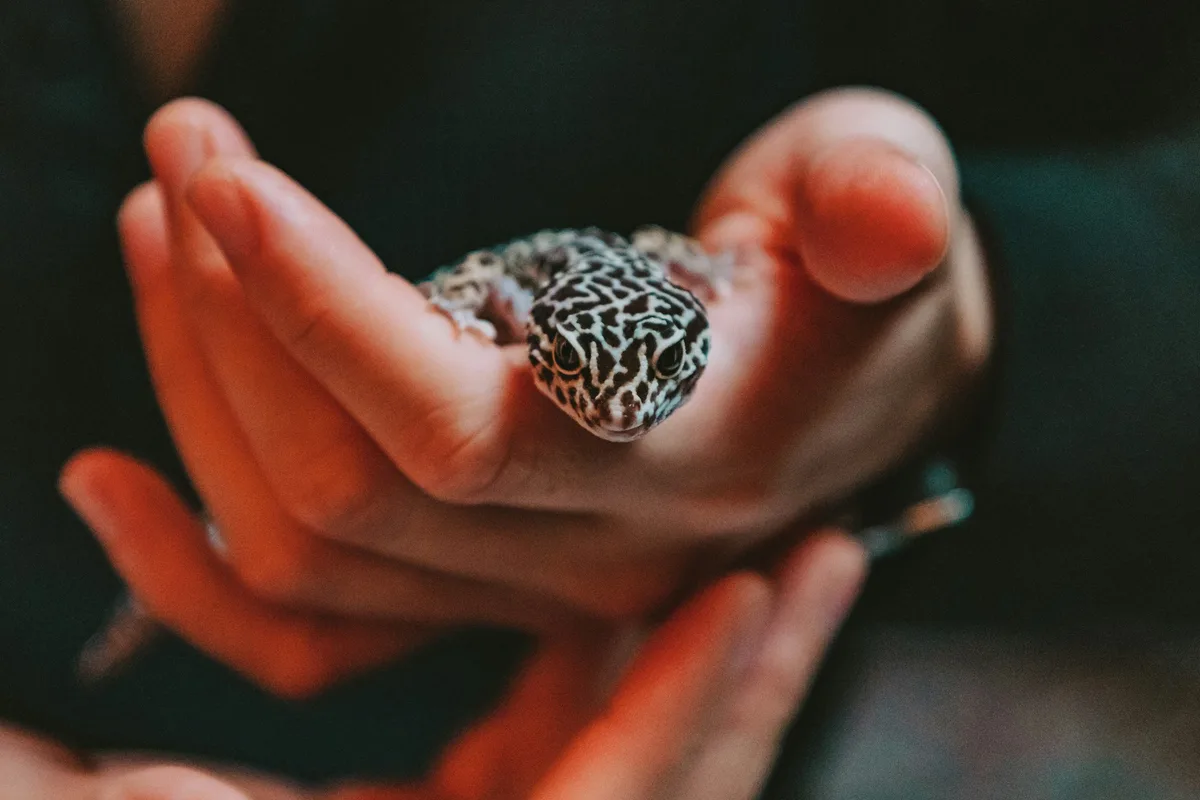
Scoop, never grab, never the tail
- Slide a hand under from the side and let it walk on. Never from above or by the tail; a caught gecko drops its tail, and the regrown one is never the same.
- 5-10 minutes, low over a soft surface, a few times a week. Leos are quick and fall badly.
- Not in shed, and not straight after a meal.
A slow tail wave is nervous; a fast vibration means a bite or a bolt. Both mean put it back.
Growing up
Gut-load the insects and dust them with calcium at most feeds. Watch the tail, not the bowl.
Feeding
Insects, gut-loaded and dusted
| Age | How often | How much |
|---|---|---|
| Under 12 months | every day | As many as eaten in 10-15 minutes |
| Adult | every 2-3 days | 5-8 insects |
Crickets, locusts and dubia roaches as staples; mealworms, waxworms and calci-worms as weekly treats at most (waxworms are fattening and geckos get hooked). No insect longer than the gap between the eyes. Gut-load for a day on fresh greens; a cricket is only as nutritious as what it ate.
Plain calcium dusted on most feeds when UVB is fitted (calcium with D3 twice a week if not), a multivitamin weekly, and the calcium dish in the viv. Remove uneaten crickets before bed; loose crickets chew on a sleeping gecko.
Keeping live insects, gut-loading, supplements: handbook, Food you store or keep alive.
Shedding
They eat it, and the toes are the problem
A leo goes pale for a day, then pulls its shed off in strips overnight and eats it, so you may never see one. The humid hide is what makes it come off cleanly. Check the toes and tail tip after every shed: rings of skin tighten as the gecko grows and cost it the toe. Soak the feet ten minutes and ease the skin off with a damp cotton bud; never pull dry shed.
Treating stuck shed: handbook, Health.
Adult life
A thinning tail is the first sign of illness, weeks before anything else shows.
Health
What leopard geckos actually get
| Problem | Why leos get it | What to do |
|---|---|---|
| Metabolic bone disease Soft jaw, bowed legs, tremors | Undusted insects, no calcium dish, no UVB or D3 | Vet. Calcium every feed, the dish, check the tube. Early cases recover |
| Cryptosporidiosis (stick tail) Tail thins while the gecko still eats; runny droppings; regurgitation | A gut parasite, contagious and untreatable, common in shop stock | Vet, and isolate. A faecal test confirms it. Never share equipment |
| Impaction No droppings, swollen belly, dragging back legs | Loose sand, oversized insects, mealworms fed to juveniles, a cold warm end | Warm soak and belly massage. Vet if nothing passes in 48 h |
| Tail loss | Grabbed, or a cage-mate | Keep the stump clean on paper; it regrows in a few months |
| Retained shed on toes and eyes | No humid hide | Soak and ease. An eye that stays shut is a vet |
| Egg binding (females) | Infertile eggs without a male. No laying site, low calcium | Laying box of damp coir. Straining with nothing laid is a same-day vet |
Respiratory infection, mites, mouth rot, burns and the same-day signs: handbook, Health. Finding a vet: handbook, Vets and insurance.
Where the advice has changed Older advice you might still come across, and what we back instead
Leopard gecko care was the last to move on from the heat-mat-and-paper-towel era. You'll still see some of these on older care sheets and in shop advice. We've looked at both sides, and this is what we back.
| Older advice | What we back | Why |
|---|---|---|
| A heat mat is all the heat a leo needs | A mat for belly heat plus overhead heat for the air | A mat alone gives a warm floor under cold air. Geckos digest on the mat and then sit shivering above it. Overhead heat on a stat fixes the air |
| No UVB; dust with D3 instead | Low UVB, Zone 1, plus plain calcium | D3 powder works but doses badly, and over-supplementing is its own problem. A low tube lets the gecko make its own and behave more naturally |
| Loose substrate impacts; keep them on paper or carpet for life | An arid soil and sand mix, or tile | Impaction is from pure sand, oversized food and cold. A firm mix on a warm, dish-fed gecko is safe and lets it dig. Carpet catches claws and teeth and harbours bacteria |
| Females can live together | Singly | Cohabiting females bully quietly; one always loses weight. The tail tells you which |
| Two hides is enough | Three: warm, cool and humid | The humid hide is what stops toe loss. Two hides and a dry viv is where most stuck-shed toe injuries come from |