

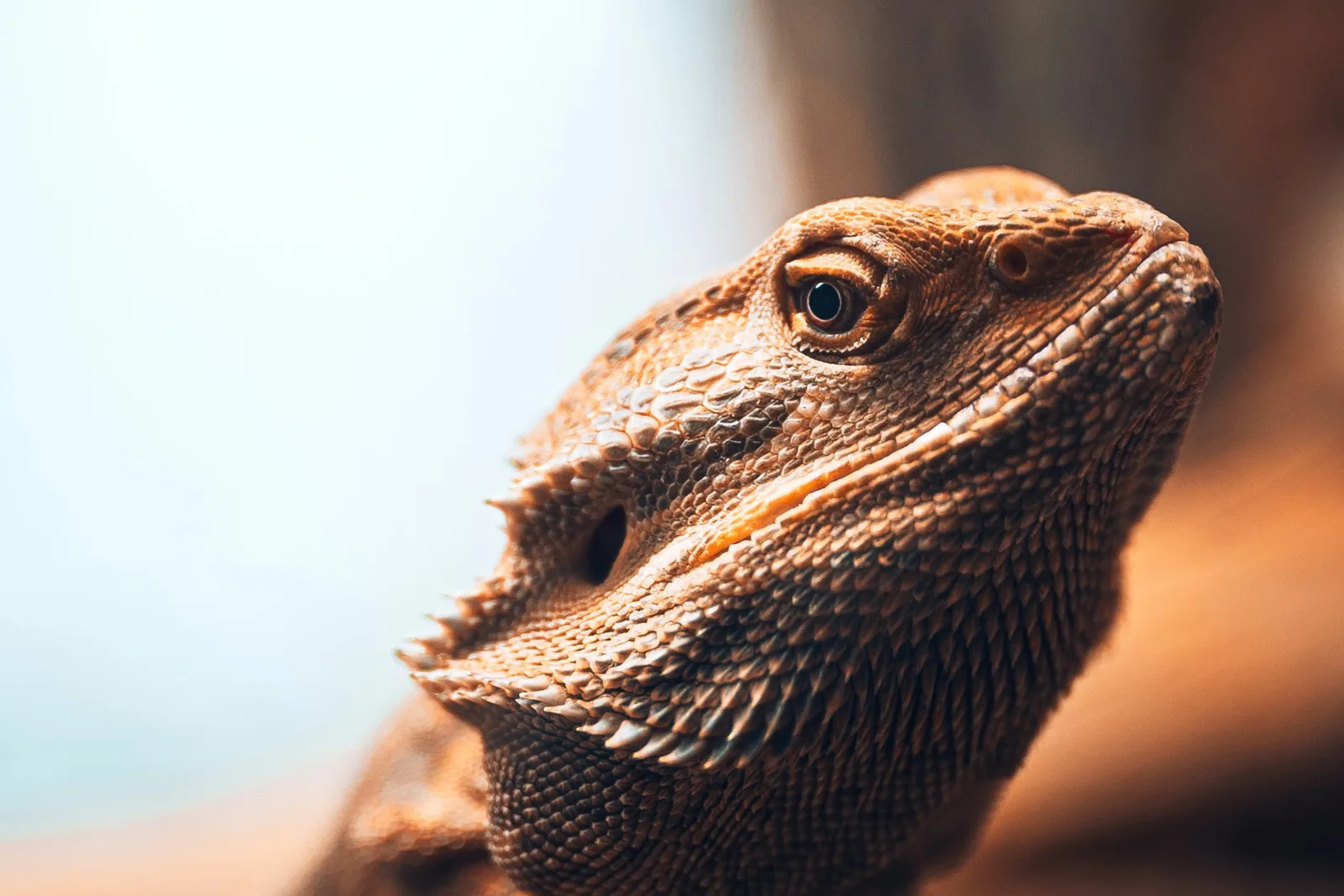
 Photo: stefzn on Unsplash
Bearded Dragoncare guide
Pogona vitticeps
A bearded dragon needs a 120 cm vivarium, a basking surface at 40-42 °C, the strongest UVB of any species on bask, and a bowl of greens every day of its adult life. Get those four right and most of what goes wrong with dragons never starts.
Before you buy
A dragon is a daily job for ten to fifteen years: greens every morning, and live insects in your house every week.
- Adult length
- 45-60 cmHead to tail tip
- Lifespan
- 10-15 yr
- Lifetime cost
- ≈ £5,450Highest monthly bill bar chameleons
- Licence
- NoneNot CITES-listed
Know this first
- They need strong light. A dragon without good UVB develops metabolic bone disease within months. It is the commonest serious illness in the species and entirely preventable.
- They are a daily job: greens chopped every morning, insects gut-loaded and dusted, water changed. A snake can be left a week. A dragon cannot.
- They may brumate. Many adults stop eating and sleep for weeks in winter. It looks alarming the first time. Brumation and behaviour covers it.
Lifetime cost, vets, live insects in the house and hygiene: handbook, Before you buy.
Morphs and welfare
bask applies REPTA's Deleterious Gene Policy in full. How the three groups work is in the handbook, Morphs and welfare. These are the bearded dragon rows.
Prohibited: cannot be listed on bask
| Morph | Condition |
|---|---|
| Silkback | No scales. Smooth skin that tears, burns under a basking bulb, dehydrates, sheds badly and has no protection from UVB. |
Breeding guidance: healthy, but not to be paired with
| This morph | Do not pair with |
|---|---|
| Leatherback | another Leatherback. Two copies of the gene produce silkbacks |
A leatherback is a healthy dragon with no welfare note. When you enquire about one you confirm you have read the pairing guidance.
Keeping a silkback breaks no rule. It cannot be advertised on bask, including to rehome it; a reptile rescue is the route. Do not breed from it.
REPTA reviews its list every six months and bask follows each change. Checked against the list published on 6 September 2026.
Buying a bearded dragon
The general seller questions, health checks and quarantine rules are in the handbook, Buying, collection, quarantine. For a bearded dragon, push harder on these.
- Which UVB tube it has been under, how old, and how far away. A juvenile raised under a weak tube may already have early bone disease.
- Whether a faecal screen has been done. Coccidia is common in shop stock.
- What it eats, and whether it takes greens yet.
Check the animal
A firm straight jaw and limbs with no swelling or tremor, straight spine and tail, all toes, bright eyes, no yellow or crusty patches. A healthy dragon holds its head up and watches you; one lying flat and unresponsive under the light is unwell.
UK law
No licence; dragons are not on the Dangerous Wild Animals schedule and not CITES-listed. Australia stopped exporting decades ago, so every UK dragon is captive-bred. Duty of care, business licensing and the release offence: handbook, UK law.
Setting up
120 cm long, a 40-42 °C basking surface, and the strongest UVB of any species on bask.
The vivarium
Long, bright, hot at one end
| Stage | Dragon | Minimum vivarium | Notes |
|---|---|---|---|
| Hatchling | 10-20 cm | 90×45×45 cm | Or the adult viv with the basking spot set right |
| Juvenile | 20-40 cm | 120×60×60 cm | Adult size inside a year |
| Adult | 45-60 cm | 120×60×60 cm | 150 or 180 cm is better for a big male and gives a real gradient under a hot bulb |
A wooden vivarium with a glass front holds the heat and takes a bulb and tube in its ceiling. Glass tanks with mesh tops lose too much heat for a 40 °C basking surface in a British room. Sixty centimetres of height gives room to mount the bulb safely over a raised platform. Keep dragons singly; two of any sex will fight or bully.
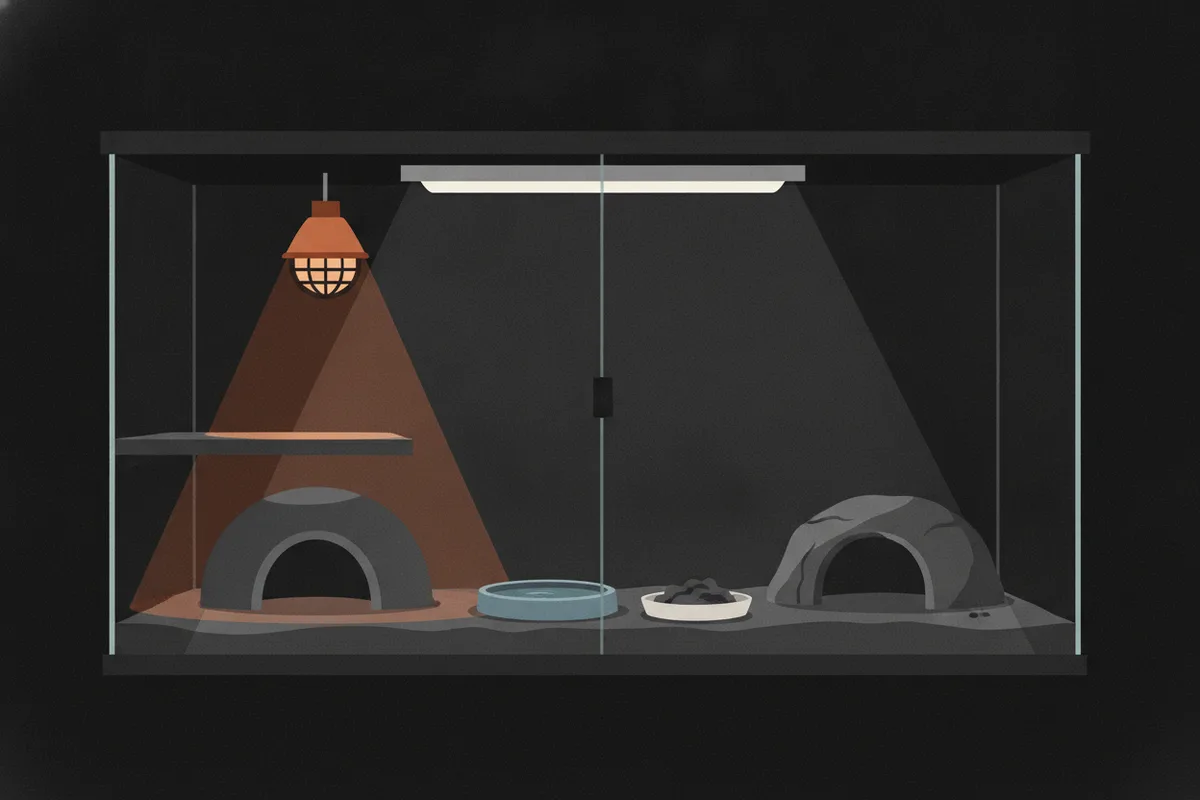
Enclosure types, ventilation, locks: handbook, The enclosure.
Heat and light
The hottest basking spot on bask, and the strongest UVB
Dragons bask in full Australian sun. The range is wider than for any snake.
| Zone | Target | Notes |
|---|---|---|
| Basking surface | 40-42 °C | Infrared gun on the platform |
| Warm-end air | 32-35 °C | |
| Cool-end air | 24-27 °C | |
| Night | 18-22 °C | All lights off. Night heat only if the room falls below about 16 °C |
A halogen basking bulb on a dimming stat, guarded, over a platform at one end. Dragons take heat from above; a heat mat does almost nothing for them. An on/off stat makes a halogen flicker and burn out in weeks, so the dimming stat is not optional. Check the platform surface with the gun after any bulb change: a dragon will sit on a surface that is burning it.
UVB
Dragons make vitamin D3 under UVB and use it to absorb calcium. Without it the calcium comes out of their bones. Fit a 12 % T5 high-output tube (14 % if above mesh) running two-thirds of the viv over the warm side, inside with a reflector, so the UV Index at the platform is 4-6 with the dragon's back 25-35 cm from the tube. Twelve to fourteen hours in summer, ten to twelve in winter. A dragon that basks flattened with its mouth slightly open is using it correctly.
Thermostats, probe placement, tube replacement: handbook, Heat, light and safety.
Humidity, substrate and furniture
Dry, diggable, with a platform and two hides
Humidity looks after itself at 30-40 % under a hot bulb. The mistakes run the other way: a big water bowl at the warm end, wet substrate, or misting the whole viv push it up and invite respiratory infection. Keep the water dish small and at the cool end.
Wild dragons dig. Give 8-10 cm of topsoil and play sand, about 60:40, which holds a burrow when lightly damp underneath and stays dry on top. Slate tiles at the basking end hold heat and clean easily. Never calci-sand, coloured sand, wood chips or walnut shell; all get eaten and all can impact. Feed insects from a dish, and keep hatchlings under three months on tile or paper until they eat confidently.
- A raised basking platform (flat rock, slate, cork ledge) big enough for the whole dragon, under bulb and tube.
- A hide at each end, so it can get out of the light at either temperature.
- A stout branch or second ledge. Dragons climb and like a vantage point.
- A shallow water dish changed daily. Many never drink from it; they take water from greens and from a ten-minute lukewarm bath once a week, which also helps them pass droppings.
Humidity: handbook, Humidity. Substrate compared: handbook, Substrate. Hides and water: handbook, Hides, cover and water.
The first weeks
Put it straight onto the basking platform with the lights on, then handle it as little as you can for a week.
Bringing it home
A ventilated tub with a towel, in an insulated box at 22-28 °C, straight onto the basking platform with the lights on. Handle as little as possible for a week. Greens every morning and a few dusted insects; remove uneaten insects before lights out. Black bearding and glass surfing for a few days is normal.
Running the enclosure empty first, quarantine and the first fortnight for any reptile: handbook, The first weeks.
Handling
The most handleable reptile on bask
- One hand under the chest, the other under the back legs and tail. Never by the tail or a leg.
- 10-20 minutes, after it has basked and before the evening. A cold dragon cannot digest.
- Approach from the front and low. A shadow from above is a bird.
Growing up
Mostly insects while it's young, mostly greens once it's grown, and calcium on most feeds.
Feeding
Insects when young, greens when grown
The ratio flips as a dragon grows. Feeding an adult like a hatchling produces the fat, short-lived dragons that fill rescue centres.
| Age | Insects | Greens | Ratio |
|---|---|---|---|
| Hatchling, 0-3 months | 2-3 feeds a day, as many as eaten in 10 min | Offered daily | 80 % insect |
| Juvenile, 3-12 months | Once a day | Daily, bigger bowl | 60 % insect |
| Adult | 2-3 times a week | Every day | 80 % greens |
| Every day | Sometimes | Never |
|---|---|---|
| Spring greens, rocket, watercress, dandelion, lamb's lettuce, butternut squash, grated carrot, pepper | Kale, cabbage, courgette, sweet potato, a little berry or mango | Iceberg (nothing in it), spinach and chard (bind calcium), avocado, rhubarb, onion, citrus |
Crickets, locusts and dubia roaches as staples; mealworms and waxworms as occasional treats. No insect wider than the gap between the dragon's eyes. Gut-load for a day, dust with plain calcium at most feeds and a multivitamin weekly. Never wild-caught insects, and never fireflies, which are lethal.
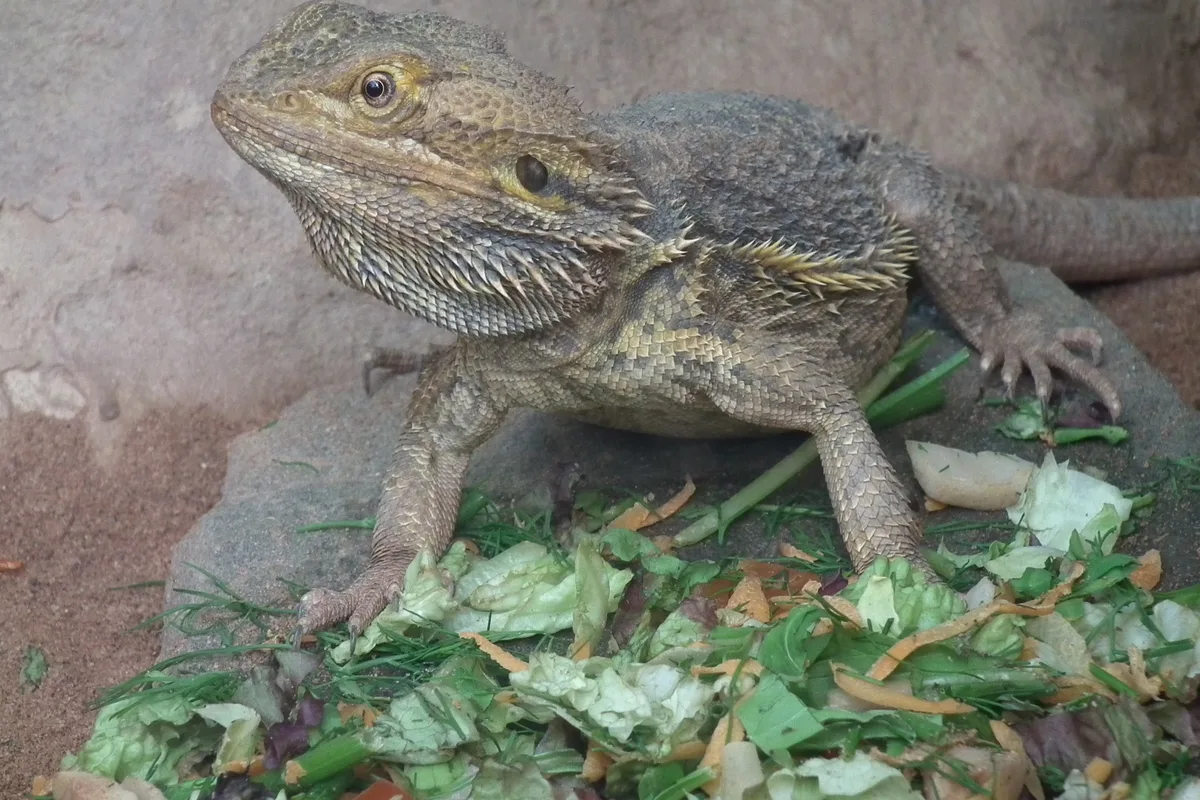

Keeping live insects, gut-loading, supplements: handbook, Food you store or keep alive.
Shedding
In patches, over days
A dragon sheds in pieces: a patch on the head one week, a leg the next. Juveniles every few weeks, adults a few times a year. Never pull it. A lukewarm bath once or twice a week during a shed loosens what is ready. Check toes and tail tip; rings of old shed there tighten as the dragon grows and can cost it the tip. Soak and ease; a ring that will not shift is a vet visit.
Adult life
A winter slowdown isn't illness. A soft jaw, swollen limbs or tremors mean a vet.
Brumation and behaviour
The winter slowdown, and what the colours mean
From their first or second winter many dragons brumate: they eat little or nothing, sleep in a hide for days, and stop basking. It can last weeks or three months and it is not illness. Weigh first; a dragon should lose only a few percent through brumation. Get a faecal check before the first one, because parasites that are harmless in a feeding dragon multiply in a sleeping one. Shorten the day to 8-10 hours, keep the UVB and bulb running while it is awake, offer water and a weekly bath, and never force food. Juveniles under a year should not brumate; a young dragon that stops eating is unwell until proven otherwise.
| Behaviour | What it means |
|---|---|
| Black beard | Stress, threat, or a male in season. Persistent with no cause means the setup is wrong |
| Arm waving | Submission. Common in juveniles and any dragon that can see another |
| Head bobbing | Dominance or courtship |
| Glass surfing | Wants out: viv too small, too hot, or it can see its reflection or another dragon |
| Gaping while basking | Normal; regulating temperature |
Health
What dragons actually get
| Problem | Why dragons get it | What to do |
|---|---|---|
| Metabolic bone disease Soft jaw, swollen limbs, tremors, dragging back legs, kinked spine | Not enough UVB or calcium. The commonest serious illness in the species | Vet. New tube, calcium every feed. Early damage reverses; a bent spine does not |
| Impaction Straining, no droppings, swollen belly | Eaten substrate, oversized insects, mealworms fed to juveniles, or a cold cool end | Warm bath, gentle belly massage. No droppings in 48 h is a vet |
| Yellow fungus Yellow crusty patches that spread and do not shed | A contagious fungal infection, often from a new animal | Vet, urgently. Isolate. Treatable early, usually fatal late |
| Coccidia Runny foul droppings, weight loss while eating | Common in shop stock | Faecal screen, then treatment |
| Tail rot Dark dry tail tip spreading upwards | Retained shed, a bite, a fall | Vet. Untreated, the tail goes |
| Egg binding (females) Digging with no eggs, straining, lethargy | Females lay without a male. No laying site, low calcium or a cool viv stops them | Laying box of damp sand and soil 15 cm deep. Straining with nothing laid is a same-day vet |
| Obesity Fat pad at the tail base, armpit folds | An adult fed like a juvenile | Adult ratio: greens daily, insects two or three times a week |
Respiratory infection, mites, mouth rot, burns and the same-day signs: handbook, Health. Finding a vet: handbook, Vets and insurance.
Where the advice has changed Older advice you might still come across, and what we back instead
Bearded dragon care has changed more than any other species here, mostly around light. You'll still see some of these on older care sheets and in shop advice. We've looked at both sides, and this is what we back.
| Older advice | What we back | Why |
|---|---|---|
| A 10 % T8 tube or a compact coil bulb is enough | 12 % T5 high-output, two-thirds of the viv, UVI 4-6 | T8 and coil bulbs give a fraction of the output at the distances a dragon sits. Most bone disease we see is in dragons under the old lighting |
| Basking spot 35-38 °C | 40-42 °C on the surface | Measured with a gun on the platform, not a dial in the air. Dragons digest and thermoregulate properly at the higher figure |
| Loose substrate causes impaction; use reptile carpet or tile only | An arid soil and sand mix, deep, plus tile at the basking end | Impaction comes from eating substrate with food, oversized insects and a cold viv. A firm soil mix on a warm, dish-fed dragon lets it dig without the risk of pure sand. Reptile carpet harbours bacteria and catches claws |
| Adults need insects daily | Adults 80 % greens, insects two or three times a week | Daily insects produce obese, fatty-livered adults. Wild adults are mostly herbivorous |
| A red or blue night bulb for night heat | Lights off at night, no heat unless the room drops below 16 °C | Coloured bulbs disrupt sleep. A night drop is natural and dragons are fine to 16 °C |
| Two females can share a viv | Keep dragons singly | Females compete quietly for the basking spot and one loses. Cohabiting is the second commonest cause of injury after bad heat |