

Hypo Corn Snakes for sale in the UK
A hypo corn snake keeps the normal pattern with far less black, so the reds and oranges look brighter while the eyes stay dark. Turn it over before you buy: grey or brown belly checkers where a normal has true black are the surest sign.
- Visuals
- £100
- 3 for sale
- Hets
- £100
- 1 for sale
Hypo corn snakes available now

About the Hypo gene
Hypo is short for hypomelanistic. It makes the black in a corn snake lighter rather than removing it. Whites, oranges and reds appear cleaner and brighter while the eyes remain dark. This gene is found among a long list of hobby staples like Phantom and Ghost.
Appearance
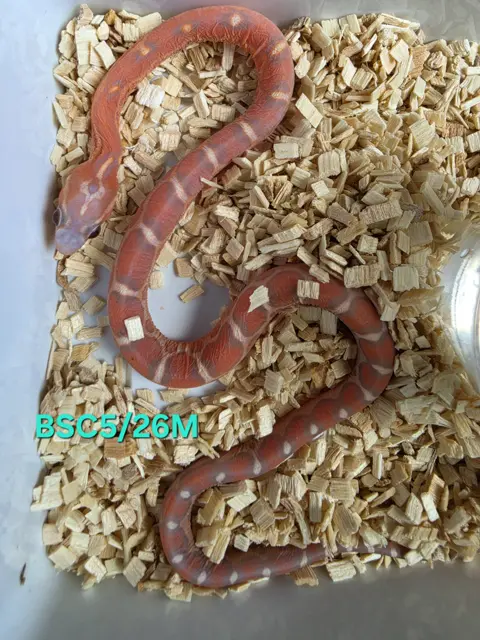
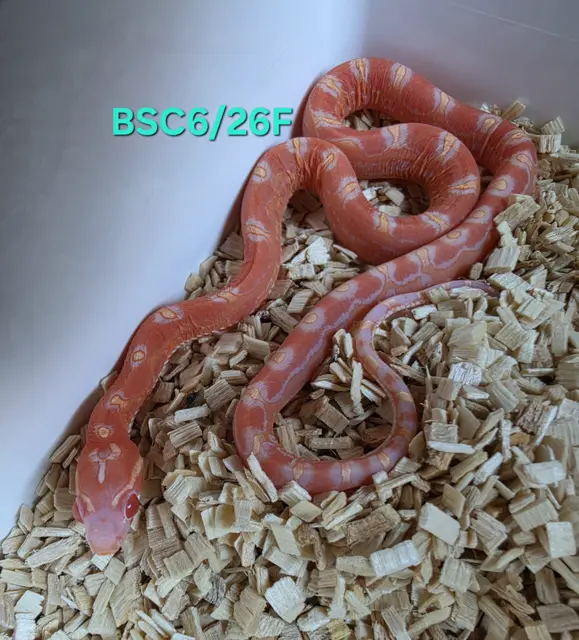
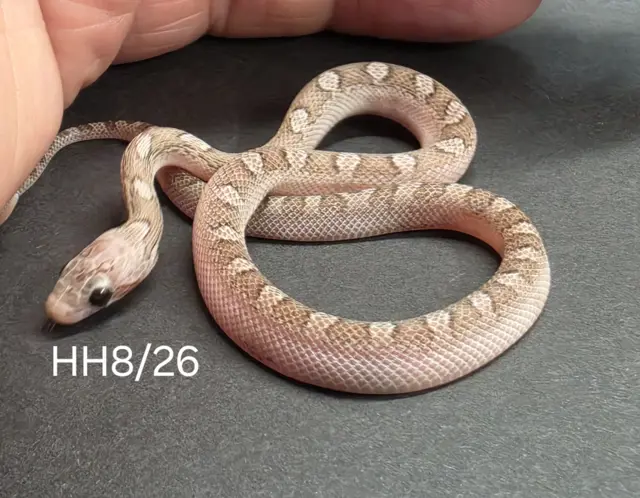
The ordinary corn snake layout remains for a hypo, including the same saddles, the usual head pattern, and a checkered belly. Only the dark pigment changes. The snake's body runs in shades of red and orange, with tan or grey sometimes appearing. The head looks brighter or lighter. Where the black borders around the saddles survive, they are brown or grey and stay narrow and reduced. To check against a normal, the belly is the most reliable. A hypo's checkers are brown, charcoal or grey, while a normal corn has true black checkers. As the snake matures, the saddle colour can creep into them. Around a black pupil, the eyes stay dark and usually match the saddle colour. Animals vary a great deal. Some look like a normal corn with the black knocked back, while others pass for an amel at a glance until you see the dark eyes because they carry so little melanin.
Genetics
Because Hypo is recessive, a normal corn snake appearance is seen in a Het Hypo, 50% Het Hypo, 66% Het Hypo or Pos Het Hypo. The hobby uses the name Hypo A to distinguish it from Sunkissed, which is a separate hypo-like gene first known as Hypo B. Strawberry and Christmas are allelic to Hypo, which anchors its own complex. A snake with one Hypo and one Strawberry copy looks somewhere between the two and is sold as Hypo Strawberry or Hypo Berry. Many established combinations include Hypo: Ghost pairs it with anerythristic, Phantom with charcoal, Amber with caramel, and Crimson with Miami, while Hypo Snow adds it to amel and anery. In the 1980s, Kathy and Bill Love proved it from the offspring of a corn snake seen at George Van Horn's Reptile World in Florida, and John Cole worked the same mutation alongside them.