

Amelanistic Corn Snakes for sale in the UK
An amelanistic corn snake has no black, brown or grey anywhere, leaving red eyes and a body of orange, red, yellow and white. It is the oldest colour mutation in the species and the base of snow, blizzard and opal, so a good amel keeps paying off in later projects.
- Visuals
- £100
- 1 for sale
- Hets
- £100
- 2 for sale
Amelanistic corn snakes available now
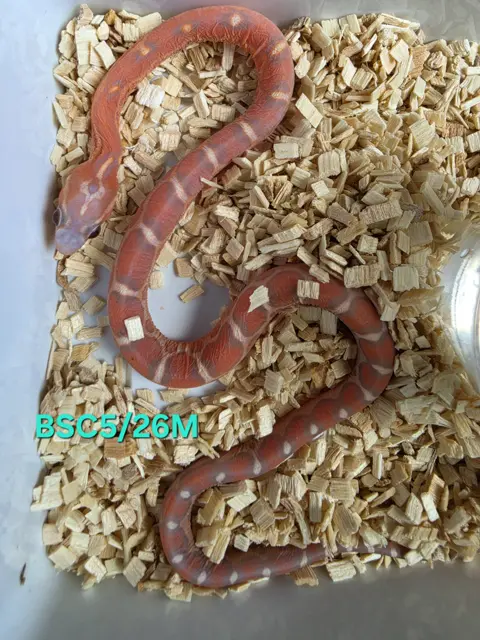
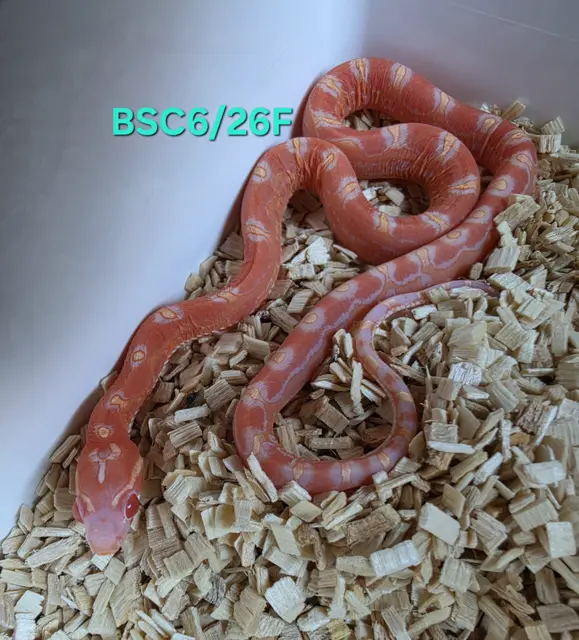
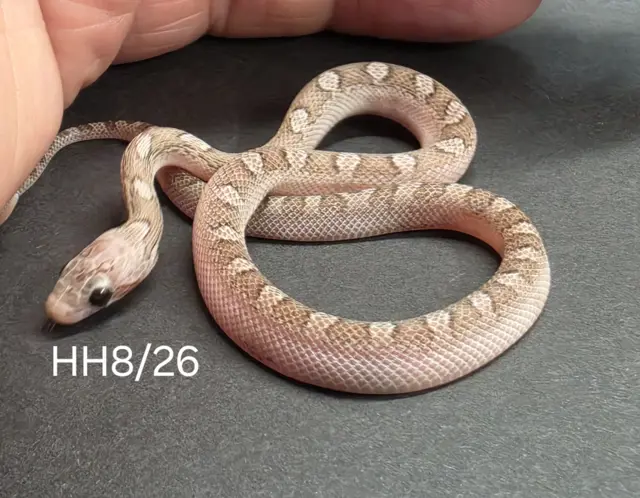
About the Amelanistic gene
By removing every trace of grey, brown and black pigment from a corn snake, the Amelanistic mutation leaves an animal with red eyes and colours of white, yellow, red and orange. This is the oldest colour mutation known in the species. Many of the brightest and palest lines in the hobby start from it, including candy cane and snow.
Appearance
The snake's body colour ranges from a duller version of the same to a vivid red or orange. There is no black, brown or grey anywhere on the animal, and the saddles are white, yellow or cream. While the eyes are red, a small dark mark often sits at the edge of the pupil. This is part of the eye's own structure and not leftover melanin. The corn snake's checkerboard is kept on the belly, but the checks are clear, white or yellow instead of black, and red or orange sometimes bleed through. As the snake matures, yellow often comes in along the neck and chin. Instead of brown, the usual corn snake head pattern of a V behind the eyes and a dark band across the nose appears in yellow, red or orange.
Genetics
Because Amelanistic is recessive, any snake that is not a visual amel looks like a normal corn snake. This includes the het, 50% het, 66% het and possible het forms. The mutation is in the OCA2 gene rather than the tyrosinase gene. A 2015 study traced this to a retrotransposon in the eleventh intron of the gene. This is why corn snake amel is a tyrosinase-positive albinism even though the hobby calls it albino. A separate reduced-melanin gene called Ultra was brought into corn snakes by interbreeding with a ratsnake. It sits at the same locus. A corn snake carrying one copy of each is an ultramel, which is a third, intermediate look. Amel is the base of several long-running combinations: snow pairs it with anerythristic, blizzard with charcoal and opal with lavender. The pattern and white borders are pushed further by selectively bred forms such as candy cane and reverse okeetee. In 1961, Bechtel first bred a homozygous amel true from a snake caught wild in North Carolina eight years earlier.
Known issues
Because Amelanistic corn snakes lack melanin in both their skin and eyes, they are more sensitive to UVB and bright light than a corn snake with normal pigmentation. Modest lighting and plenty of cover let the snake get out of it when it needs to.