

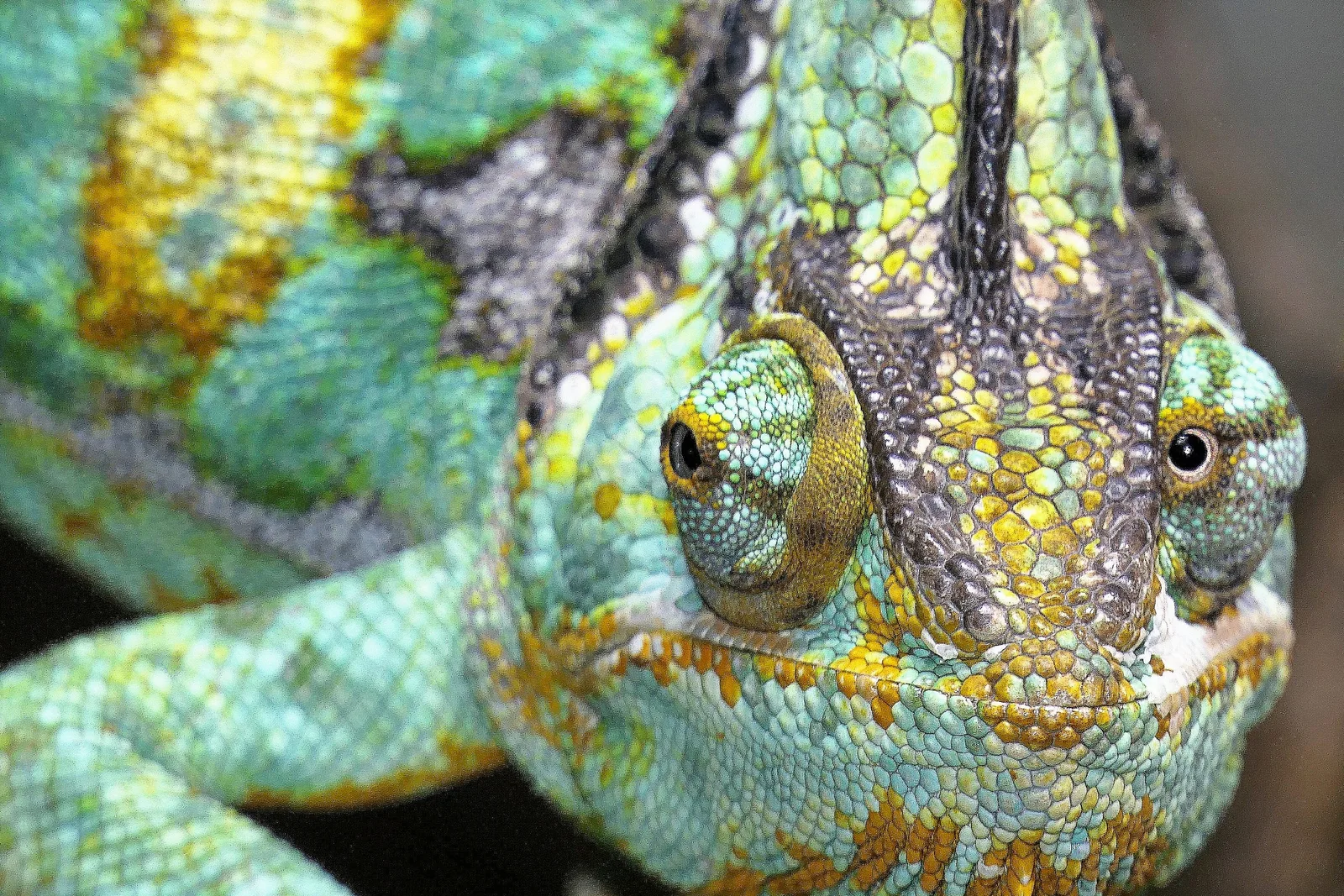
 Photo: Rolf Dietrich Brecher, CC BY-SA 2.0
.jpg)
Chameleoncare guide
Chamaeleo calyptratus · Furcifer pardalis
A chameleon needs a tall mesh or hybrid enclosure, a basking bulb and strong UVB mounted outside the top, an automatic mister, a dripper, dense planting, live insects every day or two, and a keeper who accepts that it will never want to be held. It is the only specialist-tier animal on bask.
Before you buy
It's a display animal you mustn't handle, and you can't leave it for a weekend.
- Adult length
- 35-60 cmMales larger
- Lifespan
- 5-8 yrFemales shorter
- Lifetime cost
- ≈ £3,300Highest monthly bill on bask
- CITES
- Annex BNo Article 10 needed
Know this first
This covers the veiled (Yemen) chameleon, Chamaeleo calyptratus, most of the UK market, and notes where the panther, Furcifer pardalis, differs. Jackson's chameleons are montane, live-bearing and want cooler, wetter conditions; this guide does not cover them.
- They do not want to be handled. A chameleon is a display animal. Regular handling stresses it, and stressed chameleons stop eating, darken, and die of things they would otherwise shrug off.
- They need daily attention: insects every day or two, misting several times a day, a dripper topped up. A chameleon cannot be left for a weekend.
- They drink only droplets. A chameleon dies of dehydration beside a full water bowl.
- Females lay eggs without a male and die if they cannot. A laying bin is not optional. Females also live shorter lives than males for that reason.
Lifetime cost, vets, live insects in the house and hygiene: handbook, Before you buy.
Morphs and welfare
Chameleons are not bred into morphs the way snakes and geckos are. Veiled come in a few colour lines (translucent, high yellow, piebald); panthers are sold by locale, the region of Madagascar their line descends from (Ambilobe, Nosy Be, Sambava). None carries a welfare condition and no chameleon is on REPTA's list. A panther listing should name the locale and say whether it is pure or a cross; that is honesty, not welfare. Checked against the list published on 6 September 2026.
Buying a chameleon
The general seller questions, health checks and quarantine rules are in the handbook, Buying, collection, quarantine. For a chameleon, push harder on these.
- Captive-bred or wild-caught. Wild-caught panthers arrive dehydrated and parasitised and many do not survive the first year. Ask for the breeder.
- Sex, and if female, whether she has laid. Veiled males have a spur on the back foot from hatching.
- What UVB and mister it has been under. A juvenile raised under a weak tube may already have early bone disease.
Check the animal
Both eyes open, full and turreting; a straight casque and limbs with no bowing; a firm grip with all feet; bright colour; no swelling at the throat or joints; white, not orange, urates in the enclosure. A chameleon sitting with its eyes closed in daylight is unwell whatever the seller says.
UK law
No licence; not on the Dangerous Wild Animals schedule. CITES Annex B, so no Article 10 certificate for a UK sale, but keep the captive-bred paperwork; wild panthers were imported into Europe until recently. Duty of care, business licensing and the release offence: handbook, UK law.
Setting up
Tall mesh or hybrid, heat and UVB outside the top, an automatic mister and a dripper.
The enclosure
Tall, airy, planted to the top, with drainage
| Stage | Chameleon | Minimum enclosure | Notes |
|---|---|---|---|
| Under 6 months | 5-20 cm | 45×45×90 cm | Smaller helps a juvenile find food and water |
| Adult female | 25-35 cm | 60×60×120 cm | |
| Adult male | 45-60 cm | 60×60×120 cm | 90×60×120 for a big male veiled |
Chameleons need moving air, so the enclosure is mesh or a hybrid with solid sides and a mesh front and top. In a British house full mesh loses too much heat and humidity; a hybrid is the better choice here. Height is the point: it climbs to bask near the top and retreats down into foliage to cool. Several litres of water a day go in from the mister, so the base needs a drainage tray or a bulkhead and bucket. Standing water breeds bacteria and mosquitoes.
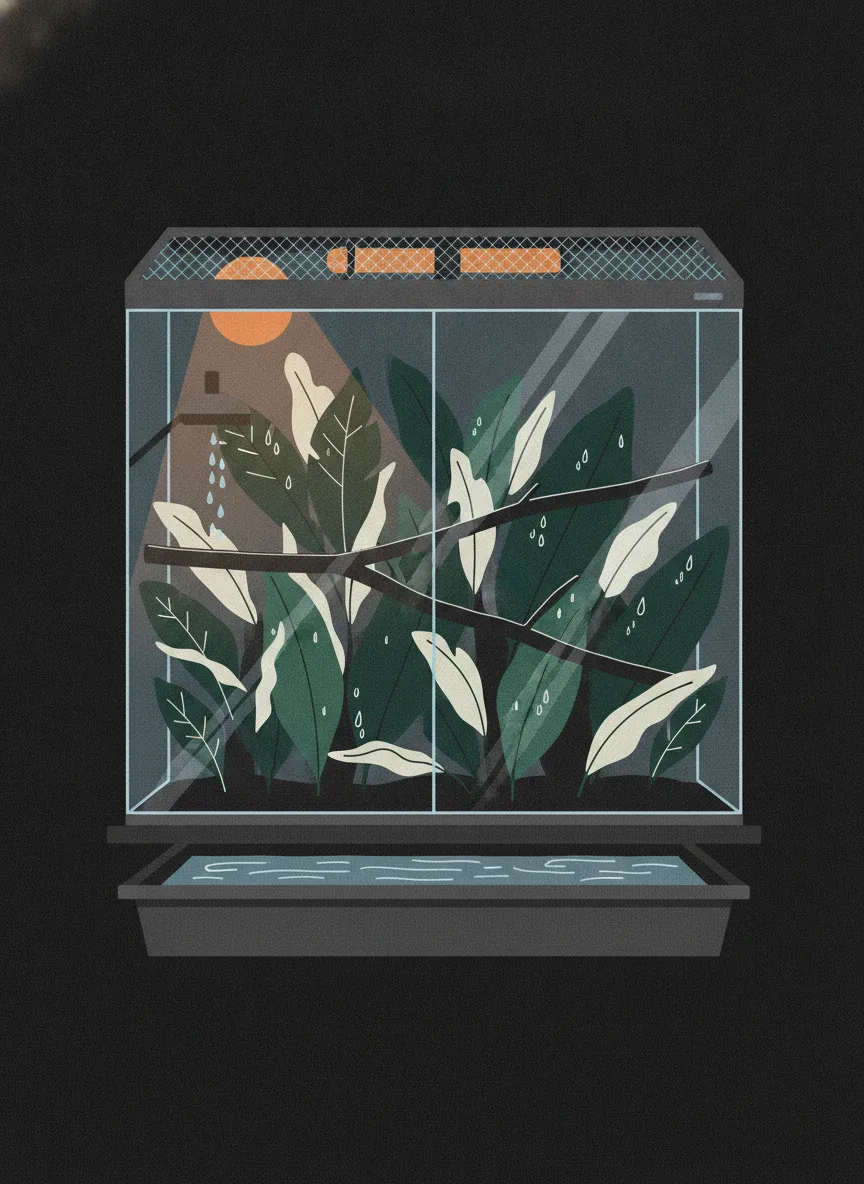
Enclosure types, ventilation, locks: handbook, The enclosure.
Heat and light
Basking at the top, cool foliage below, strong UVB from above
| Zone | Veiled | Panther | Notes |
|---|---|---|---|
| Basking perch | 32-35 °C | 28-30 °C | Gun on the branch under the bulb |
| Mid enclosure | 24-28 °C | 23-26 °C | |
| Lowest foliage | 22-24 °C | 21-23 °C | The retreat |
| Night | 16-20 °C | 16-20 °C | A real drop matters. No night heat unless the room falls below 15 °C |
A halogen basking bulb on a dimming stat mounted outside the mesh top, with the basking perch 20-30 cm below it. Never inside where a chameleon can climb onto it; burns to the casque and back are a common injury. No ceramic at night, no heat mats ever.
UVB
Zone 3. A 6 % T5 tube on the mesh top beside the bulb (12 % if the perch is further away or the mesh is dense) for a UV Index of 3-4 at the basking perch, 12 hours, with foliage below giving complete shade so it can choose its dose. Without it a chameleon develops bone disease within months and a female cannot form eggshells. Replace the tube on the date, not when it dims.
Thermostats, probe placement, tube replacement: handbook, Heat, light and safety.
Water, humidity and planting
Droplets several times a day, and leaves to hold them
- An automatic misting system, two or three sessions a day of a minute or two, one before lights-on and one in the evening. Hand misting works for a while; nobody keeps it up for six years.
- A dripper over the plants for an hour or two a day, so there is always somewhere to drink between mists.
- Humidity 50-70 % between mists, 100 % during them, a fogger at night if the room is dry. The enclosure must dry between sessions; permanently wet foliage causes respiratory and skin infections.
Sunken eyes, skin that stays tented when pinched, and orange or yellow urates (the white part of the droppings turned dark). Check the mister runs and the dripper lands where the chameleon sits.
No substrate: a bare drainage base or a bioactive layer with plants. Dense live planting (pothos, schefflera, ficus, hibiscus, washed and repotted in plain compost) holds droplets, gives shade, and a veiled eats the leaves. Horizontal branches at several heights and thicknesses, including one under the bulb at the right distance and one in shade; feet need a branch they can wrap. And sight barriers: a chameleon that can be seen from all sides, or can see a mirror or another chameleon, is a stressed one.
Humidity: handbook, Humidity. Cover for tree-dwellers: handbook, Hides, cover and water.
The first weeks
Put it on a branch in the running enclosure, then leave the room. No handling at all.
Bringing it home
A ventilated box with a branch to grip, covered so it is dark, at 20-25 °C, straight onto a branch in the running enclosure, then leave the room. No handling at all. Insects daily from day one. Bright colour and open eyes within a week mean it has settled; still dark with closed eyes after ten days means unwell.
Running the enclosure empty first, quarantine and the first fortnight for any reptile: handbook, The first weeks.
Handling and stress
As little as possible
A chameleon reads a hand from above as a bird. Handling is for a vet visit, a cage clean or a laying-bin check. When you must, offer a stick or your hand from below and in front and let it walk on; never pull it off a branch, its grip is stronger than its toes. Keep it short and put it back on a branch. Dark, mottled, gaping or hissing means stop. Strictly solitary: two in one enclosure, or two that can see each other, is a welfare problem however big the cage.
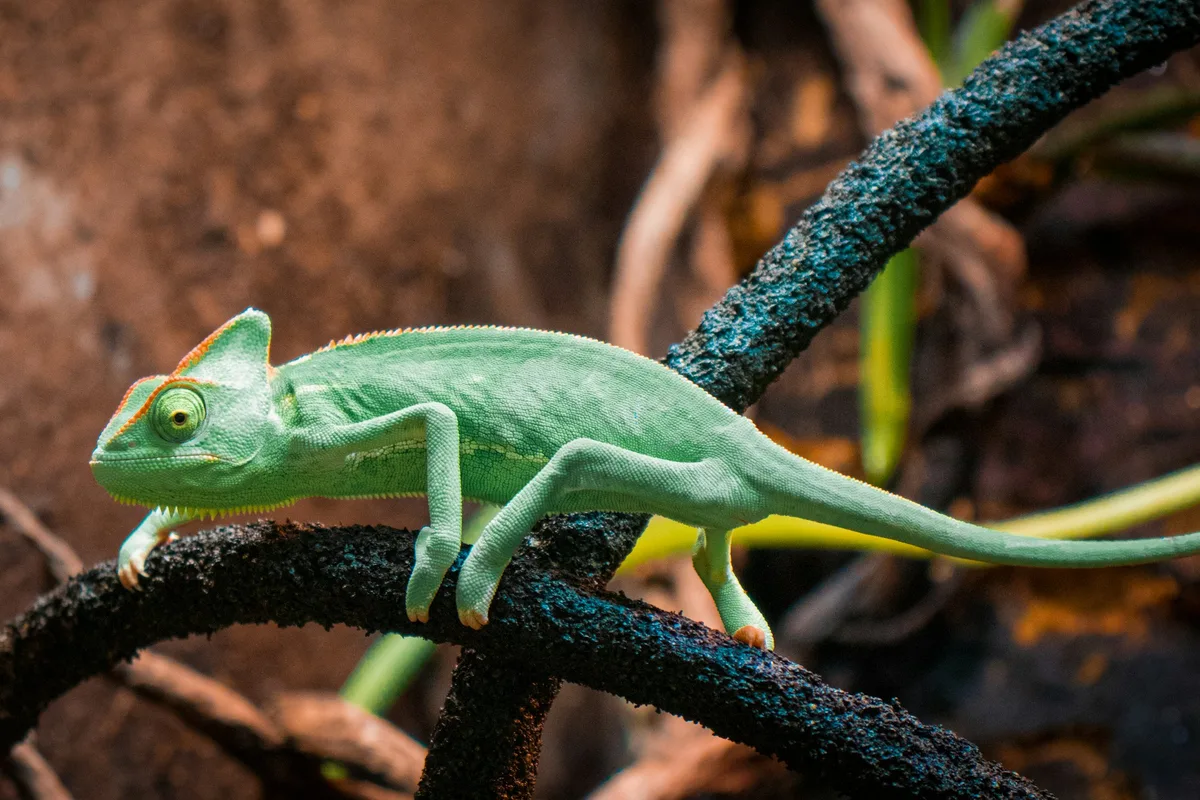
Growing up
Live insects every day or two, calcium at most feeds, and droplets to drink, never a bowl.
Feeding
Live insects, varied, on a rota
| Age | How often | How much |
|---|---|---|
| Under 6 months | every day | As many small insects as eaten in a few minutes |
| 6-12 months | every day | 8-12 insects |
| Adult | every 2 days | 5-8 insects; adult females on the lower end, to slow egg production |
Crickets, locusts and dubia as staples; silkworms, hornworms and black soldier fly larvae for variety; waxworms rarely. No insect longer than the width of the head. Veiled chameleons also take leaves and a little soft vegetable; panthers do not.
Plain calcium at most feeds, calcium with D3 twice a month, multivitamin twice a month. More is not better: too much D3 and vitamin causes oedema and gout. Gut-load every insect for a day.
Keeping live insects, gut-loading, supplements: handbook, Food you store or keep alive.
Shedding
In patches, quickly, if the misting is right
Pieces over a day or two, juveniles every few weeks, adults every couple of months. A good shed is off in big flakes within a day. Skin hanging for days around the eyes, feet and tail means the enclosure dries too much between mists. Lengthen the evening session; never pull.
Treating stuck shed: handbook, Health.
Adult life
Every adult female makes eggs without a male, so keep a 30 cm laying bin in for life.
Health
What chameleons actually get
| Problem | Why chameleons get it | What to do |
|---|---|---|
| Egg binding (females) Restless, off food, swollen, pacing the floor, then lethargic | Every adult female makes eggs without a male. No laying bin, or one too shallow or dry | Same-day vet after a day of digging with nothing laid. Prevention: a bin of damp sand and soil at least 30 cm deep, always in from six months old, and lighter feeding |
| Metabolic bone disease Bowed legs, soft or curved casque, rubbery jaw, falls | Weak UVB, no calcium, or the wrong supplements | Vet. New tube, plain calcium at most feeds. Early cases recover |
| Dehydration and gout Sunken eyes, orange urates, swollen joints | Not enough drinkable water; too much protein and D3 | Fix the mister and dripper. Gout is hard to reverse |
| Respiratory infection Gaping head-up, bubbles, clicking | Wet and cool with no airflow, often in a glass tank | Vet. More ventilation, longer dry periods |
| Oedema Soft swelling under the throat and at the joints | Too much vitamin and D3 | Cut to the rota. Vet if it does not settle |
| Eye problems A closed or sunken eye | Dehydration, vitamin A, debris under the turret | Longer misting; vet if closed more than a day |
| Burns Grey or black patches on the casque or back | A bulb inside the cage or too close | Vet. Bulb outside, and higher |
Mites, mouth rot, parasites, impaction and the same-day signs: handbook, Health. Finding a vet: handbook, Vets and insurance.
Where the advice has changed Older advice you might still come across, and what we back instead
Chameleon care has moved furthest from the pet-shop era, and the old advice is still on the shelves. You'll still see some of these on older care sheets and in shop advice. We've looked at both sides, and this is what we back.
| Older advice | What we back | Why |
|---|---|---|
| A glass tank with a mesh lid | A mesh cage, or a hybrid in a British house | Chameleons need moving air. Glass tanks gave still, wet air and respiratory infections. Full mesh is the American answer; in a cool house a hybrid holds enough warmth and humidity while still breathing |
| A water bowl, or hand misting twice a day | An automatic mister plus a dripper | They drink droplets, not standing water, and hand misting fails within months. Dehydration and kidney failure were the commonest chameleon deaths |
| Dust every insect with everything | Plain calcium most feeds; D3 and multivitamin twice a month | Over-supplementing causes oedema and gout, which are now seen as often as the bone disease the powders were meant to prevent |
| Handle it daily to tame it | Handle it for vet visits and cleaning only | Chameleons do not tame. Daily handling produces a dark, hunger-striking animal, not a friendly one |
| Females do not need a laying bin unless bred | A 30 cm laying bin always in from six months | Every mature female produces infertile clutches. Egg binding was the leading cause of death in female veileds before laying bins became standard |
| Basking spot 38-40 °C | 32-35 °C veiled, 28-30 °C panther | The higher figures came from bearded dragon sheets. Chameleons overheat and dehydrate at them |