

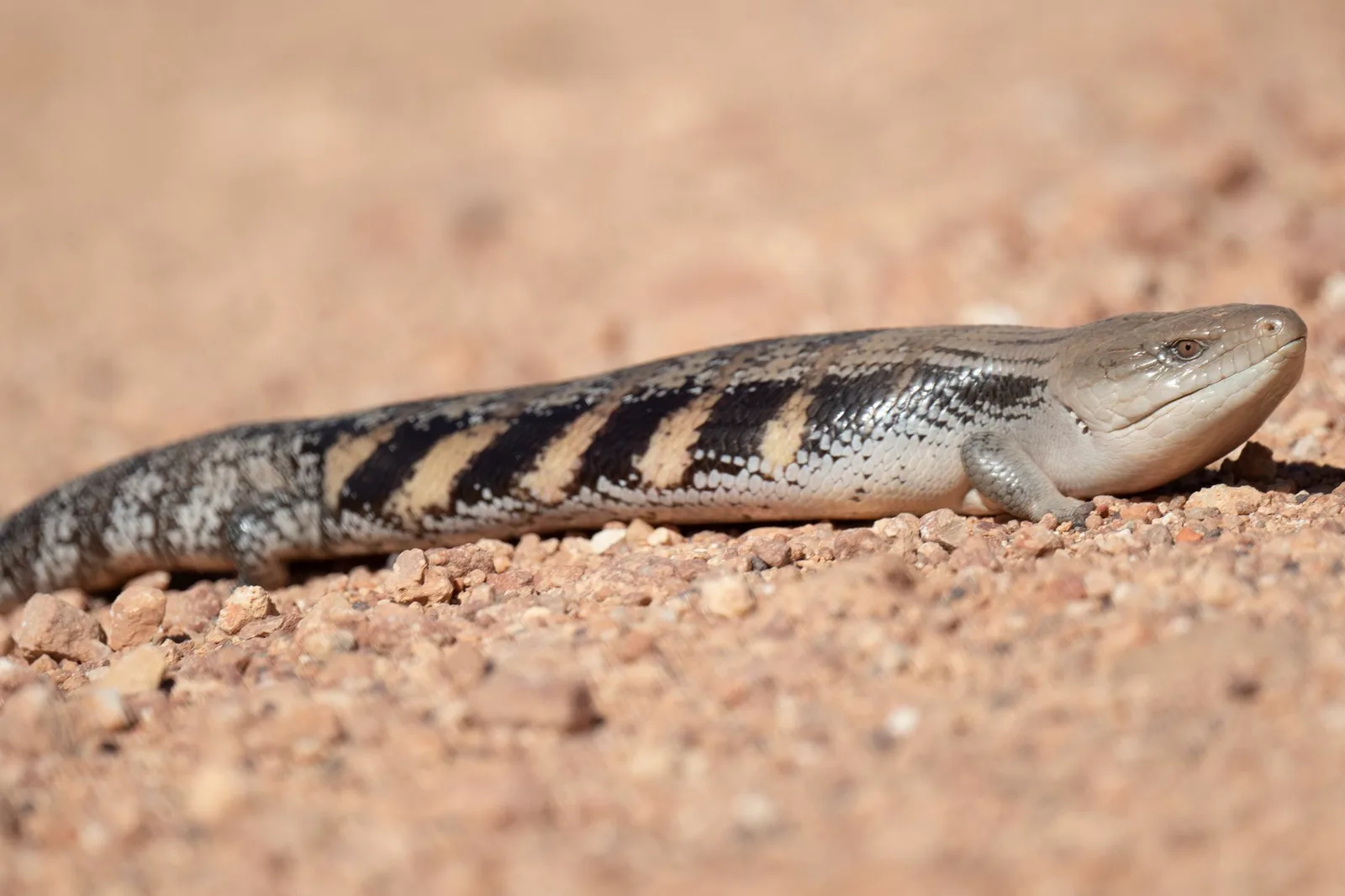
 Photo: Alan Bell, CC BY 4.0
Blue-Tongued Skink care guide
Tiliqua scincoides
A blue-tongued skink needs an enclosure at least 120×75×75 cm, a basking surface at 38-42 °C, UVB, and humidity matched to where it comes from: 40-60 % for a Northern, 60-80 % for an Indonesian form. Find out which one you are buying before anything else.
Before you buy
Find out which form you're buying, and buy one that's captive-bred in the UK. You're signing up for 15-20 years or more.
- Adult length
- 45-60 cmNorthern up to about 60 cm
- Lifespan
- 15-20 yr20+ possible
- Lifetime cost
- ≈ £7,450
- Licence
- NoneNot on the DWA schedule
Know this first
Blue-tongued skinks usually live 15-20 years, and some live longer. Cost, vets and household hygiene are in the handbook. These three points are specific to skinks.
- The form decides the setup. A Northern or Eastern skink needs 40-60 % humidity. An Indonesian form (Classic, Kei, Merauke, Halmahera, Irian Jaya) or a Tanimbar needs 60-80 %. A care sheet that gives one humidity figure is wrong for one of them.
- An adult is 45-60 cm long and burrows, so it needs a large floor, a hot basking stone and UVB. Height matters far less than floor area.
- They put on weight easily. An adult eats once or twice a week and still gains on too much protein. Weigh it monthly.
Lifetime cost, vets, live insects in the house and hygiene: handbook, Before you buy. The RSPCA advises registering with a reptile vet before you get the animal: handbook, Vets and insurance.
Morphs and welfare
bask applies REPTA's Deleterious Gene Policy in full. How the three groups work is in the handbook, Morphs and welfare. These are the blue-tongued skink rows.
REPTA's list has no blue-tongued skink entry, so no skink morph is prohibited on bask and none carries a welfare note or breeding guidance.
Forms are localities
Most of the variation you will see is locality. The form sets the humidity, so identify it before you buy.
| Form | How to recognise it | Humidity |
|---|---|---|
| Northern (T. s. intermedia) | The largest and heaviest, up to about 60 cm. Very tame from generations of captive breeding | 40-60 % |
| Eastern (T. s. scincoides) | 45-60 cm | 40-60 % |
| Classic Indonesian | Solid black forelimbs | 60-80 % |
| Kei Island | Freckling that reaches the head | 60-80 % |
| Merauke | Freckled limbs and a salmon-orange belly | 60-80 % |
| Halmahera | Reddish, with a black and white or black and pink belly | 60-80 % |
| Irian Jaya | Highly variable and taxonomically unresolved | 60-80 % |
| Tanimbar | Hard, glossy silver, grey or yellow scales. Large litters of more than 20 | 60-80 % |
Albino and other pale morphs need less UVB: no more than UVI 3 at the basking spot. A white Northern was listed in the UK at £5,000. Hypo, T+ albino and caramel Northerns are also sold, and we have not assessed them.
REPTA reviews its list every six months and bask follows each change. Checked against the list current on 22 November 2026.
Buying a blue-tongued skink
The general seller questions, health checks and quarantine rules are in the handbook, Buying, collection, quarantine. For a blue-tongued skink, push harder on these.
- Which form it is, and the evidence. Northern, Eastern, Classic Indonesian, Kei, Merauke and the rest need different humidity, and sellers mislabel them.
- Captive-bred where, in which year, and by whom? Ask to see the parents. Buy UK captive-bred: Australia bans export, so any Australian-form skink in the UK is captive-bred, while Indonesian forms are mostly wild-caught imports. Imports often carry parasites, are defensive and may have respiratory or skin infections.
- The feeding record: what it eats, how often, its last shed, and whether a faecal test has been done. Have the vet test a fresh stool for any Indonesian or unknown-origin skink.
- The price. UK shops listed captive-bred Northern juveniles at about £330-£495 in 2025-26. A £60 "baby Northern" is more likely mislabelled, wild-caught or unwell.
Check the animal
Clear eyes and nostrils, a clean vent, a firm body with no visible hips or spine, a straight spine and firm jaw, no retained shed on the toes or tail tip, and no mites in the eye, ear or skin folds.
UK law
No licence to keep one, and skinks are not on the Dangerous Wild Animals schedule. The pygmy blue-tongue (Tiliqua adelaidensis) is CITES Appendix I, listed from 23 February 2023. We found no CITES listing for T. scincoides or T. gigas, and have not confirmed that on Species+, so ask any seller for the captive-bred paperwork. Duty of care, business licensing and the release offence: handbook, UK law.
Setting up
At least 120×75×75 cm, a 38-42 °C basking stone, UVB, and 10 cm of soil to dig in.
The enclosure
Floor area first, one skink per enclosure
| Stage | Skink | Minimum enclosure | Notes |
|---|---|---|---|
| Juvenile | 25-30 cm at sale | Adult enclosure | Fill it with hides, then remove clutter gradually as the skink grows |
| Adult | 45-60 cm | 120×75×75 cm | The RSPCA minimum. 150×90×60 or 180×60×60 cm is recommended |
The RSPCA minimum for one adult is 120 cm long, 75 cm high and 75 cm deep, in solid, sealed, ventilated material, away from draughts and direct sun. ReptiFiles asks for at least 1.1 m² of floor and a footprint at least three times the skink's length. It describes 120×60×60 cm as still falling short, so we treat that older size as too small. Height of 45 cm is enough, or 60 cm if the lamps sit inside.
A wooden vivarium holds heat and humidity through a British winter better than glass. ReptiFiles cites a 2022 Federation of British Herpetologists figure of about 183×122×91 cm. We have not seen the FBH document, so read it as a sign that more space helps. Keep skinks singly: males and females are both territorial and can injure or kill each other.
Enclosure types, ventilation and locks: handbook, The enclosure.
Heat and light
A hot basking stone, a cool end and real UVB
The skink chooses its temperature by moving along the enclosure. Your job is the range and where the probe sits. Put a thermostat on every heat source.
| Zone | Target | Notes |
|---|---|---|
| Basking surface | 38-42 °C | Infrared gun on the stone. Some sources allow up to 45 °C for Northern and Eastern skinks |
| Warm-end air | 29-32 °C | The RSPCA's 30-32 °C "basking zone" is an air reading |
| Cool end | 22-27 °C | |
| Night, Northern and Eastern | 18-22 °C | Lights off. A night drop is natural |
| Night, Indonesian forms | 21-24 °C | Lights off |
Sources disagree on the basking figure mostly because they measure different things. ReptiFiles gives a surface reading by infrared gun, and the RSPCA gives a zone figure. We use 38-42 °C on the stone.
Use a cluster of at least two halogen floods in a ceramic-socket dome over a flat basking stone about 30 cm across. A 75 W lamp suits an enclosure about 60 cm tall, and you adjust the wattage to the temperature the stone reaches. Halogens normally run on a dimming thermostat. Never use a heat rock. Add night heat only if the room is too cold, from a ceramic emitter or radiant panel, which gives no light.
UVB
The only Ferguson-zone listing we found puts the Eastern blue-tongue (T. scincoides) in zone 2, partial sun, with a basking maximum of UVI 1.1-3.0. It lists nothing for T. gigas. The RSPCA asks for UVI 3-5 at the basking spot and ReptiFiles for 3-4. We use UVI 2-4 at the basking spot, falling to 0 in shade, and check it with a UVI meter. An albino or similar pale morph needs no more than UVI 3.
Fit a T5 HO tube about half the enclosure length, in the roof towards the hot end with a reflector and no glass or plastic below it. Run it 12 hours on and 12 off on a timer, and replace it every 12 months. Glass blocks UVB, so do not place the enclosure by a window.
| Tube | Over mesh | No mesh |
|---|---|---|
| 6 % (Arcadia Forest, ReptiSun 5.0) | 16-23 cm | 28-30 cm |
| 12 % (Arcadia Desert, ReptiSun 10.0) | 31-38 cm | 43-45 cm |
Distances run from the tube to the skink's back. They hold for an Arcadia ProT5 or Vivarium Electronics fixture.
Thermostats, probe placement, measuring kit, tube replacement: handbook, Heat, light and safety.
Humidity, substrate and furniture
Humidity to match the form, 10 cm of soil, hides at both ends
| Form | Humidity | Notes |
|---|---|---|
| Northern, Eastern | 40-60 % | Measure at the cool end |
| Classic Indonesian, Kei, Merauke, Halmahera, Irian Jaya, Tanimbar | 60-80 % | Aim for the upper end. Rough belly scales mean it needs more moisture |
Raise humidity with at least 10 cm of substrate. Mix water in weekly until it is damp, not wet. Mist daily, and keep a humid hide at the middle or cool end, lined with damp sphagnum moss and changed often so it does not go mouldy. Older sheets give Halmahera 80-100 %, and some experts now group it with the other Indonesian forms. Every skink gets a humid hide, whatever its form.
Give at least 10 cm of natural soil or a soil and sand mix so the skink can burrow. Use the moisture-retaining end of that range for Indonesian forms. Never use calci-sand, beech chips, corn cob or crushed walnut shell, which all carry an impaction risk. We found no source on aspen bedding.
Put a hide at the hot end and one at the cool end, plus stones and branches to climb. Water goes in a large, shallow bowl no more than 7.5 cm deep at the cool end. Change it daily and disinfect it weekly, because skinks often defecate in it. A skink that sits in the water for long periods may have a skin problem or mites.
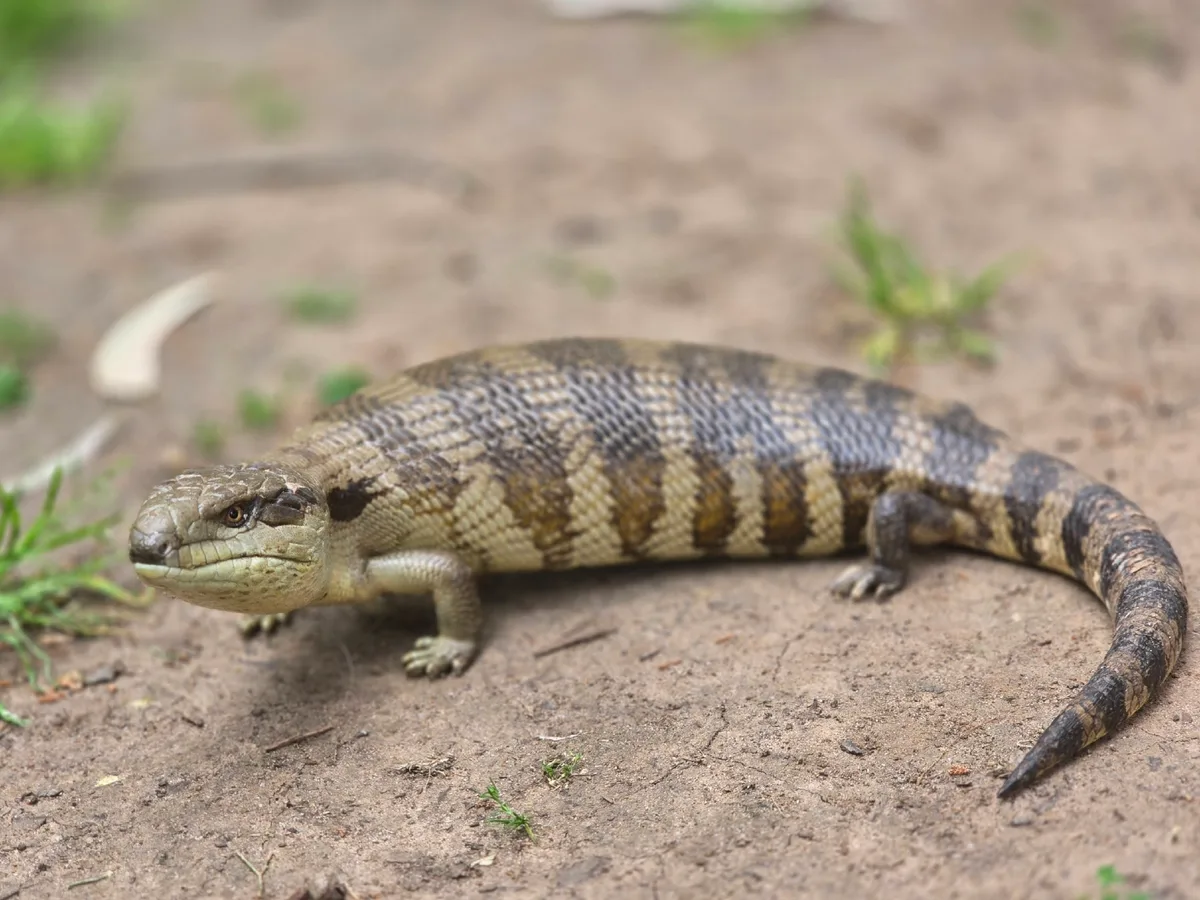
Measuring and fixing humidity: handbook, Humidity. Substrate compared: handbook, Substrate. Hides and water: handbook, Hides, cover and water.
The first weeks
Run the enclosure for a week first, let the skink walk in by itself, and leave it alone for its first week.
Bringing it home
A ventilated tub, with soft paper for a hatchling, kept warm with a heat pack if needed and never overheated, on a short journey, to an enclosure you have run for at least a week. Let the skink walk into the enclosure by itself, then offer food and water on day one. No handling for the first week.
Running the enclosure empty first, quarantine and the first fortnight for any reptile: handbook, The first weeks.
Handling
Scoop with both hands, keep it short
Captive-bred Northerns are described as very tame after generations of breeding. Wild-caught Indonesian skinks are often defensive, and a captive-bred Tanimbar is said to be more tolerant than a wild one.
- No handling for the first week.
- Scoop with both hands and support all four legs. Never grab.
- Keep sessions to about 10-15 minutes so its body temperature does not drop.
- Back off if it retreats or shows its tongue.
- Mind the sharp nails. They snag on carpet and clothing.
- Wash your hands before and after, because of Salmonella.
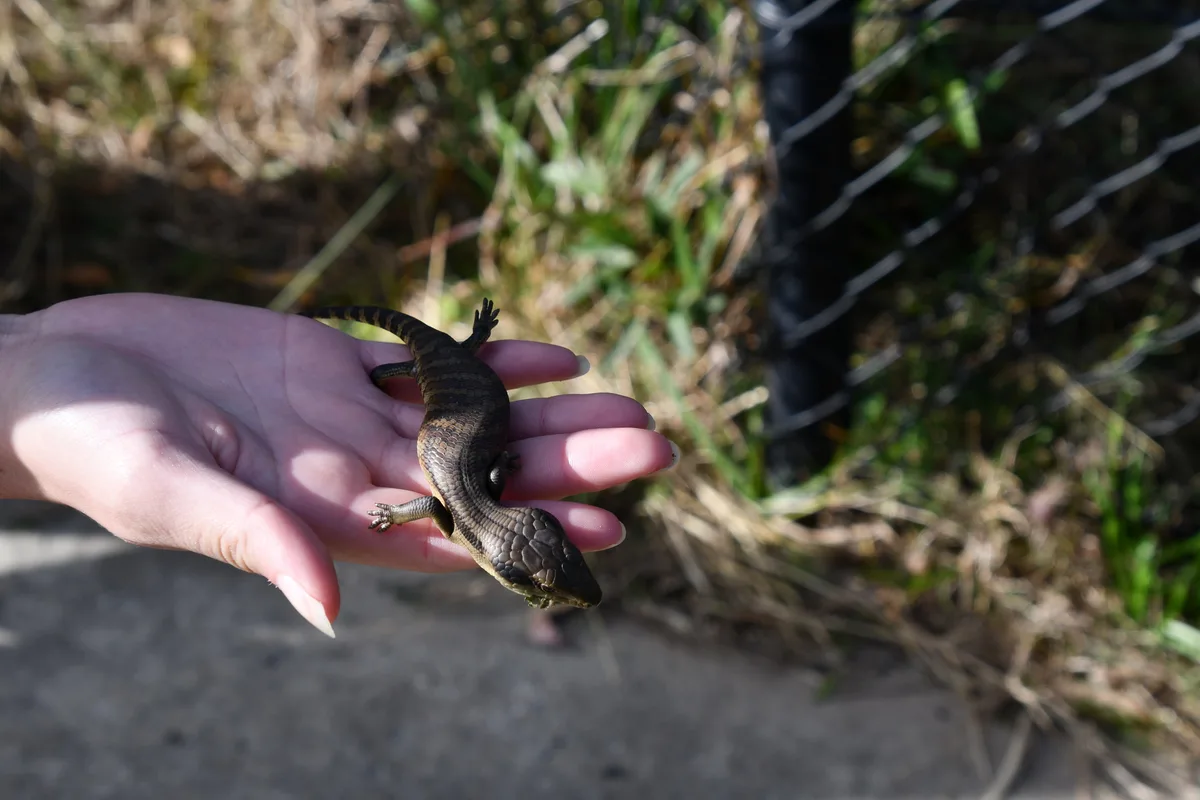
Growing up
An adult eats once or twice a week, about half animal protein and half veg. Weigh it every month.
Feeding
Half animal protein, half veg, fruit as a treat
The ratio shifts as a skink grows, and so does the schedule. Offer a portion about the size of the skink's head, roughly 1-2 tablespoons. Fruit stays at 10 % or less of the diet at any age.
| Age | Meals | Animal protein / veg |
|---|---|---|
| Hatchling, 0-3 months | daily | 70-80 % / 20-30 % |
| Juvenile, 3-8 months | 3 times a week | 70-80 % / 20-30 % |
| 8-12 months | 1-2 times a week | 70-80 % / 20-30 % |
| Adult, over 12 months | 1-2 times a week | 50-60 % / 40-50 % |
| Protein | Veg and greens | Never |
|---|---|---|
| Gut-loaded roaches and locusts, black soldier fly larvae, silkworms, hornworms, earthworms, shop-bought snails, eggs, lean meat. Treats only: superworms, pinkies, fish | Squash, bell pepper, parsnip, carrot, dandelion, turnip and collard greens. Fruit in small amounts. Keep spinach and kale occasional | Avocado, onion, aubergine, citrus, rhubarb, seeds and pits, fireflies, scorpions, wild-collected snails, buttercup, azalea, daffodil, lily of the valley, tulip |
Gut-load insects for at least 24-48 hours before feeding. A good wet dog food with no fish and no artificial colours can be one item in the rotation, never the staple. Cat food suits juveniles only, and ReptiFiles moves skinks to dog food at about a year because it is less likely to cause obesity. Do not feed Bluey Buffet as a staple: ReptiFiles reports anecdotal neurological and growth problems in Indonesian skinks.
With UVB fitted, dust insects and meat with a pinch of calcium with low or no D3 at every feed, and add nothing to a fortified prepared diet. Give a multivitamin about once a week, following the label. No source fixes that frequency, so ask your vet. Weigh monthly and write it down, because obesity is the commonest diet problem. A UK winter slowdown is common. Sudden refusal or heavy weight loss needs a vet.
Keeping live insects, gut-loading and supplements: handbook, Food you store or keep alive.
Shedding
Shedding problems usually mean low humidity
Poor sheds are usually linked to humidity that is too low for the form. Check the toes and tail tip after every shed, because retained skin there can tighten and cut off circulation. A tepid soak helps loosen it. A shed that keeps sticking needs a vet.
Treating stuck shed: handbook, Health.
Adult life
A winter slowdown is common. Sudden refusal, heavy weight loss, a wavy spine or a soft jaw means a vet.
Health
What skinks actually get
| Problem | Why skinks get it | What to do |
|---|---|---|
| Metabolic bone disease Wavy or dipping spine, jaw changes | Too little UVB, according to the RSPCA | Vet. Check the tube age and the UVI at the stone |
| Vitamin A deficiency Skin changes, infection around the eyes and lips | Listed by the RSPCA among common problems | Vet. Go through the diet and multivitamin with them |
| Parasites Abnormal droppings, weight loss | Common in wild-caught imports, especially amoebae and flagellates | Vet, with a fresh stool sample. Test any Indonesian or unknown-origin skink |
| Mites and skin problems Long soaks in the water bowl, visible mites | A 2025 study found mites on Indonesian blue-tongues | Vet. Do not wait for it to clear |
| Obesity | Too much protein or too many meals in an adult. Extreme excess protein can also strain the kidneys | Adult schedule, adult ratio, monthly weighing |
| Impaction | Calci-sand, beech chips, corn cob or walnut shell | Vet. Switch to soil |
| Poor shed | Humidity too low for the form | Raise humidity, soak, and see a vet if it persists |
A wavy spine or soft jaw, swelling around the eyes or lips, weight loss or abnormal droppings, long soaking or visible mites, a shed that keeps sticking, or sudden refusal to eat outside winter.
Respiratory infection, mouth rot, burns and the same-day signs: handbook, Health. Finding a vet: handbook, Vets and insurance.
Where the advice has changed Older advice you might still come across, and what we back instead
Blue-tongued skink care sheets disagree with each other, and a current UK retailer sheet still carries several older positions. You'll still see some of these on older care sheets and in shop advice. We've looked at both sides, and this is what we back.
| Older advice | What we back | Why |
|---|---|---|
| A 120×60×60 cm vivarium is fine | At least 120×75×75 cm, with 150×90×60 or 180×60×60 cm recommended | A large, active burrower needs floor area for a temperature gradient and exercise. The RSPCA sets the minimum |
| UVB is optional if you dust with D3 | UVB at UVI 2-4 at the basking spot, with shade at 0 | The RSPCA links metabolic bone disease mainly to too little UVB, and UVB lets the skink make its own D3 |
| One low-humidity figure for every blue-tongue | 40-60 % for Northern and Eastern, 60-80 % for Indonesian forms and Tanimbar, and a humid hide for all | Indonesian forms come from tropical habitats, and low humidity causes shedding problems |
| Beech woodchip, corn cob or walnut shell as substrate | At least 10 cm of soil or a soil and sand mix | The RSPCA lists these chips and shells as impaction risks, and skinks burrow |
| Dog or cat food as the staple, or a fruit-heavy diet | A varied mix of insects and whole protein, 40-50 % veg for adults, fruit at 10 % or less | Obesity is common, and excess protein can strain the kidneys |
| Cheap wild-caught Indonesian skinks are fine | UK captive-bred, with a faecal test for any import | Wild-caught skinks usually carry parasites, are often defensive and can have respiratory or skin infections |