

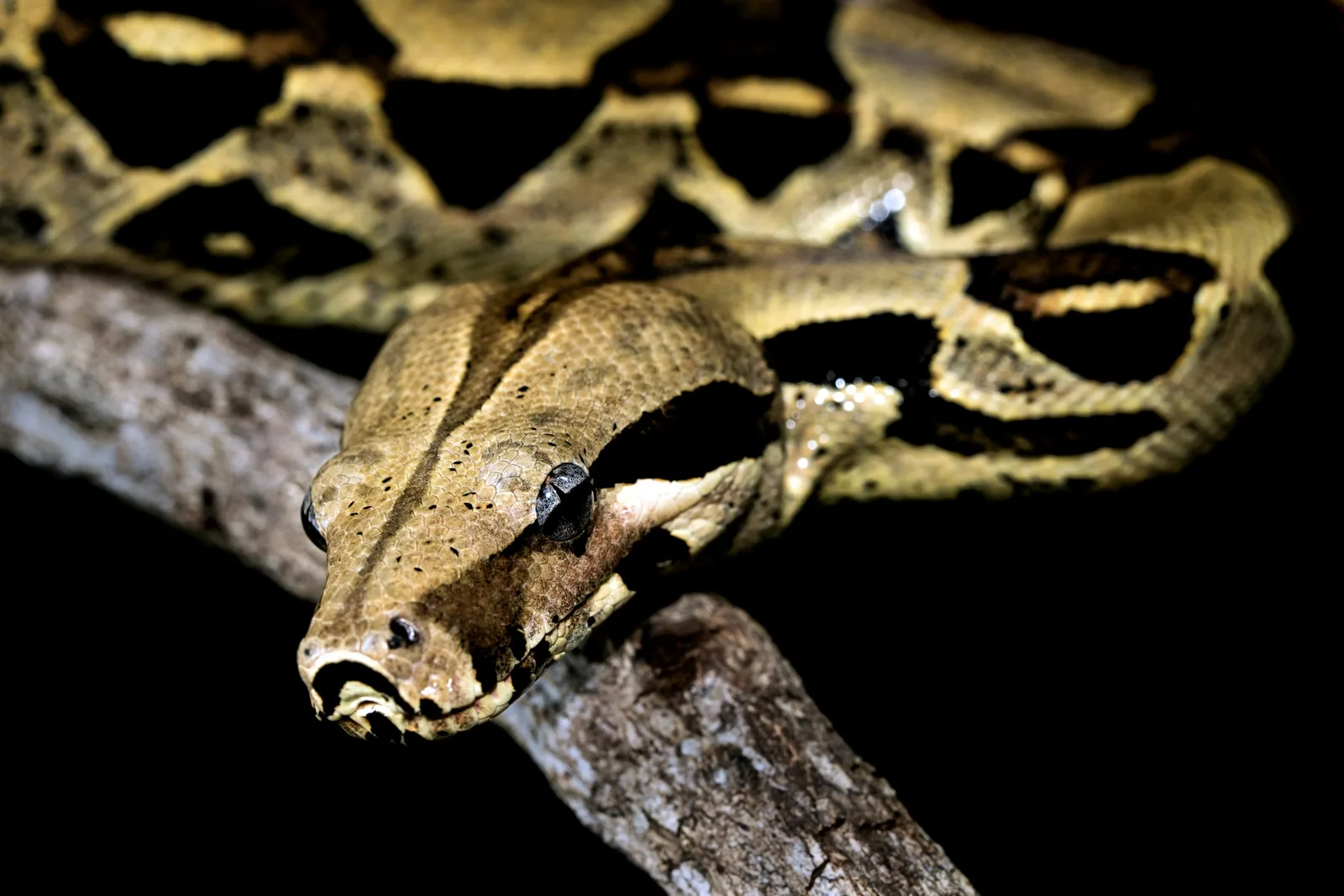
 Photo: David Clode on Unsplash
Boa Constrictorcare guide
Boa imperator / Boa constrictor
A boa constrictor needs a 180 cm vivarium, 32-34 °C at one end and 24-26 °C at the other, humidity in the sixties, and a keeper who has thought about lifting a 10 kg animal in twenty years' time. It is the largest snake on bask and the one most often bought without that thought.
Before you buy
Decide now where a 180-240 cm vivarium goes, and who helps you lift a 10 kg snake.
- Adult length
- 180-250 cmBig females to 300
- Adult weight
- 4-15 kg
- Lifespan
- 20-30 yr
- Lifetime cost
- ≈ £8,200Highest on bask
- CITES
- Annex BNo Article 10 needed
Know this first
This covers the common boa, Boa imperator (BCI, Colombian, Central American), and the true red-tail, Boa constrictor (BCC), which grows larger. Rainbow, sand and tree boas are different animals with their own category.
- Size is the commitment. A hatchling fits in a shoebox; in ten years it may be 2.5 m and heavier than a large cat. Decide now where a 180 or 240 cm vivarium goes and who else can lift the snake.
- Feeding is rare and easy to overdo. An adult eats every four to six weeks. Boas fed monthly on big prey for a decade become obese and die young.
- Inclusion body disease. A fatal virus of boas with no cure, spread by mites and contact. Quarantine is not optional with this species. See Health.
Lifetime cost, vets, freezer space and hygiene: handbook, Before you buy.
Morphs and welfare
bask applies REPTA's Deleterious Gene Policy in full. How the three groups work is in the handbook, Morphs and welfare. These are the boa rows.
Prohibited: cannot be listed on bask
| Morph | Condition |
|---|---|
| Super Motley | Metabolic. Argentine, Central American and Colombian lines alike: loss of muscle tone, inability to pass faeces, a heavily shortened life. |
| Super Jungle | Metabolic. Poor digestion and fertility problems. |
Breeding guidance: healthy, but not to be paired with
| This morph | Do not pair with |
|---|---|
| Motley (any line) | another Motley |
| Jungle | another Jungle |
A single-copy Motley or Jungle is a healthy boa with no welfare note. When you enquire about one you confirm you have read the pairing guidance.
REPTA reviews its list every six months and bask follows each change. Checked against the list published on 6 September 2026.
Buying a boa
The general seller questions, health checks and quarantine rules are in the handbook, Buying, collection, quarantine. For a boa, push harder on these.
- Where it came from and what it has lived with. IBD spreads through collections. Ask whether the seller has had any snake with neurological signs or unexplained regurgitation.
- Which boa: BCI or BCC, and locality. It sets the adult size by half a metre.
- Feeding interval and last weight. A boa fed weekly by the seller is already on the wrong schedule.
Check the animal
Watch it move on a flat surface. Head tilt, stargazing or difficulty righting itself when gently turned is a reason to walk away whatever the explanation. No mites, no mid-body swelling, straight spine, muscle tone that grips.
UK law
No licence; boas are not on the Dangerous Wild Animals schedule (the constrictors some sites exclude are anacondas, Burmese and African rock pythons). CITES Annex B, so no Article 10 certificate for a UK sale, but keep the captive-bred paperwork. Duty of care, business licensing and the release offence: handbook, UK law.
Setting up
Two heat sources on thermostats, 55-70 % humidity, and hides the whole snake fits inside.
The vivarium
Buy for the adult, or plan to buy twice
| Stage | Snake | Minimum vivarium | Notes |
|---|---|---|---|
| Hatchling | 45-90 cm | 90×45×45 cm | Cluttered heavily; a hatchling in a bare 180 cm viv will not settle |
| Juvenile | 90-150 cm | 120×60×60 cm | Outgrown in two years |
| Adult male | 150-200 cm | 180×60×60 cm | The 6×2×2 ft wooden viv |
| Adult female | 200-300 cm | 240×75×75 cm | Often made to order. Budget for it from the start |
A wooden or PVC vivarium on a stand rated for its furnished weight, against a wall. Runners must be strong; an adult boa pushing at glass has real force behind it. Two locks on a long door.
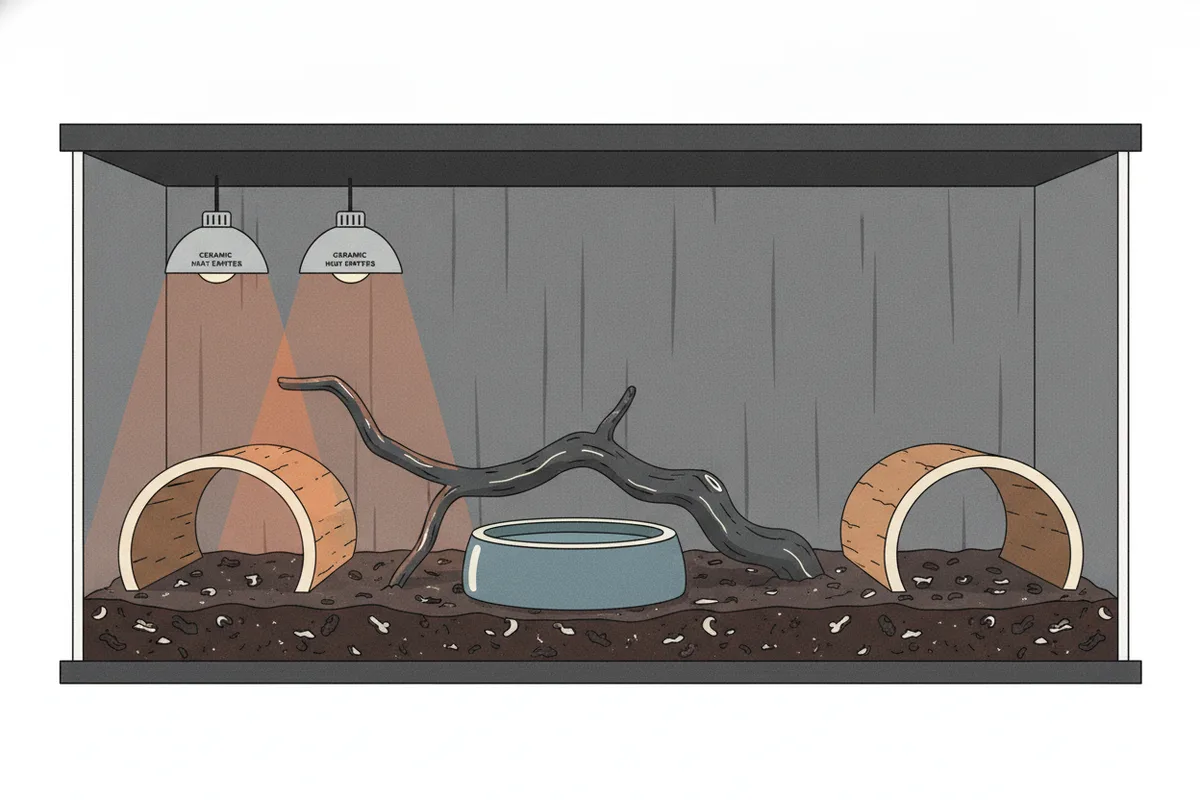
Enclosure types, ventilation, locks: handbook, The enclosure.
Heat and light
A degree or two warmer than a royal, and two heat sources
| Zone | Target |
|---|---|
| Basking surface | 32-34 °C |
| Warm-end air | 29-31 °C |
| Cool-end air | 24-26 °C |
| Night | 22-24 °C (boas tolerate less of a drop than temperate snakes) |
Deep heat projectors or ceramics on pulse stats, guarded, at the warm end. Heat mats belong in racks in a warm room, where the tub is shallow; in a vivarium a mat cannot warm the air, and a heavy-bodied boa lying its weight on one is how mat burns happen. Guards matter more here than with any other species: a 10 kg snake can pull a poorly fixed guard off and will wrap a hot fitting.
UVB
Zone 1-2. A 6 % T5 tube over the warm half for a UV Index of 1-2, 12 hours. In a 180 cm viv that means a longer tube, not a stronger one.
Thermostats, probe placement, tube replacement: handbook, Heat, light and safety.
Humidity, substrate and furniture
55-70 %, a bale of bark, hides the whole snake fits in
Boas shed badly if dry and get respiratory infections if held wet and cool. Eight centimetres of orchid bark, coir or cypress mulch and a large bowl at the cool end hold 55-70 %; a cork tube packed with damp moss covers sheds. Aspen moulds at this humidity; never pine, cedar or calci-sand. A 180 cm viv takes a full bale for 8 cm of depth.
A hide at each end the whole snake fits into with contact on the sides: large cork tubes or purpose-built boxes, not the caves sold for royals. A branch or shelf strong enough to take the full weight. Water in a tub the snake can submerge in, on a base that will not tip, changed every other day.
Humidity: handbook, Humidity. Substrate compared: handbook, Substrate. Hides and water: handbook, Hides, cover and water.
The first weeks
Keep it away from your other snakes, don't handle it for 7-14 days, and offer the first meal after a week, warmed, at dusk.
Bringing it home
Cloth bag in a rigid insulated box that takes the weight, at 22-28 °C, straight into the viv you ran for 48 hours. No handling for 7-14 days. First meal after a week, the same prey the seller used, warmed, at dusk. Three months' quarantine on paper if you keep other snakes.
Running the enclosure empty first, quarantine and the first fortnight for any reptile: handbook, The first weeks.
Handling a heavy snake
Two people over two metres
- Wait 72 hours after a meal.
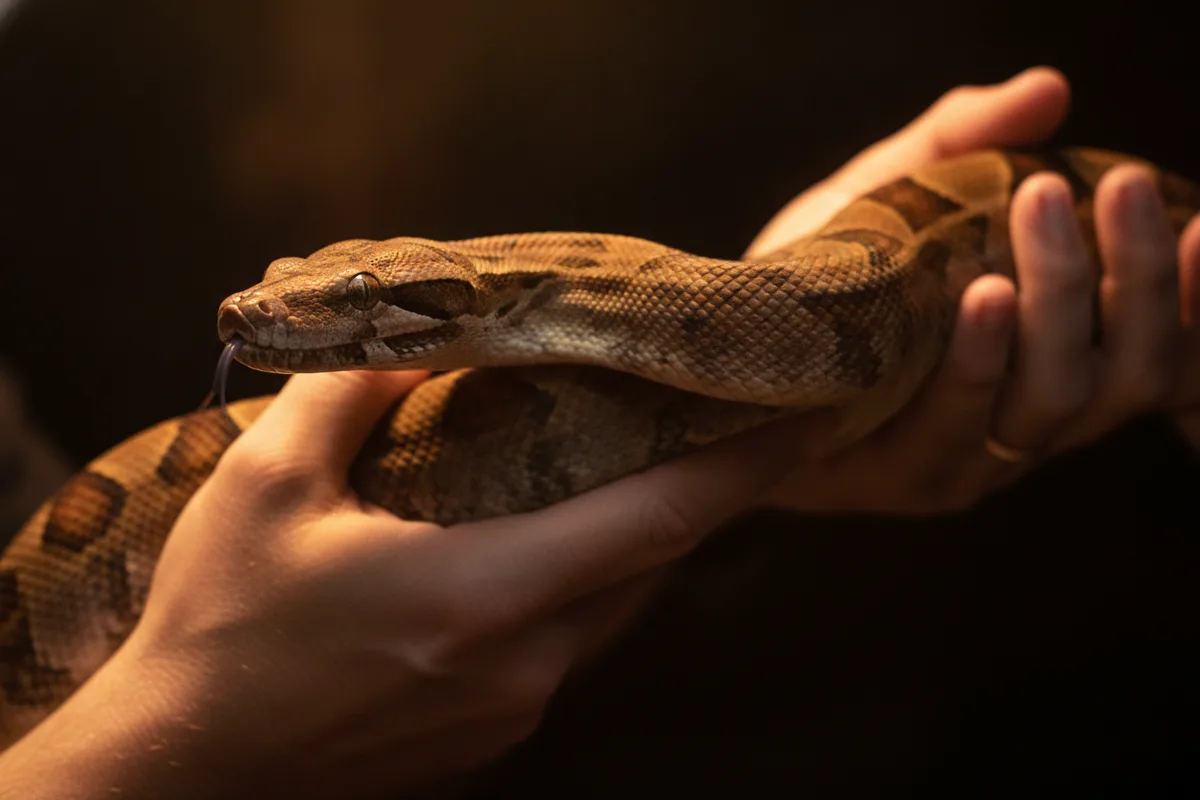
- Support at two or three points along the body. An adult female needs two people, one at the front third and one at the back.
- Never around the neck, and never alone with a snake over 2 m across your shoulders. A startled boa tightens, and you cannot unwind a constrictor one-handed.
- Wash your hands first. A feeding-response bite from an adult boa is deep enough to need cleaning at a minor injuries unit.
- 10-20 minutes, a few times a week, not in shed.
Growing up
It eats less than any other snake here: an adult feeds every four to six weeks.
Feeding
Less often than any other snake here
Prey at 10 % of body weight, no wider than the snake, on intervals that lengthen every year.
| Age | Interval | Prey |
|---|---|---|
| Hatchling, under 300 g | 7-10 days | Hopper or adult mouse, then rat pup |
| Juvenile, 300 g-1.5 kg | 10-14 days | Rat weaner to small rat |
| Sub-adult, 1.5-4 kg | 3-4 weeks | Medium to large rat |
| Adult, over 4 kg | 4-6 weeks | Large rat, or a small rabbit |
The commonest mistake is feeding an adult fortnightly because it looks hungry. Boas always look hungry. Round in cross-section with skin folds behind the head is obese, and obesity shortens boa lives more than any illness. Weigh monthly on bathroom scales. Feed in the vivarium with long tongs and leave the snake 72 hours; adults defecate rarely, sometimes weeks after a meal.
Thawing, tongs, live prey: handbook, Food you store or keep alive.
Shedding
One long piece, every two to three months
Juveniles every four to eight weeks, adults every two or three months. At boa size a stuck shed is a big job, so put the damp-moss cork tube in as soon as the eyes go blue and mist the warm end daily until it sheds. Check the tail tip; a retained ring on a boa can be several centimetres long.
Treating stuck shed: handbook, Health.
Adult life
Once it's over two metres, handle it with two people, and see a vet at the first sign of stargazing or corkscrewing.
Health
What boas actually get
| Problem | Why boas get it | What to do |
|---|---|---|
| Inclusion body disease Stargazing, corkscrewing, cannot right itself, repeated regurgitation, weight loss | A virus of boas and pythons spread by mites and contact. Fatal, no treatment | Vet, and isolate. A boa with these signs is a risk to every snake in the house. This is why a new boa gets three months' quarantine on paper with its own equipment |
| Respiratory infection | Cool and damp together, common in big vivs with one heat source | Vet. Raise the warm end, improve airflow |
| Obesity Round in section, folds behind the head | Fed like a juvenile for years | Adult interval, monthly weighing |
| Mites | Arrive with animals and equipment, and spread IBD | Treat animal and viv together, repeat on the product's interval |
| Scale rot | Wet substrate compacted under a heavy snake | Vet. Dry the viv, paper while treating |
Mouth rot, burns, parasites, dehydration and the same-day signs: handbook, Health. Finding a vet: handbook, Vets and insurance.
Where the advice has changed Older advice you might still come across, and what we back instead
Boa care sheets were written when boas lived in racks. You'll still see some of these on older care sheets and in shop advice. We've looked at both sides, and this is what we back.
| Older advice | What we back | Why |
|---|---|---|
| Feed adults every 2-3 weeks | Every 4-6 weeks | Boas have a very slow metabolism. The fortnightly-fed adults of the 2000s were obese by ten and dead by fifteen |
| A 4×2×2 ft viv is fine for any boa | 180 cm for a male, 240 cm for a large female | A 2.5 m snake in a 120 cm box cannot stretch out, which the welfare acts require |
| Boas need no UVB | Low UVB, Zone 1-2 | The same reasoning as for royals: a cheap tube, and the animals use it |
| A heat mat or heat tape is all a boa needs | Heat mats for racks in a warm room; overhead heat in a vivarium | Mats and tape work in a racking system, where the tub is shallow and the room is already warm. In a vivarium a mat cannot warm the air, and a heavy-bodied boa lying on one is how mat burns happen. Never a mat under a boa in a viv |
| One big ceramic is enough | Two smaller heat sources on separate stats | One unit cannot warm the air across a 180 cm hot end, so keepers ran it hotter and burned snakes |
| Quarantine a month | Three months minimum, on paper, own equipment | IBD can take months to show. Boas are the species where a short quarantine has cost keepers whole collections |