

Leopard Royal Pythons for sale in the UK
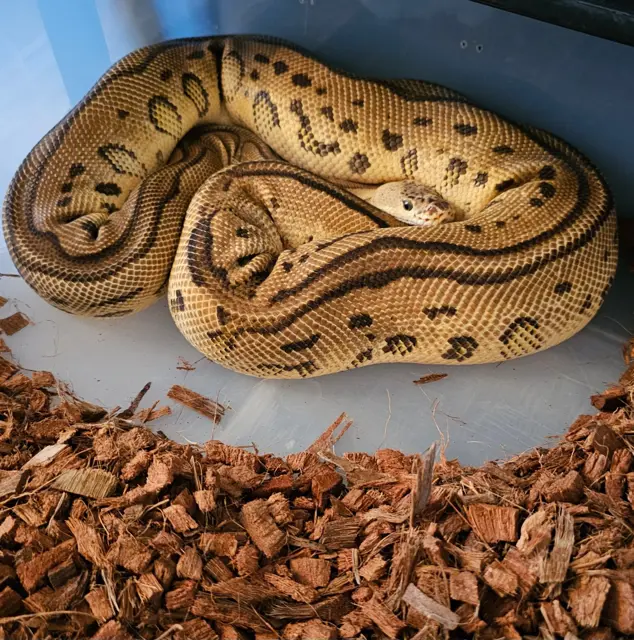
Leopard darkens a royal python's pattern and breaks the alien heads into splattered shapes on a jet black background under a dark head. It does not mean the snake carries Piebald, and breeders use it mostly for what it does to the colour and pattern of a combo.
- Visuals
- £75
- 26 for sale
Leopard royal pythons recently sold
PB - Pastel Leo Yb Clown

Female leopard firefly 66% double het desert ghost pied
About the Leopard gene
Leopard is a gene that affects the colour and pattern of the royal python (ball python). It darkens the pattern around the normal alien heads and breaks them up. Because it is known for lifting the colour of the combos it goes into, most Leopards are sold in multi-gene projects rather than as a single gene.
Appearance
The head is usually black or very dark brown with a slightly lighter stamp in the centre. While the eye stripes and lips keep their normal layout, they look brighter. The alien heads look splattered and shaken up, losing their normal shape within a jet black "puzzle" pattern that has some blushing between the shapes. Clear of markings, the belly is bright white. On the tail, messy alien heads crowd either side of the dorsal stripe. Hatchlings start bright yellow and the yellow fades with age, so an adult Leopard reads darker than it did as a baby.
Genetics
The Super Leopard exists, but keepers disagree on whether it can be told apart from a single-copy Leopard. Because of this, the gene is listed as dominant in some places and as incomplete dominant, the hobby's "co-dom", in others. Both Leopard and Super Leopard are listed here. Leopard belongs to no allelic complex.
Many breeders assumed every Leopard was het Piebald for years because the first ones came from a visual Piebald. Proof breeding has since shown the two genes separate. A Leopard is not automatically het Pied, so ask for the Pied het by name if you want it. Leopard Pied is the combination of the two.
The trade shorthand is Leo. Named combos include the Cheetah (Leopard, Pastel, Spider and Yellow Belly), the Batman (Leopard, Spotnose and Clown), the Ocelot (Leopard, Lesser and Pinstripe), the Raven Claw (Leopard and Woma) and the Leopard Extra (Leopard, Mojave, Pastel and Spider).
In 2005, Greg Graziani produced the first Leopards shown to the hobby. The gene came out of the collection of Peter Kahl.